Showing posts with label TTIP. Show all posts

Friday, 18 March 2016

Latest Leak Confirms TTIP a 'Serious Threat to Democracy as We Know It'

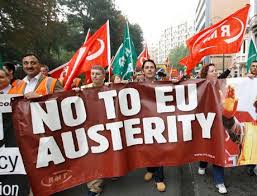
Protesters demonstrate in Brussels against the TTIP earlier this year. (Photo: AFP/Getty)

Written by Deirdre Fulton and first published at Common Dreams

EU member states and the European Parliament will be "sidelined" in favor of big business and U.S. interests should the TransAtlantic Trade and Investment Partnership (TTIP) go through, according to a leaked document revealed Friday.

The leak, of the corporate-friendly trade deal's draft chapter on "regulatory cooperation" between the EU and U.S., was made public by The Independent and Brussels-based campaign group Corporate Europe Observatory (CEO).

It exposes "a labyrinth of procedures that could tie up any EU proposals that go against U.S. interests," as The Independent put it, as well as "the extent to which major corporations and industry groups will be able to influence the development of regulatory cooperation."

As Kenneth Haar, researcher for CEO, explained:
Lengthy procedures, including vetting by business for possible economic impacts, are thus envisaged for new regulations. Such measures have already been used informally to weaken EU ambition on financial sector supervision in the years leading up to the 2008 collapse, to offer a free pass to US companies on personal data protection, and to delay or water down EU proposals on animal testing and aviation emissions.
This leaked document from the negotiations confirms fears that the Commission will be obliged to consult with US authorities before adopting new legislative proposals while EU Member States and the European Parliament are sidelined. The leak also offers a glimpse at the proposed bureaucratic labyrinth of impact assessments, dialogues, consultations and reviews that could tie up any proposals that go against US business interests.
In short, he said, "this document shows how TTIP's regulatory cooperation will facilitate big business influence—and U.S. influence—on lawmaking before a proposal is even presented to parliaments."

Nick Dearden, executive director of Global Justice Now, told The Independent: "The leak absolutely confirms our fears about TTIP. It's all about giving big business more power over a very wide range of laws and regulations."

As such, Haar added, the TTIP represents "a serious threat to democracy as we know it."

The proposed trade deal, being negotiated in secret, faces growing opposition across the European continent.

Just last month, a report from Global Justice Now and the Netherlands-headquartered Transnational Institute showed how the TTIP would undermine national sovereignty by hampering governments' ability to enact effective and fair tax systems to finance vital public services. Also last month, heavily redacted documents obtained by the Guardian revealed that European officials had assured ExxonMobil that the pending U.S.-EU trade agreement would force the removal of regulatory "obstacles" worldwide, thus opening up even more countries to exploitation by the fossil fuel empire.

After the latest round of talks last month, trade officials pledged to accelerate negotiations in the hopes of releasing a full draft text by this summer, and reaching the final stage of talks by October.

However, speaking in Moscow on Friday, former Prime Minister of Italy and former President of the European Commission Romano Prodi said he sees "no prospect" for the deal to be finalized before the U.S. presidential election in November.

Irish Prime Minister Enda Kenny made similar remarks on Thursday, telling journalists in Brussels:

"It now appears as if the TTIP arrangements will not be completed before the American presidential election," and adding that this would probably create "a sense of vacuum."

Tuesday, 1 March 2016

Why Greens Should Vote to Leave the EU


This is an extract from a much longer piece written by Larry O'Hara

The onward march of ever greater EU centralization and the growing (if covert) influence of shadowy pressure groups like the European Round Table of Industrialists (hereafter ERT) has been watched by me with ever growing concern, even if viewed with indifference by many in the Green Party.  In recent years, the disgraceful treatment of Greece’s Syriza government by the EU seemed to momentarily lift scales from some eyes, for here was a genuine radical government being totally crushed by the EU, who were (and are) dictating to a democratically elected government, empowered by a popular referendum even, that they had to tear up their radical programme, privatize industries, dismantle welfare provisions, annihilate pensions, all in order to appease the loan shark parasites of the international banking community.  Surely, one might have thought, the fate of this government tells us something about the nature of the EU?  That has not altered since a defeated Greece is now out of the headlines.

At its minimum, the EU is about market ‘harmonization’: code for driving down workers living conditions worldwide.  This is what Tory supporters (and even opponents like Boris Johnson) of the EU mean when they concede it has been good for trade.  One instrument for harmonization is ‘bench marking’, whereby the most disadvantageous (to workers) practices are made the norm.  Another aspect is introducing ever more competition in the provision of services hitherto provided by the public sector.  It is this that provides the backdrop to welfare state privatization, Royal Mail sell-off and the unmitigated disaster that has been the PFI initiative in the NHS, mortgaging the future for generations to come while saddling citizens with ever mounting debt.  The Campaign Against Euro-Federalism have bravely, and indefatigably drawn attention to these matters in great detail.  What a pity Europhiliacs in the Labour Party and elsewhere blithely ignore this evidence; as too have most Greens to date.  TTIP and the related Comprehensive Economic and Trade Agreement between the EU and Canada, which will provide a back-door for US corporations to sue elected governments as in TTIP, are both dangerous and blatantly contradict Green principles, as can be seen by perusing the excellent Leave.EU pamphlet on these subjects .  Yet both are imminently set to become EU reality.

A paradox needs explaining: the mismatch between fundamental Green principles and the EU itself, a gap so wide that the fact many Greens (and Leftists generally) do not realise it demands serious explanation.  The gap can be summarized thus:

a)            Internationalism should always be voluntary to be genuine (e.g. the 1930s International Brigades) and should never be confused with the creation of supranational institutions with imperial ambitions: which the EU has been ever since Jean Monnet’s vision took shape in the 1957 Treaty of Rome, explicit aim, ever-closer union.  Like a ratchet, every single EU development has travelled that path, whether it be majority voting, Maastricht Lisbon and the rest.  EU centralization operates like a ratchet, that only goes one way.  I fully support Europe as an idea, and co-operation between European peoples, but no way should this be confused with the EU (on this at least I agree with Boris Johnson).  This very article was started in Hamburg, indeed.  One mendacious act of many is the deliberate sleight of hand by which proponents of Empire (the EU) seek to conflate Europe as an idea with the EU as an institution.

b)            Every accretion of power to EU institutions (of whatever stripe) is a diminution of power available locally.  If any referendum produces the ‘wrong’ (i.e. anti-centralist) result, it is re-run until the right answer ensues.  Furthermore, the whole notion of ‘subsidiarity’ is a pathetic fig-leaf: the centre decides what powers to give away, and it is the centre that can rescind any concessions.

c)            It is not just beyond belief, but even comprehension, that anybody could really think that a political entity with 503 million inhabitants like the EU could be democratic.  Institutions to be democratic have to be on a scale that people can understand, meaningfully relate to, and control.  Those numbers mean that is just not possible: but is conversely why the ERT favours the EU.  How much easier to negotiate with one government than 28.  Just when did some Greens think the slogan ‘Think Global, Act Local’ became redundant?  As Tony Benn never tired of pointing out, if you don’t elect people (European Court/Commission) and you can’t remove them, they’re not accountable to you.  

This is the definition of undemocratic. It is fascinating, therefore, to hear Benn’s thoughts echoed in Michael Gove’s 20/2/16 statement on the EU “My starting point is simple. I believe that the decisions which govern all our lives, the laws we must all obey and the taxes we must all pay should be decided by people we choose and who we can throw out if we want change. If power is to be used wisely, if we are to avoid corruption and complacency in high office, then the public must have the right to change laws and Governments at election time. But our membership of the European Union prevents us being able to change huge swathes of law and stops us being able to choose who makes critical decisions which affect all our lives. Laws which govern citizens in this country are decided by politicians from other nations who we never elected and can’t throw out. We can take out our anger on elected representatives in Westminster but whoever is in Government in London cannot remove or reduce VAT, cannot support a steel plant through troubled times, cannot build the houses we need where they’re needed and cannot deport all the individuals who shouldn’t be in this country. I believe that needs to change“.  If this applies to even a Tory government, why would it apply less to a Green government or even a Corbyn-led one?

d)            As for the European Parliament, giving it even more power, which I do not favour, would inevitably (and unavoidably) be at the expense of national governments, who whatever their faults can at least in principle be removed: on this Tony Benn Michael Gove and George Galloway are all right.  Even if every single MEP (and MP) elected from the UK (or even England) favoured withdrawal from the EU or any other policy, MEPs elsewhere, if we give them power, would be able to prevent such a policy happening.  Anybody thinking that situation democratic is beyond reason, or even hope.  As too the current European Council of Ministers where the UK has voted against 72 measures, and been defeated 72 times.

e)            Sustainability is not merely an argument for more recycling bins and altering fridges: it should be at the heart of Green policies aimed at breaking the capitalist market cycle of planned obsolescence which will ineluctably mean taking on the multinational corporations who are so keen, with EU acquiescence, to push through the devastating TTIP (Transatlantic Trade Treaty).  In proper context, developing a genuinely sustainable economy is a dagger to the heart of capitalism, and the illusory religion of economic growth.

I could certainly say more, and maybe will elsewhere, but have hopefully said enough to substantiate my claim that, as I see it, there is a gap between genuine Green principles and the EU.  The paradox therefore which needs explaining is this; if these things are so axiomatic and obvious to me and the few Greens who share such views (like Jenny Jones and a minority of Green Left members) why is this the case?  This, I would suggest, requires an exploration of the political journeys undertaken by those who have arrived at a different destination to me.  In the real world, the Green project cannot advance without support from others including elements in the unions and the Labour Party.  Uncomfortable but true, which means making sense of current Labour/union policy on the EU: any progressive anti-EU coalition needs to build bridges, if not with most of the leadership, certainly the members.  This includes those who flocked to join Labour in the belief Jeremy Corbyn and his allies in Momentum intend, and are capable of, bringing about radical change.  I do not look at all tendencies within Labour, just the most important in relation to the current EU debate.


In 1990 a motion to withdraw from the EU was narrowly defeated at the Green Party (hereafter GP) conference, which I thought then was a great mistake.  Had Greens the nerve to advocate EU withdrawal, that may well have helped create the political space to make a breakthrough, conjoining radical politics with an anti-EU stance.  Instead, Greens vacated that space, some of which was later colonized by UKIP.  Since then Green policy has been contradictory: practically accommodating to the EU in many areas, contrasting party policies with others, while remaining within.  All encapsulated in the ‘Three Yeses’ policy adopted in 2013: Yes to a referendum, Yes to the EU and Yes to major change within the EU.  My contention is the first two are inconsistent with the third.

The rationale for such a policy is various.  Firstly, Greens were actually getting elected to the European Parliament, and joined a Europe-wide Federation of Green Parties (formalized 2004).  It also has to be said that the lavish wages allowances and such available in the European Parliament are inevitably corroding.  It was this de-radicalising effect that initially led German Greens to propose rotation in elected positions after all.  Dropping that policy was one more nail in the German Green’s coffin, and sadly rotation has never even been tried in the UK.  I have never agreed with Green MEPs (or any others) having the right themselves to allocate such funds, this should always be a party matter: but it never has been.  Secondly, on a more positive note, having elected MEPs allowed Greens to influence (however minutely) policy in a way denied the Greens until Caroline Lucas (a former MEP) was elected to Westminster in 2010.  The third reason is similar to that affecting Labour and the unions: a basic pessimism about getting change in the UK alone means the EU offers a better prospect.  As we shall see, this motivation still applies today.

At this point, a mea culpa on my part: while perturbed at the general pro-EU drift of GP policy, concentrating on other areas, and the fact that even in Green Left (of which I am a member) anti-EU positions are held by only a minority, I did not pay attention to the nuts and bolts of that policy.  I probably should have, but in any event rectify that now.  Before looking at pro-EU arguments by some Greens, I review GP policy as a whole, not least to substantiate my outline summary above.  

The Europe policy (part of the ongoing ‘Policies For a Sustainable Society’) can be found on the Party web-site at http://policy.greenparty.org.uk.    Numbering refers to policy sections therein. 

Early on they sort of grasp the subsidiarity nettle, saying “many issues currently decided at the EU level should be dealt with at a more appropriate level for effective action, which might be local, national or global” (EU120).  Which begs the question: who decides which is which, and how is this to happen?  There is no unequivocally clear answer, in that the areas they outline are ambiguous and open to interpretation and contestation.  It is not as if the GP does not know the reality of “subsidiarity in the European Union at present, a top down distribution of a fraction of power accumulated at the centre” (EU390).  They state the ‘European level’ should “safeguard basic human social and political rights” (EU121), indeed “high standards of human and civil and social rights” (EU212) and “cooperation to regionalize the industrial base, services and resources” (EU212).  All these beg definition because not only is there no universal agreement about rights, in the real world, rights often conflict.  Who, exactly, is to decide what ‘high standards’ are? There is the unproven assertion that air pollution “can best be resolved at the European level” (EU121), but this is not obvious, and a basic confusion of Europe-wide with European, which in this case means imposed.  

The European level is supposed to “promote sustainable, non-exploitative, self-reliant local and regional economies” (EU121).  Yet this does not happen currently, indeed as we shall see such economies will be resisted at the ‘European level’.   This is the reality which confounds the GP recognition that “subsidies are sometimes necessary to protect local, regional and national economies and the environment, and we will support them in these instances” (EU413).  The contrast between what the GP supports and EU reality is at times staggering: try telling Greece that “each member state government should be entirely free to set its own levels and methods of taxation, public spending and public borrowing” (EU425).

Conversely, do the GP really believe that EU members will “initiate programmes to support local economies against market centralization” (EU426)?  I don’t, but if they did, they’d get the Greek treatment. 

I find many GP policy aims appealing (just as well given I’ve been a member for 28 years!), the problem is that they have no realistic transitional strategy to get there other than the implicit mirage of a Green majority in the EP.  In parallel with this, exhorting current national governments to do things they have no intention of doing, or, if they did, would be stamped on.  In this context, GP policy is inappropriately abstract and unrealistic while appearing otherwise.  I agree wholeheartedly that “tariff barriers and quotas should be gradually introduced on a national and/or regional bloc level, with the aim of allowing localities and countries to produce as much of their goods and services as they can themselves” (EU443).  My objection  is simple: this will not and cannot happen within the EU.  I have no problem up to a point with “a democratically accountable and controlled European Confederation of Regions, based on Green principles” (EU302).  

Though the problem is that confederations by definition are voluntary, so where does this word ‘controlled’ come from?  Unless you mean control by the regions, but as we shall see this is not consistent with other aspects of GP policy.  It is naïve to imagine any of this can arise if you “reconstitute the EU” (EU302).  How, exactly, does the GP imagine the EU will ‘reconstitute’ itself, liquidating its own power?  We are told “regions should also have the right to define themselves, where appropriate across national frontiers…through referenda” (EU393).  Dependent on the approval of who?  For example is Spain really going to accept Basque independence, or France Corsican?  


A further contradictory policy is belief the European Council of Ministers “should seek to make decisions by consensus” (EU320), immediately followed by support for non-consensual Qualified Majority Voting (EU321).  While the European Commission’s powers are to be reduced (EU310) potential conflict between the European Parliament and Council of Ministers is made more likely by supporting “the extension of ordinary legislative procedure with the European Parliament…to all issues where the Council decides by Qualified Majority Voting” (EU326), indeed the “powers of the European Parliament should be extended to give its members greater oversight of the work of the EU” (EU333).  Oversight and more voting will inevitably be at the expense of national parliaments and governments, how could it be otherwise? 

The fact national parliaments get no positive mention in this policy is telling.   The European Parliament itself is to decide on the wording for referenda on a future European Constitution defining “the values, objectives powers, decision-making procedures and institutions of the EU” (EU356/352).  The only area where the policy wholeheartedly (if transiently) accepts national level democracy is in the area of having referenda on Monetary Union (EU423) and a new European Constitution (EU354).  But given the European Parliament decides the rules, question, and even date, of any referendum we can see where power lies (EU356).  Ironically, not only does this undermine national parliaments, being serious about decentralization would mean regions being the voting basis, surely?  Yet they are not.

Looking at all this in the round, leaving aside pressure/interest groups, there are six potential competing centres of power within the EU: the European Parliament, European Commission, European Council of Ministers, the Regions, national Parliaments and finally the European Court of Justice (ECJ).  While adding the meaningless qualification that “care should be taken not to duplicate the roles of existing courts in member countries”, the nub is this: “the role of the CJEU should extend as appropriate within the competencies of the EU” (EU342).  Not only can these judges not be removed by nation states, the policy states that judicial “candidates should be nominated by the Committee of Regions…Appointments shall be made by the European Parliament” (EU346).  The blatant intent is to undermine nation states, not really to give real power to the regions (else power would be genuinely decentralized elsewhere) but undermine the nation state in favour of supranational EU institutions.  Technically, decentralization as a function of centralization.

Above I have concentrated on areas where I either disagree with the principle, or am sceptical about the practice.  Opposition to NATO for example, or a European Army, and European Monetary Union, I fully support.  If the GP was arguing for decentralization and self-sufficiency as part of an anti-EU programme aimed at seeking mass support across Europe for undermining/bypassing the EU, I would not demur.  Yet the simultaneous support for EU institutions, particularly the EP, is intended to give the EU legitimacy it does not deserve.  Internationalism does not mean the liquidation of nations, but voluntary cooperation between them and also groups within those nations.  A simple point, but one that seems to have eluded those writing GP policy. 

I am equally unimpressed by the absence of explicit anti-capitalism, for me such is integral to Green politics.  Despite this important absence, policies like genuine decentralization and self-sufficiency would genuinely undermine the EU if implemented, but the fact the GP don’t either realise or accept this is unfortunate.  Though hardly accidental: one reason I define myself as Left/Green rather than just Green is the traditional far left understood only too well the necessity of confronting powerful interests, and mobilizing support to do so, within a strategic context that does not see the state (any state,including the EU) as a neutral instrument.  Which is where Lukacs and Lenin (or indeed Henri Weber’s famous interview with Nicos Poulantzas ) come in.  The point is not to disavow GP policy on the EU, but to keep the attractive bits and help them become reality.  Which will mean leaving the EU, using the momentum of that departure to galvanise sympathisers within the EU to make genuine decentralisation and confederation come about.

Given the above policy framework, it is little surprise that GP luminaries have lined up to support the EU.  Caroline Lucas makes the point that the Tory “government are the loudest cheerleaders for TTIP, and ministers would happily create an equally dangerous bilateral deal with the US if we left the EU” .  I agree: but of course if/when we leave the EU we can tear up this treaty with a change of UK government, something we cannot do while staying in the EU.  She also makes the same point many Labour supporters do “exit would leave many of the things we hold dear—be it maternity pay, the right to join a trade union or providing refuge to those seeking sanctuary—in peril”.  Quite possibly: but only if you think a progressive government could never be elected in the UK, which is again unbridled pessimism.


A draft letter circulated by Caroline Lucas’ office to be sent to papers (19/2/16) is even more vacuous.  It says that “in a fast-changing world we need international rules to control big business and finance”.  Indeed: yet TTIP which the EU is covertly negotiating is all about big business and finance controlling governments.  Then there is the non-sequitur that “only by working with our European neighbours can we tackle climate change, protect wildlife and reduce pollution”.  Really?  What would stop an independent UK doing all this?  Nothing at all.  Then we have the canard that EU countries have agreed to “share sovereignty”—yet not only is such not possible, the GP policy above as we have seen involves ceding such.  How being in the EU helps the UK to meet the challenge of “international terrorism” is asserted, not explored.  After all, the US cooperates with the EU while not formally joined, and while indelicate, it has to be mentioned porous EU borders both externally and internally made it easy for ISIS murderers to travel to Paris from Belgium (and back in one case).   Is that not why France moved to suspend Schengen border arrangements? Or are we supposed to forget this?  The letter concludes by saying a “better EU is possible: where corporate influence is curtailed, where more power is held locally, and citizens have a real say”.  Yet this is not the content, or thrust, of GP policy: Lucas evidently hopes voters do not know this.  Understandable, but dishonest.

Amelia Womack, Green Deputy Leader, heading the Green Yes campaign, is equally unimpressive.  Claiming that “just as Caroline Lucas has been working to shake up and democratize parliament, the Green MEPs have been doing the same at the EU level” .  If the EP is democratized, how does that affect national parliaments?  No answer.  There is also the claim that as an internationalist party the GP believes in working with like-minded people.  Indeed, but why restrict this to the EU?  Then pessimism kicks in: “by exiting, we’d be facing a whole new raft of deregulation and slashing of…workers’ and environmental rights”.  Maybe: but this could be resisted locally, whereas very real proposals/policies to undermine those rights at the EU level cannot.  Speaking of TTIP, Womack is at her most dishonest, saying this “deal is signed at both European and state level—it’s down to our own Parliament to accept it, or not”.   The idea this would be voluntary is incredible: no way would the UK be allowed to ‘opt out’, Qualified Majority Voting would ineluctably apply.

Rather more honest is Green Left’s Mike Shaughnessy, who admitted that “probably the vast majority of the political left will campaign to remain in the EU…with the vague idea promoted by the more radical elements of changing the system from within.  It is not clear to me how this will be achieved, and I doubt it is really possible anyway, given the anti-democratic nature of the EU beast. ‘A People’s Europe’ is the slogan, but this is just a pipe dream at best, dishonest at worst”.  Couldn’t have put it better myself!  Shaughnessy will vote to stay because the No campaign is dominated by the Little England/nationalistic/racist tendency.  Which need not necessarily be the case.  He concludes by saying “in the end I’m going to go with my emotions….I am going to vote to remain, although I have to say, with not much enthusiasm for the EU of the corporates” .  These sentiments should, logically, lead him to vote no, but as he says, it’s an emotion thing.

What Lucas and Womack have to say on the other hand hardly convinces, interestingly neither spell out the full centralist thrust of GP policy, preferring instead to emphasise a supposed correspondence with some Green principles.  I prefer to stick with those principles, in their entirety, and follow Green/decentralist aspects of GP policy to their logical conclusion.  Exiting the EU.

Larry O'Hara is a Green Party member who lives in Suffolk, and is a Green Left supporter.

Wednesday, 24 February 2016

TTIP Threat to Privatise the NHS is ‘Real and Serious’ - Legal Expert


The trade union UNITE has commissioned a European law expert to examine the proposed transatlantic trade deal and his findings, for those with legal mind it can be read here.  

According to Michael Bowsher QC, a former chair of the Bar Council’s EU law committee, the secretly negotiated agreement will:

Privatisation of elements of the NHS could become irreversible by future British governments.

Could allow private companies with links to NHS contracts to win higher levels of compensation through bypassing domestic courts.

Could force the NHS to contract out services it wants to keep in house or spin off them off as “mutuals.”

This is the clearest indication yet, that the TTIP deal has Britain’s NHS in its sights for privatising, where health corporations estimate they could make billions of pounds in profits from the health care sector in the UK. What else is left of the public realm in this country will also be vulnerable to the corporate vultures who, the deal is designed to benefit.

For over thirty years the steady march of privatising public services has seen a steady erosion of publicly owned services, as the capitalist system, with growth stagnating as it was in the early 1980s, increasingly seeking new areas of potential expansion.

Private corporations now infest our public services, but as always, the corporations want more. It is the nature of the beast, grow or die, and they have long desired to exploit the lucrative, previously largely off limits, NHS in the UK, to keep profits flowing.

Will we allow this?

38 Degrees have collected over 3 million signatures on its petition already. If you haven’t already, you can add your name here. You might also write to your MP to get them to oppose any NHS privatisation through TTIP.


Saturday, 20 February 2016

EU Referendum – I’ve Finally Decided Which Way to Vote


Well, after all the speculation we will now have a referendum on Britain’s continued membership of the European Union on Thursday 23 June. The Prime Minister, David Cameron got agreement from all the other 27 heads of state on reforms to our membership, and this will now be put to the British people to decide on whether we remain in or leave the union after over forty years of membership.

Cameron’s reforms don’t amount to much, despite his hyperbolic rhetoric about his reforms achieving a special status for Britain. The restrictions on EU ‘immigrants’ claiming welfare benefits will only fully affect new claimants for twelve months, and then be tapered off. Child benefit for children living abroad will be paid at the indexed rate in the country they reside. This affects a tiny proportion of the total child benefit costs in the UK, and will probably cost more to administer, than it actually saves. All of this though is unfair and discriminatory, I think.

Protections for the City of London, against Eurozone decisions that may affect profits, only amounts to the UK government being able to call a meeting of all states, to discuss any proposals.

Cameron also secured an effective opt out for the UK from the EU mantra of ‘ever closer union’. This really only applies to states that are members of the Euro anyway, no one has seriously considered Britain will aim for this goal since we rejected joining the single currency. It is just words really as far as we are concerned.

So, not much change really to our current membership terms. But all of this of course has been an exercise in management of the Conservative party, which is hopelessly split on the issue of Europe. Cameron has just about kept them together with his promise of reforms and a referendum on the issue, but I expect to see fireworks now the deal is done and with the vote looming. So much for the good of the country, it has all been about cynical political calculation.

Regular readers of this blog will be aware that I’ve been undecided on this issue, a pretty strong supporter of the EU all my life, the sickening treatment of Greece’s financial crisis last year, despite a wholly incompetent strategic approach by the Greek government, gave me pause for thought. Do I want to be in a club that treats its members this way, kind of thing?

The EU is constructed for the benefit of big business, and increasingly so. We have the TTIP trade agreement coming soon, which amongst other things, is likely to allow corporations to sue democratic governments that stop them making huge profits out of privatising public services. It is a free market utopia, and anti-democratic. The TTIP negotiations have all taken place in secret, democracy is an irritant and barrier to the free market, just look at what happened to Greece.

Probably the vast majority of the political left will campaign to remain in the EU though, with the vague idea promoted by the more radical elements of changing the system from within. It is not clear to me how this will be achieved, and I doubt it is really possible anyway, given the anti-democratic nature of the EU beast. ‘A people’s Europe’ is the slogan, but this is just a pipe dream at best, dishonest at worst. Let us vote on the reality of the EU, not some fantasy EU, which it never has been, and never will be, in my opinion.

On the other hand, the leave campaign is dominated by the right wing, little England tendency, nationalistic and racist/xenophobic, take your pick. I have sympathy with the small part of the left that will campaign to leave on the basis that the EU is anti-democratic and a capitalist worshipping club, but I have to ask myself, would we be any better off outside the EU? The establishment in Britain like this state of affairs and would no doubt want to replicate this, and perhaps go even further in following this route as a nation state.

So, I think either way, the British people will be the losers. And here we come to nub of the argument. This referendum is pretty irrelevant to most people’s lives, whichever way the result of the referendum turns out.     

Which way to vote? I have even considered abstaining, but it really isn’t in my DNA not to vote, although I’m not naïve enough to think voting ever changes much. I still see it as a duty, fought for, with much sacrifice from my forebears, I do not want to disrespect that sacrifice.

In the end, I’m going to go with my emotions. I am an internationalist, and I have always liked the idea of a community of European nations and peoples. I am going to vote to remain, although, I have to say, with not much enthusiasm for the EU of the corporates.

Sunday, 18 October 2015

TTIP is a ‘revolution against international law’, says UN Expert


Written by Nick Dearden and first published at Global Justice Now

“Globalization cannot be allowed to become the grand global casino where investors rig the system to guarantee that they always win.” UN human rights expert Alfred-Maurice de Zayas (pictured above) doesn’t mince his words when it comes to the new generation of trade deals like TTIP.

He believes the corporate court system at the centre of the deal, which allows foreign companies to sue governments in secret “is tantamount to a revolution against law, it is retrogression in terms of legality and predictability, a no-man’s land of arbitrary arbitrations.”

De Zayas was speaking to the UN Human Rights Council and his transcript is well worth reading in full. He believes the privileges which big business is gaining through trade agreements like TTIP “constitute an attack on the very essence of sovereignty and self-determination, which are founding principles of the United Nations.”

The ‘corporate courts’ system is “a Trojan horse” threatening “a privatized system of dispute settlement, outside and contrary to … the International Covenant on Civil and Political Rights.”

And there’s more.

“Experience shows that many of the 608 arbitration awards that have become known,  have overridden national law and hindered States in the sovereign determination of fiscal and budgetary policy, labour, health and environmental regulation, and have had adverse human rights impacts, also on third parties, including a “chilling effect” with regard to the exercise of democratic governance.”

Officially known as Investor State Dispute Settlement or ISDS, corporate courts bring us closer to a private international system of law which threatens the whole basis of human rights and democracy. De Zayas says:

“An international order of sovereign and equal States … must not be undermined by private attempts to replace it with an international order ruled by investors, speculators and transnational enterprises lacking democratic legitimacy.. international investment agreements are usurping State functions as if the only rights were the rights to trade and to invest.”

What can we do about all of this? We’re constantly told by the British government that hundreds of such courts already exist and we’re trying to defy history. De Zayas disagrees:

“termination of international investment agreements may be a complex task, but much less problematic than, for example, dealing with armed conflict. The world economy has had to adjust time and again to advance the cause of human dignity.

“So it was with the prohibition of the lucrative slave trade, the abolition of slavery and decolonization, which were replaced by other economic models. … eventually investor–State dispute settlement will be recognized as an experiment gone wrong, an attempt to hijack constitutionality, resulting in the retrogression of human rights.”

To start off, de Zayas lays down straightforward guidelines for the British and other governments contemplating deals like TTIP. First, “ISDS should be abolished” as it has no place in a democratic world. He believes states must defy corporate court decisions that violate human rights and even suggests appealing to the World Court to prove “the invalidity of ISDS awards that are arbitrary and manifestly ill-founded.”

Second, government need to “conduct human rights, health and environmental impact assessments” and give maximum transparency to the negotiations which “must not be secret or ‘fast-tracked’”. Deals must not involve “unreasonable ‘survival clause’”, something which surely covers the 20 years it would take a government to withdraw from TTIP.

Finally de Zayas urges states to work together against this corporate coup, because a “democratic and equitable international order can only be achieved by States in international solidarity”.

Friday, 25 September 2015

Why we have to have a proper debate about THIS Europe


Written by Haroon Said

Henri was the name of my friends exchange student. I was 14 years old. He was my first encounter with “Europe”. Trying to communicate in “Franglais” which had us as at times rolling about in laughter as he explained that it was a sheet he needed and not a shit. It made me realise that Europe was more “non-English” than English and as such more like me. In a way, that initial experience stayed with me and I have always regarded “Europe” as a good thing.

However, the Europe of my youth is not the Europe of today. The Europe of today for me looks like

THIS:

However, it’s not just the treatment of migrants that makes me question my position on the EU project.

Let’s take the European Parliament. Interest in voting in EP elections has steadily declined from over 70% to just 43%. There are many reasons behind this negative trend but you can sum it in the phrases low trust and low accountability. Caroline Lucas in a recent piece for the Huffington Post wrote:“I'm the first to admit that the EU is far from perfect - indeed my decade in the European Parliament as an MEP confirmed that to me. In recent times it has been locked in the hands of neoliberal national Governments who have attempted to use it to their own ends.”

I fully agree with Caroline but THIS Europe for me has been locked into “neo liberal hands” for decades, not just recently. THIS Europe has been legitimised and created through far reaching acts such as the Single Market Act, linked to the treaty of Amsterdam which have laid the basis for the corporate dominated Europe we have.

Let’s take the European Commission. This is a wholly unelected executive and civil service organisation rolled up into one. This is one of the centres of power in the EU project. It has the power to propose legislation.

Let’s take Greece, Spain, Ireland, Italy, Slovenia, Portugal, Slovakia, all in the Eurozone who have been effectively treated as “financial colonies” through the imposition of “structural reforms” , which we all know means, job losses, more shit work, cuts in public service and the fire sale of public assets.

Let’s take climate change. Here the EU takes first place if you place all global pledges side by side. However, whilst within the EU you will find really excellent actions, these have been locally (at district, city, town or regional) driven. In THIS Europe we have had the appalling Emissions Trading Scheme, which from the outset set out to give the big polluters huge windfall profits. Moreover as we cruise to 40% reductions by 2030, what fails to get mentioned is that we have used phoney/useless offset measures, relocation of dirty production and discounting any CO² contribution arising from the transportation of all the stuff that we like to buy in order to place ourselves in pole position as champions of climate change.

Let’s take NATO and its transformation as a force for keeping peace to one of making war. Which brings me back to the migrants and my questioning of the EU project.

Talking with activists and those working for not for profit organisations in Brussels (where I work) and across the EU there is a growing questioning of the EU project taking place. National and EP elections are sending the same message as more people start to question the EU. We as a party need to also make some reflection.

Our party has always regarded the “European Project” with justified caution. In fact if you revisit our EU policy then you will find the following:

EU301 The present EU structures are fundamentally flawed. Their remoteness has resulted in a lack of accountability which is working against the interests of people and the environment.

EU302 Our aim is to reconstitute the EU as a democratically accountable and controlled European Confederation of Regions, based on Green principles. Its organisation would follow the Green principle of subsidiarity, that decisions are made at the lowest appropriate level, not impose the "harmonisation" of the current EU.

This policy goes back to the 1990’s before we had any MEP’s in the European Parliament. Since 1999, the party has pursued a policy to bring about reform from within. Has this worked? What are the tangible real gains that we can identify that signify some positive and meaningful reform? Can we bring about change from within? If we think we can, then should we also think whether we are in the right grouping inside the parliament? Since we have had MEP’s a new Green and United left group has been created. Podemos and Syriza as well as Scandinavian Green parties can be found in this group. Should we move to this Group?

We also need to review our policy ahead of the referendum because the party I joined five years ago is no longer the same party in that our membership has increased by 500%. We need to engage with our new and wider membership in reviewing this policy.

If you are interested in putting some time and effort into such review then please get in touch.

Haroon Saad Waltham Forest and Redbridge Green Party h.saad@ludenet.org

A full version of this article can be found on my Facebook page

https://www.facebook.com/haroon.saad.50

Haroon Said is member of Waltham Forest and Redbridge Green Party and a supporter of Green Left

Thursday, 24 September 2015

Feeding the Monster at Home and in Europe - Part 2 Europe


Written by Charles Gate

The EU is on the agenda of this week’s GP conference.

Some on this list will trail through many green websites etc everyday in search of good copy for our various social media activities. Every day I go to the European Green Party and the Greens/EFA web sites. Quite often some of the more innovative stories and projects can be found there but so too can some of the worse. IMO the worse are those on the Greek crisis where upper-mind is that first comes maintaining the unity of the EU with the add-on of debt forgiveness, but the main thrust of the piece is invariably EU unity over and above whatever the consequences are for the ordinary people of Greece.

I have no doubt, that the preservation of the EU at all costs is driven by German Greens and the long shadow of WW2 and the Nazis, but it’s time for the new generations of Germans to get over their grand-parents past (it isn’t the new generations fault and they bare no responsibility for it), just as we Brits of today bare no responsibility for the past horrors of the British Empire and some of those horrors are much more recent than WW2. (It is noticeable that the guilt shared by many modern day Germans still lead to the mistaken defence and support of Israeli atrocities against Palestinians).

The defence of the EU project by German and other European Greens though doesn’t explain why many UK Greens support this failed and miserable project. A project 60 years in the making seems to get worse all the time rather than better. 

At some stage you have to say it has failed and we need to look for a new Europe with a totally different approach and way forward. Most of us anti-EU Greens (but we are not anti-Europe Greens) generally site the dual problems of how, firstly, the EU has treated Greece and other heavily debt laden EU countries (the debt of course all belonging to the 1% but paid for by the 99%) and, secondly, the push by the EU representatives of the 1% for TTIP. I think now we can add a significant third, the treatment of the migrant issue. An issue created by the war actions of Blair and Bush and their followers in the EU and carried on by their successors. 

The greater migrations yet to come, due to climate change, will of course have stemmed from the actions/inactions of the capitalist west. The EU has and will continue to fail to deal with the root causes (us, our western 1%) and will fail more and more to treat migrants in a humane manner. This in itself should be enough for UK Greens to ditch the EU project as a fail, but we get the mantra of, well the EU has given us certain good environmental laws and worker rights which we otherwise wouldn’t have had.

What is this deference to EU bureaucratic law makers? Have a certain section of our Green leadership so little regard for the democratic choices of the British people and the potential in the organised UK working class that we must look to action from bureaucrats in Brussels rather than to our own rather more local actions and activity. 

These Greens prefer a top down Europe it seems. We must be allowed to make our own choices democratically, good or otherwise, and not even have good law imposed from afar, because as we see with Greece and TTIP these bureaucrats (reps of the 1%) can very easily and swiftly make matters worse – the EU parliament is hardly a democratic counter weight and is presently centre right anyway, with a great fear that in future years a more virulent right wing will replace it, invariably due to the EU failure of producing the goods that we would like to see put into place.

As Greens we need to give voice to a New Europe, a Green Europe, free from the grip of EU bureaucrats and the 1%. To that end WE MUST SAY the Europe of the EU has failed, we need to go back to the drawing board and the EU needs to be dismantled. 

Yes this won’t happen overnight but we need to make a start with it. This doesn’t mean we will tell our MEPs to leave the EU, on the contrary I want more UK Green MEPs in the EU as presently formed, but arguing for an end to the present EU (actually forthrightly arguing for a dissolution of the current EU to be replaced by a new organisation based on a democratic run assembly rather than a bureaucratically and council of ministers led EU – I leave the finer details to others – I think most of it is already in our European policy). The point that we must make constantly is that the EU is a failed model for Europe and this is our vision for its replacement. At the moment we are part of the problem and not the solution to Europe’s many major problems. 

Perhaps had we been seen as more anti-EU at the last EU elections we would have returned 10 MEPs instead of the 3 we have after many years of PR elections, which were supposed to have been the gateway to greater Green success. PR doesn’t guarantee anything if you have the wrong message. Greens need to be seen as part of the solution for a new Europe not as an apologetic sop for its current form.

Charles Gate is a member of Calderdale Green Party and a Green Left supporter

Part 1 Home is here

Monday, 21 September 2015

TUC General Council statement on EU referendum


Congress notes that there will be a referendum on Britain’s continued membership of the European Union at some time in the next two years, possibly before the 2016 Congress.

Over the years, Congress has consistently expressed support for a European Union that delivers economic prosperity based on social justice, civil and human rights, equality for all and rights at work. However, two developments in the recent period have called the achievements of the EU into question:

i. The part played by the institutions of the EU in intensifying the crisis in Greece, in demanding the imposition of further neo-liberal measures including extensive privatisation and cuts to welfare and social provisions on that country, and in undermining the policies of its democratically elected government.

ii. The EU’s advocacy of CETA, TTIP and similar agreements designed to advance the interests of transnational capital across Europe, opening up public services to marketisation and privatisation and over-riding the policies of elected governments.

These factors reflect the increasing domination of neo-liberal ideology within the European Union and inevitably prejudice the EU’s historic high standing within the labour movement.  There is a danger that these factors can only be exacerbated by David Cameron’s renegotiation of the terms of Britain’s membership. He has made it clear that these include the possibility of a further dilution or even disappearance of EU wide social protections as they apply in Britain.

These protections have included rights for women, part-time, temporary and agency workers, rights in situations of redundancy and information and consultation, rights for working parents and a range of health and safety rights, including limitations on excessive hours and the creation of a work-life balance. The positive benefits that the EU has delivered for working people are recognised – rights which are essential in any modern economy -  and those rights should be  both promoted and strengthened. Congress strongly rejects the attempts being made by the Prime Minister to use the renegotiation process to undermine workers’ rights, to foster divisions around migration, and to promote a Europe for financial and business elites only.

Congress believes that Conservative attempts to obtain an ‘opt-out’ from EU wide protections for UK workers, seeking to water down rights – especially the Working Time Directive and the Temporary Agency Workers Directive – and to impose a moratorium on future employment rights is wrong and counter-productive. Working people, faced with the prospect of a Europe based on insecurity at work and flexibility on employers’ terms, will have little enthusiasm to vote and be even less likely if they do, to vote to stay in the European Union.

We have also consistently argued that Government attempts to restrict benefits for migrants coming from other parts of Europe would herald an attack on everyone’s in-work benefits – a view justified by reports this summer. Some employers will always try to use new entrants to the labour market – women, young workers or migrants – to drive down wages, and we believe the EU has a positive role to play in preventing this exploitation by providing a floor of EU wide fundamental rights and labour standards, including the right to collective bargaining and the protection and enforcement of national level collective agreements. Congress believes that the only effective and acceptable ways to address concerns about free movement are to provide working people with the security against exploitation and undercutting that strong unions and decent rights at work, robustly enforced, would provide; and to expand access to public services and housing, using EU funding that follows migrants so that they can adapt to population changes.

Since the Government announced its plans for the EU Referendum, the TUC has campaigned and lobbied to expose the Government’s anti-worker rights agenda; to press employers to accept the need for a high level of workers’ rights as the quid pro quo for access to the single market; and to persuade other European Governments to reject the agenda of worse rights for working people, including freedom of movement, that the Prime Minister is more or less openly advocating. We have worked closely with other trade unions across Europe in seeking to ensure that their politicians understand that no concessions will satisfy the Prime Minister’s Eurosceptic backbenchers or UKIP, and that such concessions would also undermine support for the European Union in their own countries.

The European Union is Britain’s biggest trading partner, and millions of jobs in Britain aligned to that trade and could be put at risk if the UK left the EU. But we deplore the way in which European political leaders have put narrow sectional interests and the economics of austerity ahead of solidarity with countries facing economic crises - in particular Greece, but also Ireland, Italy, Portugal and Spain - as well as refugees like those fleeing oppression and war on Europe’s southern borders. We reject the European Union’s support for liberalisation and deregulation, including in trade deals like CETA with Canada and TTIP with the USA, both of which the TUC opposes, measures undermining collective bargaining in Eastern and Southern Europe and judgements of European courts that undermine negotiated sector level agreements providing minimum labour protections.

The TUC will continue to advocate a positive vision of a people’s Europe and reforms that would promote investment for sustainable growth, decent work with good wages and a greater say for people at work. Investment in public infrastructure like social housing, transport, telecommunications and energy efficiency could create 11 million highly skilled and well-paid jobs across Europe. Europe needs a pay rise and an adequate floor of enforceable minimum wages to protect the most vulnerable.

In the run up to the EU Referendum, we will continue to campaign and lobby against the Government’s attempts to further water down Social Europe.  The government and industry needs to understand that neither the TUC position nor the votes of millions of trade unionists can be taken for granted. Workers will not back or support a Europe that fails to protect and enhance the position of working people, citizens and civil society or one that solely works in the narrow interests of global corporations and finance capital. We hope that the Prime Minister’s efforts to weaken workers’ rights will fail but if they do not, we are issuing a warning to the Prime Minister: you will lose our members votes to stay in the EU by worsening workers’ rights. Once the full results of the renegotiation and timetable for the referendum are known the TUC will take stock of our position. However, both the Prime Minister and CBI should note that should he succeed in further undermining British workers rights pressure to put TUC resources and support in the referendum behind a vote to leave the European Union will intensify dramatically.

From the TUC website

Saturday, 5 September 2015

How Can We Achieve a ‘Progressive’ European Union?


What I call the soft left in Britain appears to want to campaign for staying in a different European Union (EU) at the upcoming in/out referendum on the issue. But how can this be achieved realistically rather than being just a hollow mantra?

Caroline Lucas, the only Green Party MP, has taken this line. Writing on her website she states:

'We should be building a progressive case for Britain’s membership of a radically reformed union that works better for all of us. Completely reappraising the values and end goals that lie at the heart of the European Union’.

The EU environmental and employment legislation is worth keeping (and strengthening) as she says, but Cameron may well negotiate that away in the coming months and we would then be left with just a ‘free’ trading market and freedom of movement for citizens. Will lefties still vote to stay?  

I think many on the British left can agree with the sentiments expressed by Lucas, but in practical terms what does she suggest as a way of keeping the good bits and getting the changes to the EU that we would like to see?

Man of the moment Jeremy Corbyn, front runner for the leadership of the Labour Party has expressed a similar view as reported in the New Statesman (quoting an interview in The Guardian). He is quoted as saying:

‘We cannot be content with the state of the EU as it stands. But that does not mean walking away, but staying to fight together for a better Europe’.

But his only tactic to realise this is ‘working with our European allies to set out a reform agenda to benefit ordinary Europeans across the continent’

Haven’t we been trying this for years to no discernible effect?

Nigel Farage, UKIP leader, has got in on the act by suggesting he can work with Corbyn on a campaign to leave the EU which he suspects Corbyn is open to. I have my doubts that Corbyn will share a platform with Farage, although he has shared platforms with dodgy individuals before. It could be Corbyn will campaign for exit, particularly if the TTIP treaty is not significantly amended, but separately from UKIP.

Labour MEPs proposed an amendment in the European Parliament to exempt the NHS from TTIP, but this was defeated on the first vote, by social democrats in Germany and elsewhere. How can we work with ‘allies’ like this?   

As Lucas notes, it is the national governments, especially Germany, France and the UK (to some extent), that set the agenda in the EU, so we need first for like-minded governments to be elected in most of the EU member states to get a positive change. Apart from this being unlikely, how is this any different from independent national governments, outside of the EU straightjacket, being able to cooperate to achieve this in a newly formed and reconstructed semi-union?

We might set a good example. At least we would only have the domestic right to fight off, not the whole EU juggernaut of neo-liberalism.  

The Labour and Green Parties are completely impotent in the 'reform' negotiations, whilst Cameron is setting the agenda from the right. I can’t think of any strategy that would lead to us voting for anything other than worse EU membership terms at the referendum, to be held by the end of 2017 at the latest, the way we are going.

And this really is the rub. Lucas and Corbyn can demand a different Europe until they are blue in the face, but we won’t be voting on that in the referendum.

I’m beginning to think that this is all just wishful thinking, and there is no possibility of getting anything like the sort of EU we want, at this referendum at least.

But how about this for an idea? Might we on the left be better to say to Cameron that unless he comes back with reforms that are better for the people of Britain (and Europe), rather than the multi-national corporations, we will vote to leave?

Cameron wants to remain in the EU, it would at least put some pressure on him from the left if we said something like this, rather than mouthing well-meaning, unachievable platitudes about staying in.

Tuesday, 1 September 2015

Local councils are starting to tear strips off TTIP


Written by Kevin Smith and first published at Global Justice Now

Politicians in both Brussels and Westminster have taken great pains to try and brush off people’s many concerns about the toxic trade deal being pushed through by the EU and the USA. But an exciting new front is emerging in the battle against TTIP, harnessing the energy of grassroots groups to push opposition to the corporate power grab up the political food chain via the power of local councils. In the UK and across Europe, TTIP Free Zones are popping up like people power mushrooms.

On the one hand, it may be seen as a symbolic gesture to get your local council to declare itself a TTIP Free Zone, after all these councils don’t have a direct say in whether or not the deal would be passed. But there is a real political value in creating pressure in this manner – it’s a powerful expression of grassroots opposition that MPs and MEPs might otherwise not be exposed to.

But TTIP Free Zones are equally importantly a means of promoting an understanding of what impact TTIP would have on the powers of local councils.  TTIP could also affect existing powers granted to local authorities such as planning. The decision of Lancashire County Council to deny planning permission for fracking in the local area is the sort of decision that would be harder to make under TTIP – first because such a decision could be challenged under ISDS, and second because of the pressure to ‘harmonise’ energy regulations.   

The provision of local public services and procurement could also be affected. Current EU rules allow for environmental and social considerations in awarding contracts. For example, local governments can decide to buy only fairtrade or organic produce. Local authorities are also allowed to ensure that procurement benefits small and medium-sized businesses in the area – for instance a number of cities, including Manchester and Glasgow, have become Sustainable Food Cities, and are trying to use more locally sourced, sustainable food in the public sector.

This could all be threatened under TTIP because the European Commission, keen to access US local markets by getting rid of “Buy America” schemes across the Atlantic, has said it wants TTIP to open local procurement to greater competition. This means that procurement could be constrained far more by price alone – giving US multinationals more access to markets at the expense of the local economy and the environment. Official EU estimates are that TTIP will induce a 25-50%  liberalisation of government procurement.

So it’s not surprising that in a short space of time, 19 local councils across the UK have, to some extent, declared themselves as being a TTIP Free Zone, including Sheffield, Glasgow and Bradford city councils.  Chas Booth, a Green Party councillor for Leith, Edinburgh which is one of those 19 councils, said:

“In Edinburgh, we are proud of initiatives such as the Edinburgh Guarantee which aims to ensure employment or training for school leavers. Likewise the Edible Edinburgh initiative aims to encourage local and seasonal food. These are just two of the possible targets from corporate lawyers if TTIP goes through unchallenged.”

And it’s not just the UK. In Austria, Germany, France and Belgium there are significant numbers of TTIP Free Zones being declared by local authorities. When negotiators in Brussels leave their meetings they immediately walk out into the Brussels municipality which is itself a TTIP Free Zone.
There are 39 no TTIP councils in Spain and a good covering in Northern Italy. This is a Europe-wide movement of local resistance to the corporate power grab that TTIP represents.

There’s still a long way to go. There’s over 400 local councils of different kinds in the UK, so there are a lot of opportunities for local groups who are concerned about TTIP to raise the issue. Fortunately, Global Justice Now has worked with Unison, the public sector union, to produce a campaign pack, consisting of briefings, posters, leaflets, badges, stickers and a sample motion for you to use in getting your local council to come on board with the TTIP Free Zone campaign. They’re free and can be ordered from this website.

The biggest threat of TTIP has always been to democracy – the threat that corporations could have more say about what we eat, what we wear and how we structure our societies. So it’s fitting that one of the most exciting forms of pushback happening right now is happening at the level of local democracy that is less impeded by the corporate lobbying that’s so prevalent in Brussels and Westminster. Get in touch with your local councillors about becoming a TTIP Free Zone and let us know how you get on.

Read the briefing on local authorities and TTIP.

Donate to the crowdfunding appeal to get as many TTIP Free Zone packs out to people as possible

Wednesday, 5 August 2015

Which Political Parties Might Split Over the EU Referendum?


We have been promised an in/out referendum on the UK’s membership of the European Union within the next sixteen months. What is the potential for splits over the issue in the main UK political parties?

UKIP

The referendum was to some degree forced on David Cameron the Prime Minister by the increasing popularity of UKIP two or three years ago. Conservative Eurosceptic MPs and members panicked by UKIP electoral gains forced Cameron to concede a referendum after he negotiates some minor reforms to our membership.

So, this should be solid ground for UKIP, a clear unifying issue for the party. But it has not quite developed along those lines so far. The fiasco of UKIP leader Nigel Farage resigning then doing a U-turn within a couple days and infighting at the top of party was not a good start.

The issue for UKIP is whether Farage’s style will encourage or discourage voters to vote for our exit? The party is split on this aspect of the campaign and will no doubt rumble on in the coming months. 

However, it is such a central issue for UKIP that I find it hard to see them splitting before the referendum. Afterwards, though is another matter.

Potential split rating 2/10 (before the referendum)

Lib Dems  

Almost the mirror opposite of UKIP. I expect under new leader Tim Farron for the Lib Dems to return to the traditional slightly left of centre political ground, after the disastrous ‘Orange Booker’ experiment under Nick Clegg’s leadership. Traditionally, the most pro-EU party, I think the referendum will have a unifying affect on the Lib Dems as they start to try and re-build the party.

Potential split rating 0/10 

SNP

This is an interesting situation to watch. The SNP are firmly pro-EU because being in the EU is a mainstay of the party’s Scottish independence plan. Remember, the original idea was to adopt the Euro as currency after independence, but this had to be hastily and unconvincingly re-thought after problems in the Eurozone developed in recent years. It would, I suspect, look too risky to leave the EU and UK and if the UK as a whole votes for out of the EU, and Scots do not, there will certainly be a demand for another independence referendum. However, many of the SNP’s newer members are from the political left and I don’t think the Scottish left will be completely immune from the Eurosceptic feeling that has developed amongst the wider British left watching events in Greece.

Potential split rating 1/10

Plaid Cymru

I can’t claim to be any kind of expert on PC’s internal politics but it seems to me as though PC will want to remain in the EU for similar reasons to the SNP, that is national independence. They also do not appear to have had the same influx from the Welsh left as has happened with the SNP in Scotland.

Potential split rating 0/10

Conservative Party

A big potential for a split in the Tory party. The EU has been a divisive issue for the Tories for 30 years now. It was Edward Heath’s Tory government that took Britain into what was then the European Economic Community in 1973, but ever since the mid 1980s there has been a serious split amongst Tories over our EU membership. Eurosceptic Tories now probably out number Europhiles in the party and many sceptic MPs have been dreaming of the day they get the chance to quit the EU.

Of course the Prime Minister, David Cameron, is trying to square this circle by negotiating ‘reforms’ to our membership before the referendum, but few Tories think he will obtain anything significant from the negotiations and many will want out, including in his Cabinet. It would be a surprise if there isn’t considerable turbulence in the Tory party over this and even a split.

The only saving grace is that the Tories always seem to pull through these bouts Europhobia one way or another, but expect trouble.

Potential Split rating 7/10

Labour Party

The Labour party in the 1970s and early 1980s always had a significant minority against EU membership, Tony Benn chief amongst them. But since the late 1980s Labour has been supportive of ‘social Europe’ by and large. But as already mentioned, events in Greece have rekindled Eurosceptic feelings on the British left, and I think Labour now has some potential for a split over the issue. This will become even more likely if TTIP is endorsed by the EU, especially without an exemption for Britain’s NHS in particular.

At the moment the Eurosceptic wing of Labour is small and represented mainly by MP Kate Hoey, but as I say that could all change. Cameron’s ‘reforms’ to UK membership are also likely to increase scepticism in Labour.

Potential split rating 5/10  

Green Party

The Green party has maintained a mild Euroscepticism over the years, preferring to remain in the EU, but try to change the nature of the organisation to a more people friendly Europe, rather than for the multi-national corporations. Caroline Lucas, the Green party MP has already announced she will campaign to stay in a ‘different’ Europe, but I see no plan, credible or otherwise on how this is to be achieved.

But again, like Labour, and depending on Cameron’s reforms and the TTIP issue, many Greens could move towards an out of the EU position. I don’t really see this is a serious split issue though, given the party’s tolerance of members expressing differing views, but there is certainly more potential for a split than I would have imagined a year ago.

For my own part, a confirmed Europhile for as long as I can remember, I’m now an undecided on the issue and am thinking this over very carefully.

Potential split rating 4/10    

Saturday, 6 June 2015

30 Reasons why Greens oppose TTIP


The Transatlantic Trade and Investment Partnership raises a whole host of concerns in a variety of areas. In no particular order, here's a list of some of the reasons why we are currently against the deal.


1. Because it is not about trade


Traditional trade agreements focus on the removal of tariffs, but as these are already so low between the EU and US, it will not be the main point of the deal. Instead, 80% of the projected ‘wins’ will come from removing ‘non-tariff barriers to trade’ (NTBs). These NTBs are trade-speak code for often hard-won standards and regulations. Greens believe the drive to remove essential standards will negatively impact both regions in a variety of ways.


2. Because the agenda has been captured by corporations

On both sides of the Atlantic, the main stakeholders consulted have been lobbyists representing some of the biggest multinational corporations in the world. In Brussels over 93% of preparatory meetings were with business groups according to documents garnered from a freedom of information request by the Corporate Europe Observatory, while in Washington, the trade advisory system is dominated by industry pressure groups, accounting for 85% of seats. Concerns regarding the risks to the environment, workers or health and safety regulation are therefore secondary.


3. Because it is highly secretive

A year into negotiations and only a select number of technocrats from the European Commission have inside knowledge of the talks, amid loud calls for greater transparency from all corners of civil society. Both the Council and the European Parliament have been left out of the negotiating process, as too has the Congress and the Senate in the US. The original EU position texts are only accessible to the Council, members of the INTA committee and handful of other committee chairs in the European Parliament. No one has seen the US proposals. To make things even less transparent, once both sides begin writing joint-proposals for a final text, it is likely that even less oversight will be granted to EU institutions. Only a dozen or so MEPs will have access to "Secured Reading Rooms" and they will be forbidden from taking notes or sharing with the public what they have read. 


4. Because the people have the right to know


National and state parliaments, as well as and citizens in Europe and the US are being left in the dark too. If TTIP includes plans to change regulations which have been fought for for decades, our parliaments and our citizens need to know what is at stake. Transparent negotiations are essential, a feeling felt by many in the US too. Recently Massachusetts Senator Elizabeth Warren is quoted as saying:
 
“I actually have had supporters of the deal say to me ‘They have to be secret, because if the American people knew what was actually in them, they would be opposed."


5. Because the numbers don’t add up

Proponents have continued to use misleading figures from the Commission-funded CEPR impact assessment report on TTIP. It claims that the EU's economy could benefit by 119 billion euros a year and the US economy could gain an extra 95 billion a year - with gains of 545 euros for each EU family. However, the CEPR study goes on to reveal that such gains will only be felt after 2027, and only if a comprehensive agreement is reached, meaning that half of all ‘actionable’ NTBs are removed, which is highly unrealistic. A number of esteemed economists believe political leaders are overstating the positives, which in reality may only amount to 0.05% increase in GDP in the EU. Watch Monitor's report on 'TTIP's numbers fairytale'.


6. Because the promise of jobs is dishonest 

The EU is desperate to find solutions to the ongoing job crisis. Although the effects of TTIP may not be felt for over a decade, it is being oversold as the answer to all of Europe's problems. Moreover, the deal is likely to fundamentally shift the direction of global trade, inevitably affecting existing jobs in all regions. There is no guarantee that the impact will always be positive.

In the Commission's Impact Assessment Report on the future of EU-US trade relations they admit that TTIP is likely to bring "prolonged and substantial” dislocation to European workers as a result of this shake up: "..there will be sectors that will be shedding workers and that the reemployment of these workers in the expanding sectors is not automatic..” According to the economist Dean Baker of the US based Center for Economic and Policy research:

‘Implying that a deal that raises GDP by 0.4 or 0.5 percent 13 years out means "job-creating opportunities for workers on both continents" is just dishonest. The increment to annual growth is on the order of 0.03 percentage points…In addition, there are reasons to believe the growth effect could go in the opposite direction.’


7. Because investors will be able to sue states for laws they dislike

Under the proposed investor protection chapter, the Investor-to-State Dispute Settlement would allow investors to sue EU countries for loss of future profits if a country creates new regulation that could impact that investment. ISDS has been criticised as the worst judicial system in the world, and raises many concerns, including fair and equitable access to justice. Neither governments, civil society or national businesses can take a case against investors under such international tribunals. The mechanism is only open to multinational companies operating in another jurisdiction, and has already led to multinationals suing countries for regulating in a host of environmental, health and safety areas. EU-US subsidiaries operating in each other's regions amount to 75,000, leaving many to believe that such ISDS lawsuits could be come a regular fixture under TTIP, threatening government's ability to legislate. 

Flagship cases:
Philip Morris sues Uruguay over proposed public health regulations
Swedish energy company Vattenfall sues Germany for phasing out nuclear
Lone Pine Resources sues Canada for its moratorium on fracking.


8. Because corporations will get a chance to screen future legislation

TTIP also envisions the establishment of a Regulatory Cooperation Council that ‘would allow early intervention by US and EU regulators in each other’s rule making processes’. In December 2013 Corporate Europe Observatory disclosed documents revealing that US and EU business groups have lobbied for such a formal structure for years. They warn that such a body could result in business lobbies imposing undue influence through privileged access at this early stage of policymaking. Businesses then may be able to influence laws that could impact our social, environmental and consumer standards before they’re even discussed at national level. 


9. Because it formalises never ending negotiations 

It is no secret that negotiators on both sides have found some issues “challenging” in recent months. But many of the most difficult areas could be left unaddressed until after the deal is officially signed. Commissioner for Trade Karel De Gucht wants TTIP to be “a living agreement that promotes greater compatibility of our regimes and accelerates the development of global approaches.” In essence, politically sensitive issues could be worked out at a later date, once the public focus on TTIP has dissipated. A 'living agreement' could also mean that new policy changes could be influenced on an on-going basis without the need to renegotiate the deal.

10. Because it threatens governments' right to make decisions

Whether through the threat of being sued under ISDS for legislating, early interventions by a Regulatory Cooperation Council, or continuous revision of regulations under plans for a ‘living agreement’, TTIP will have an inevitable ‘cooling effect’ on national governments ability to legislate for the public good. International trade agreements should not surpass the rights of nations to democratically make decisions.


11. Because it is already negatively impacting EU decision making 

The EU has already seen the cooling effect TTIP has had on EU laws. Several proposals have been disrupted, shelved or pushed through as a consequence of the pending agreement.

The Fuel Quality Directive has mysteriously vanished from the Commission’s agenda, while in the ENVI committee of the European Parliament, a resolution against the treatment of meats with lactic acid, something that in normal circumstances would’ve clearly been supported, failed due to intense and unprecedented lobbying by the Commission. Proposals on labelling requirements for meat from cloned animals were drastically watered down in 2013, even though all three institutions had already agreed in principle in spring 2011. And recently the European Food Safety Authority issued an overall positive assessment of peroxyacetic acid solutions as a sanitary wash for poultry carcasses and meat, something which a 2004 EU regulation prohibits, but may now form the basis of allowing such processed meat to be sold here. It is understood that all of these issues would have been handled very differently if TTIP negotiations were not taking place.
 
In a recent TV interview, MEP D. Roth-Behrendt from the ENVI committee said:

“Why can a high public servant of the Commission’s Directorate-General on Trade come to me and urge me “please, please, please do not reject this law, let it pass because otherwise the US will not trust us and will abandon the negotiations.” What about this very weak proposed cloning legislation that has been tabled in the midst of the negotiations on free trade? That already shows how things will be run from now on.”


12. Because taxpayers will foot the bill

Under the Investor State Dispute Mechanism (ISDS) taxpayers will pay out compensation costs to multinationals who take cases against EU countries if they feel their future profits will be affected by new or existing legislation. The German government are currently being sued for billions by the Swedish company Vattenfall under an ISDS mechanism, for Germany's decision to phase out nuclear energy, for example. This could become the norm under TTIP.

Moreover, there are a number of other indirect costs that are not factored into the Commission's reports as described in a recent study by ÖFSE:

'Costs of unemployment, including long term unemployment, might be substantial, especially during the 10 year transition period of TTIP. Based on projected job displacement in one of the studies of 0.4 – 1.1 million, our rough (and conservative) calculation suggests implied costs of €5 – €14 billion for unemployment benefits, excluding costs for re-training and skills-acquisition. In addition, foregone public income from taxes and social contributions from unemployment might accrue to €4 – €10 billion'

The study also writes that the removal of non-trade-barriers could have undue cost implications for countries through loss of revenue that has not been calculated by previous studies. 

'Most importantly, the elimination of NTMs will result in a potential welfare loss to society, to the extent that this elimination threatens public policy goals (e.g. consumer safety, public health, environmental safety). The analysis of NTMs in the studies, particularly Ecorys, completely ignores these problems.'


13. Because industry demands are pretty scary

Whether it is the US meat industry calling for the EU to lift bans on ractopamine in pork, hormone injected beef or chlorine-washed chicken or some of the biggest financial institutions in the City of London hoping to challenge new US financial regulations, the corporate wish list of standards they want to see removed under TTIP is frightening. The chances of “levelling up” regulations is therefore highly unlikely, and Greens fear we’ll see the worst lowest-common denominator standards prevailing in the end.


14. Because addressing climate change needs to be taken seriously

In May 2014, the Huffington Post revealed a draft EU negotiating text calling for the US export of “coal, crude oil, oil products, natural gas, whether liquefied or not, and electrical energy” under TTIP. Climate activists worry the deal could lock both sides of the Atlantic into continued and intensified fossil fuel use, impeding the move to much needed renewable energy sources. To make matters worse, TTIP may prohibit state or national support for renewable programs through the elimination of ‘local content requirements’ also known as buy-local rules, further undermining efforts to transition to a low carbon economy. While according to a report by the Heinrich Böll Stiftung: 

‘..greater [EU-US trade] cooperation is not predicted to result in reduced GHG emissions. On the contrary, the most ambitious TTIP scenario predicts an increase of 11.8 million tonnes of CO2 emissions: 3.9 million tonnes in the US, 3.6 million tonnes in the EU and 4.3 million tonnes in China due to carbon leakage attributable to its “less environment-friendly product techniques”’
 
At the same time, the most recent IPCC report on climate change tells us we ‘need to use all available tools and measures to meet the challenge of climate change’. TTIP may do more damage than good in tackling the climate crisis. 


15. Because workers could bear the brunt 

Since negotiations began, some of the largest trade unions in Europe and the US have raised their concerns against the deal. Many believe it could put downward pressure on wages, export jobs abroad and weaken labour rights and safety standards that are already under pressure due to the economic downturn. The EU generally has higher labour standards than the US, who have not ratified six of the core International Labour Organisation (ILO) conventions. Thus the prospect of ‘levelling up’ standards for workers is again, highly unlikely.


16. Because public services are in jeopardy  

The further liberalisation of public services on both sides of the Atlantic is a concern for many, with opponents believing TTIP could lock countries into deeper privatisation of essential public services. There have been calls to exclude education from the deal altogether, citing concerns that US companies are “for profit”, leaving the education sector in Europe more “exposed to increased pressures of commercialisation and privatisation” On healthcare, similar worries have been raised, particularly in the UK, that US healthcare giants could be given “irreversible" powers under planned competition rules:

“… the rules "completely undermine" the ability of the NHS to "plan and optimise" local services, adding that a treaty which made it easier for US healthcare giants to secure contracts would further "unpick the NHS fabric”.


17. Because supporting local economies is a good thing

The EU wants to prohibit US states from continuing with programs which encourage support for local economic activity at state level, including the transition to renewables or local organic farming for school nutrition programs. The Commission argues that such laws are discriminatory and act as “localisation barriers to trade.” But we believe efforts to support local businesses are essential for the creation of robust and vibrant local economies. According to Sharon Treat, a State Legislator from Maine:

‘In our state of Maine, which is a rather low-income state with limited economic opportunity (especially now that our textile and shoe factories have almost all moved offshore following NAFTA and other trade agreements), a bright spot is local food initiatives.  Our land use and procurement policies are encouraging young people to take up farming, and developing new markets for farmers to sell their produce to schools, hospitals, and other institutions.’


18. Because the Precautionary Principle is one of Europe’s greatest achievements

US negotiators on behalf of industry are doing all in their power to undermine the precautionary principle, a cornerstone of EU policymaking, calling it “unscientific”. Such efforts by business are well established, as Colin Macilwain of Nature magazine has explained:

‘The term 'sound science' may sound innocuous — comforting, even. Don't be fooled. In policy circles, its use is now pretty-much confined to the determined band of brothers who make their livings trying to roll back government regulation, by fair means or foul.’

The precautionary principle is based on the idea that if a risk or danger to humans, animals or the environment cannot be ruled out in a product or process, that product or process is banned. You need to be able to demonstrate that there is absolutely no risk before you can put something on the market. In the US, the opposite is true - you need to be able to prove that something is hazardous before it is taken off the shelf. This is a fundamental difference, and explains why in the US, asbestos has yet to be banned. In the EU we expect to be protected before something happens. In the US, they expect to be able to sue when something does.

If the US successfully argues that the precautionary principle is "unscientific, ..burdensome, discriminatory, ..unwarranted and create significant barriers to U.S. exports", then we will see our hard-won standards dismantled in front of our eyes.


19. Because a “win-win” deal is flawed

Proponents of the deal talk of a “win-win” scenario for both sides, but fail to mention the global impacts of moving away from multilateral trade talks. Even conservative studies indicate that TTIP could negatively impact many of the developing nations we claim to be helping. Countries in North Africa, for instance, whose fragile economies rely on exports to Europe, are set to see a drop in real income per capita of anything between 2.8 and 4.0% according to the Bertelsmann Stiftung.

Under an ambitious agreement scenario, the majority of other nations outside the EU and US will be negatively affected by the redirection of trade, with border nations like Mexico set to see a drop of up to 7.2%. Internal trade between certain EU countries could drop as much as 40%, which could have serious implications for EU economic integration, on which the European project was based. 


20. Because data rights should not be further undermined

Data privacy is not on the table, but data-flows are covered under the eCommerce chapter Data protection regimes in the US and EU ‘are starkly different and unbalanced’, with Europe viewing them as a basic right, and the US as a barrier to trade. The recent NSA scandal and EU government surveillance have highlighted the global need for high level data protection standards. Data flows need to remain outside TTIP until both the US and the EU can deliver comprehensive data protection measures. European Digital Rights Institute (EDRi) writes:

‘Inclusion of free flows of data in TTIP will make privacy an issue to be decided by TTIP dispute settlement tribunals. The EU will lose leverage needed to protect privacy. In addition, investor-to-state dispute settlement may further undermine privacy.’


21. Because consumer groups are worried

Efforts by big business to remove non-tariff barriers (NTBs) to trade will negatively impact consumers, too. NTBs can be anything from more comprehensive food labelling, that identifies where and how food was made, to online privacy measures, to regulation banning certain chemicals from cosmetics, toys and other products. The erosion of such protections are not to the benefit of consumers, regardless of whether costs are reduced or not. 


22. Because our food standards are at risk

One of the most prominent controversies surrounding TTIP has been the impact on our food. The EU are adamant that it will not allow hormone-injected beef, chicken washed in chlorine baths, and pork treated with ractopomine from the US, enter the EU market. The widespread use of antibiotics on US farms is also worrying. Such harmful processes could negatively impact the food industry, as such food is produced more cheaply and at a lower quality. However, US negotiators, at the behest of US corporations, continue to push for these products to be included in TTIP. The agreement could also make it much harder for EU member states to make up their own mind on accepting GMO crops, for example. Many organisations in the US do not want to export its broken food system to the EU, and are doing what they can to reverse agri-industry trends of mass production of sub-standard food. 

Read 10 reasons why TTIP is bad for good food and farming (US Institute for Agriculture and Trade)


23. Because negotiation means trade-offs between grossly different things

The Commission is preparing for give-and-take concessions as part of these talks, meaning we are likely to lose some battles in order to gain wins in other chapters. So although we aim to protect our food standards, nothing is off the table in negotiations. The EU hopes to gain more in procurement, which may mean sacrifices in agriculture, according to Hiddo Houben, an EU official in the trade and agriculture section of the delegation in Washington who said in April:

"We are, I think at least in political terms, going to be giving more in agriculture than we get ... and in procurement we are hoping to get more that we give, because our market is more open today. At least that's what we would argue."

The Greens have legitimate concerns that this approach could see key EU standards pawned off for other gains in transatlantic trade.


24. Because it could freeze progress on new safety standards for harmful chemicals 

Recent revelations by the Center for International Environmental Law and ClientEarth suggest that the chemical industry on both sides of the Atlantic have teamed up to ‘exploit regulatory differences between the two parties to slow regulatory developments at all levels, prevent the regulation of endocrine disrupting chemicals (EDCs) and obstruct efforts to promote substitution of all harmful substances with safer alternatives.’ They believe that such proposals could ‘freeze progress in regulating toxic chemicals, create an industry bypass around democracy, give commercial interests and trade precedence over the protection of human health and the environment, stifle innovation in safer chemicals and Impede global action on toxic chemicals.’ Not a particularly citizen-friendly list.


25. Because access to affordable medicine is a human right 

Campaigners are concerned that the pharmaceutical industry’s wish list for TTIP will undermine public health policy and negatively impact citizen’s access to affordable medicine. Drug companies are hoping to expand periods of monopoly through patents and other intellectual property measures, while there are suggestions that it aims to undermine regulations set by European Member States to protect public health. Such moves are not in the public interest and will could increase the cost of medicines. 

At a recent conference, Dr. Margaret Chan, WHO Director-General is quoted discussing TTIP and TPP saying:  “If these agreements open trade yet close access to affordable medicines, we have to ask: is this really progress at all?”


26. Because corporate law firms are cashing in 

The number of investor claims against states has exploded in recent years, with a few dozen in the early 90s, to nearly 600 cases in 2013 alone. According to Corporate Europe Observatory, this has been great news for some of the biggest corporate law firms in the world:

‘…as the number of investor-state disputes has grown, investment arbitration has become a money-making machine in its own right. Today, there are a number of law firms and arbitrators whose business model depends on companies suing states. Hence they are constantly encouraging their corporate clients to sue – for example, when a country adopts measures to fight an economic crisis.’

We don’t believe law firms should be profiting through corporate attempts to halt a country’s right to legislate. 


27. Because we don't need more deregulation in the financial sector

The EU are pushing for the inclusion regulatory cooperation for financial services in TTIP, a move strongly resisted by the US. US negotiators believe the inclusion of financial services regulation may risk watering down new standards set by the 2010 Dodd Frank law aimed at enhancing oversight and stability of the US financial system. We Greens fully support the Dodd Frank law, and are against attempts to undermine such financial regulation. With Europe edging out of an economic crisis, we strongly oppose the inclusion of regulatory cooperation of financial services in TTIP which at present could only result in weakening regulation and oversight on both sides of the Atlantic. This is not in the best interest of citizens in Europe or the US. At a time when we should be doing all in our power to steady our financial systems, the last thing we need is to expose either side of the Atlantic to more undue risk. 


28. Because our leaders are ignoring citizen concerns 

Although controversy over TTIP continues to build, our political leaders remain committed to pursuing a comprehensive agreement, with David Cameron calling it a once in a generation prize.”  Hundreds of open letters from civil society remain unaddressed. Calls for transparency have largely fallen on deaf ears, as Members of the Council were unwilling to make the EU TTIP mandate public in May. Meanwhile the Commission seems adamant to suppress public-opposition, as seen with the unprecedented arrests of over 250 peaceful protestors at an anti-TTIP demonstration in Brussels recently, including a number of Green Parliamentary assistants. The Greens will continue to work to hold our leaders to account on TTIP and work to ensure these issues are not ignored.


29. Because resistance is growing and it needs our support

In recent months we’ve reported the growing grassroots campaigns in Italy, Belgium, Germany, as well as campaigns in France and the UK. With so many issues at risk under TTIP, the Greens have made it a priority to tackle these issues head on. But there’s still a lot to do to build awareness amongst citizens across Europe and the US. 


30. Because if you won't take our word for it, perhaps these organisations might convince you

Hundreds of civil society organisations, NGOs, trade unions, consumer groups and watchdogs are also raising their concerns on both sides of the Atlantic. As we have showcased, TTIP raises legitimate and substantial worries on a wide variety of issues that could impact your daily life. Here are just some of the organisations actively working on TTIP.