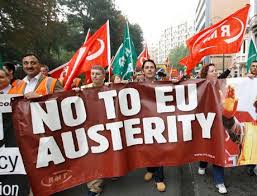
Showing posts with label Greece. Show all posts

Wednesday, 23 November 2016

“Left-wing” Trident? You’re having a laugh


Written by Gabriel Levy and first published at People and Nature

The UK Labour leader Jeremy Corbyn should drop his opposition to the Trident nuclear weapons programme, the journalist Paul Mason argued in a video broadcast in April this year.

What a monstrous example of “socialist” and “left wing” discourse being turned upside down and inside out.

“We” (which in the broadcast means “the British state”) should participate in the NATO strategy in Europe using conventional weapons, Mason argues. But Corbyn should drop his opposition to Trident, so he can get elected and focus on what “really matters for ordinary people ”, e.g. defending the National Health Service and stopping “shovelling public assets into private business” as they were during the banking crisis.

The kindest thing I can say is that maybe Mason imagines he is thinking pragmatically about how Labour, with a clearly left-wing leader for the first time since the 1920s, might win the next election.

It doesn’t even work on that level.

Mason’s argument assumes people will decide how to vote on the basis of Corbyn’s defence policy. Why? All sorts of things influence election results – family finances, xenophobia and racism, perceptions of class interest, actual armed conflicts (rather than nuclear weapons) – and it’s impossible to be sure that Corbyn will lose votes by opposing Trident.

It’s equally possible that his opposition to Trident will help bring young people, who otherwise wouldn’t vote, to the polls to support him. If that happened, and he was elected, it would certainly give Corbyn a stronger starting-point for taking other radical measures.

More important, to my mind, is that Mason’s “left wing case for nuclear weapons” (as he calls it) involves swallowing great chunks of ruling-class ideology that will poison any pro-Corbyn movement long before Corbyn gets anywhere near government.

First, it bigs up the NATO military alliance on the grounds that “we” (the British state) face “an unpredictable Russia”. Oh come on. It takes two to tango. Since the end of the Soviet Union, NATO (invading Iraq, putting armaments eastern Europe after promising not to, etc) has contributed as much as Russia (supporting Ukrainian separatists, Assad in Syria, etc) to the “unpredictability”. (You don’t have to be an apologist for Putin to think this. See other articles on this blog, e.g. here.)

Why should socialists take it upon themselves to advise the British elite on its part in this game, in which ordinary people on all sides have no interest?

Second, Mason argues that Trident, which he says would cost “£41 billion plus” is a deterrent that will “never be used militarily”. This ridiculous justification for nuclear military technology – which can only ever produce mass civilian casualties – has been repeated as long as that technology has been around.

This argument requires an unbelievable level of confidence that military commanders in a capitalist state – even in a crisis, even when in a corner – will never press the button. Oh yeah? Look at Syria, Iraq, Ukraine, etc, to see just what restrained people you’re dealing with.

Moreover, all this is incompatible with any outlook that could meaningfully be described as socialist. It trashes the anti-militarist foundation of socialism, the central idea that we are aiming for a society that ends large-scale military conflict along with labour exploitation and practices and laws that subjugate women.

Again, the damage is done by corroding the ideas around which any pro-Corbyn movement might coalesce – again, before Corbyn gets anywhere near government.

To be honest, even if Corbyn made it to no. 10 Downing Street, I think Paul Mason has as much chance as I do of influencing defence policy – i.e., zero. So 100% of the impacts of these arguments are on the pro-Corbyn movement, not on actual policy. And they are negative.

Perhaps the worst thing is Mason’s use of the word “we” to mean “Britain” or “the British state”. That’s the first trick of parliamentary politics that any radical anti-capitalist movement has to avoid. That was one of the ideological mechanisms by which reformist socialists of the early 20th century ended up justifying the slaughter of the first world war. It’s analogous to the knots in which Alexis Tsipras, the Greek socialist leader no less radical than Corbyn in his rhetoric, tied himself.

“We” means the movement outside parliament – call it working-class movement, communities, social movements, whatever. Mason is one of the few journalists who has reported on it and communicated with it. And that (rather than the defence ministry) is where his “left wing case for nuclear weapons” might cause damage.

I took Paul Mason’s book Postcapitalism seriously enough, as a discussion of the transition to a better kind of society, to comment on it in detail (here and here) – and was therefore disappointed by his broadcast.

One issue I picked on in Postcapitalism was Mason’s contention that the working-class movement as a motive force of change is dead, and that what matters is “networked humanity”. A semantic quibble? It seems not.

From “networked humanity”, Mason’s “we” seems to have moved to “the British state”. I’ll stick with “the working class movement” as my “we”, thanks.

Another point I raised about Postcapitalism was its one-sided view of technology, which is presented as an almost entirely positive force for change. I argued in response that technology not only shapes society but is shaped by it, and that one of the ghastly proofs of that is … nuclear weapons. Hmm.

■ The photo shows the radioactive plume from the US plutonium bomb dropped on Nagasaki on 9 August 1945, seen from 9.6km away, in Koyagi-jima. It killed about 40,000 people on impact. About the same number died, after great suffering, in the months and years that followed. Source: Nagasaki Atomic Bomb Museum/Getty Images.

Sunday, 20 March 2016

The Inside Story of Syriza’s Capitulation to the European Union


This is an edited extract and summary of a much longer interview in New Left Review with Stathis Kouvelakis, a former member of Syriza’s central committee and one of the leaders of the party’s Left Platform. He is now a member of Popular Unity after resigning from Syriza in the aftermath of the Greece’s handling of the financial crisis.

The interview provides a fascinating insight into what was going on at the time, and the full version is well worth a read.

The Evolution of Syriza

The Tsipras leadership made very clear and, in a sense, very tough decisions in that summer of 2012, about the party’s line and about the type of party they wanted. First, they needed to turn a coalition of disparate organizations into a unified party; this was quite widely recognized, and there was no real disagreement about it. They also wanted to use the unification process to transform the culture of the party and its organizational structure at a very deep level. Instead of a push to recruit people who’d been active in the social mobilizations of the period, the aim was to open the gates to the sort of people who want to join a party when they think it has a serious chance of accessing power—clientelist mentalities and habits are very deeply rooted in Greek society, including in the popular classes; there’s a type of micromanagement of social relations.

Kouvelakis says that many of these people were from a PASOK background, the nominally social democratic party whose actions had contributed hugely to the crisis when they were in power, often practising corruption. He then goes to say:

Turning Syriza into a leader-centred party was the second aspect of the process. The aim was to move from a militant party of the left, with a strong culture of internal debate, heterogeneity, involvement in social movements and mobilizations, to a party with a passive membership which could be more easily manipulated by the centre, and keener to identify with the figure of the leader.

The inner-party restructuring went together with the rightward drift. From the summer of 2012 onwards, the position on the euro was transformed into a constant display of fidelity to the Eurozone. This was expressed in Tsipras’s trips to mainstream institutions, mainly in the US—the Brookings Institute and so on….Second, from 2012 onwards, the type of political practice favoured by the Tsipras leadership didn’t move beyond parliamentarism….At this point the Tsipras leadership also started building bridges to people in the core state apparatuses—military and diplomatic circles—and began to indicate their loyalty to the fundamental tenets of the Greek state.

Domestic Policy

There was an unprecedentedly low level of legislative activity. No more than ten or twelve bills were passed in that first period. Most were positive, but they were very limited: a minimal package to deal with the humanitarian crisis, about one-sixth of the package announced in the Thessaloniki programme, including reconnection of electricity, but targeting only the most desperate cases; the €5 entry ticket to go to hospital was scrapped—a widely hated Memorandum measure.

In a few cases, Left Platform ministers could pursue some initiatives. For instance, Lafazanis blocked privatization of land around Piraeus and of the national power company.

Greece’s obsession with the Euro

First, one shouldn’t underestimate the popularity of the euro in the southern-periphery countries—Greece, Spain, Portugal—for whom joining the EU meant accessing political and economic modernity. For Greece, in particular, it meant being part of the West in a different way to that of the US-imposed post-civil war regime…Having the same currency as the most advanced countries has a tremendous power over people’s imagination—carrying in your pocket the same currency as Germans or Dutch, even if you are a low-paid Greek worker or pensioner—which those of us who’d been in favour of exiting the euro since the start of the crisis tended to underestimate.

Even now, after five years of some of the hardest shock therapy ever imposed—and the first imposed on a Western European country—public opinion is still split on the issue of the euro, although now with a much narrower majority in favour of staying in.

Second, in contrast to the position of Sweden, Denmark or the UK, for Greece quitting the euro would be extremely conflictual, because it would mean breaking with the neoliberal policies of the Memoranda. If you are serious about this, you have to be prepared for a confrontation. From 2012, when Syriza emerged as the largest opposition party, poised for government, it was clear that Tsipras didn’t want that fight, which is why he switched to a stance of staying in the Eurozone. Syriza’s original position was summed up by two slogans: ‘No sacrifice for the euro’ and ‘The euro is not a fetish’, which left open the question of how far to go in confronting the Eurogroup and the Troika. But this line was shelved soon after the June 2012 elections.

In the summer of 2015 it was Tsipras who used the argument of fear—that exiting the euro would mean chaos. In early June, after the Eurogroup rejected the Greek terms, which had already been intended as a capitulation, the Syriza Finance Minister Euclid Tsakalotos was asked by Paul Mason what would happen if Greece left the euro. He replied that it would be a return to the 1930s—the rise of Nazism! Tsipras himself used the image of collective suicide. What such statements reveal is that, for the Syriza leadership, exit was unthinkable—a black hole. It was outside their cognitive mapping, alien to their strategy which had already ruled out the possibility of an all-out confrontation.

Tsipras the Leader

Tsipras’s personal staff were beyond the control of anyone in the party. So was the Commission for the Programme—essentially dominated by the Commission for the Economy, led by Yannis Dragasakis…Dragasakis wanted his hands completely free. He knew he couldn’t put the programme he really wanted down on paper, because the party wouldn’t accept it—but he was the most open in saying the only option was improved management of the Memoranda framework.

When Tsipras went to address what was, in a way, the real audience—the representatives of ruling circles in Europe and the US—the logic of what he was saying was: ‘Look, I’ll lay down my radicalism, of which you are rightly afraid, but in which I don’t genuinely believe. I see things differently now, and I’m ready to be a nice boy, much more reasonable than you think—but I should get something in return.’ He really believed he could get something—that was clear.

The result, you could say, was objectively the worst political betrayal perpetrated by any contemporary left-wing force—certainly in Europe.

Perhaps one could compare Tsipras to Achille Occhetto, the Italian Communist Party leader who liquidated the whole tradition of the party. Occhetto visited NATO headquarters in Brussels and said, ‘This is the centre of world peace.’ He visited Wall Street and said, ‘This is the temple of civilization.’ 

These are things no social democrat, or even a conservative, would ever say. The Italian Marxist Constanzo Preve made the point that former left-wingers who disintegrate internally tend to stop believing in anything.

Tsipras, who built his entire political position on a pledge to abolish the Memoranda, now becomes their loyal servant.

Varoufakis

Varoufakis is a more complex figure. As we now know, he was doing things behind the scenes that showed he had an awareness of the need to go beyond what was being said in public. At the same time, he signed up to the 20 February 2015 agreement, constantly defended it and was the first to make statements, as early as February 2015, saying Greece should adopt 70 per cent of the Memorandum. He bears a lot of responsibility for what happened. Nevertheless, he had a clearer perception of the situation and was keen to adopt a more confrontational attitude within that framework—and in fact this was why Tsipras chose him. Tsipras sensed that, even if it was pure theatre, some such stance was necessary if only for purposes of legitimation, or possibly for getting some concessions, and that Dragasakis would be quite incapable of playing that role. He needed a more flamboyant figure like Varoufakis.

The Referendum

As for Tsipras, the one certainty we have is that he only thinks about tactics. There are two possibilities, not mutually exclusive. The first is that he thought he could get what he said: a further sign of popular support to improve his position in the negotiations. The question posed would be sufficiently vague—No or Yes to the Juncker package—that it wouldn’t raise the issue of rupture with the euro. He must have imagined this would take place in a relatively controlled and calm atmosphere—clearly he completely underestimated the effect of bank closures, shortage of currency and so on, when the ECB upped the pressure by cutting off the emergency funding mechanism to the banks. The tension rose suddenly that Monday, 29 June, with the banks closing. At that point it was clear, I think, that Tsipras either wanted the Yes to win, or a very narrow margin for the No.

The second possibility is that he had already taken the decision to sign up to the Third Memorandum, but needed a display of bravery up to the last moment, to legitimize it—so that he could say, ‘You see, I’ve used all the weapons I had, and I couldn’t get more than this; there is no alternative.’ So, those were the intentions.

Lessons for the European Left

First, that it’s impossible to fight austerity or neoliberalism within the framework of the existing monetary union, and, most likely, of the EU as such. A rupture is indispensable. Second, the political practice of radical-left parties vitally needs to articulate parliamentary politics with popular mobilizations; when the second is lost, the first becomes weightless, and actually reinforces the ongoing collapse of representative politics. Third, a proper reinvention of a broad, anti-capitalist vision of society is needed—neither a return to the old recipes, nor a mythical tabula rasa.

It was predictable that defeat in Greece would send a negative shock wave across the rest of Europe. Though there are other factors involved, I think it played a role in Podemos saying they won’t break with the euro, not even with the Stability Pact, and revising their position on the debt. Currently, they’re not even setting a break with austerity as a condition for collaboration at government level. Iglesias says that the point is to rise above the shoulder of PSOE and orient the hand of social democracy to the left. The Portuguese have drawn a similar conclusion; there the impact of Syriza’s defeat is even more apparent. I can understand that the deal struck by the Left Bloc and the Portuguese Communist Party with the Socialists was to some extent a tactical move, because the right had lost its majority in parliament, and there was a demand to allow the Socialists to take over—otherwise the right would once again be in command.

But it’s a fundamental mistake for formations of the radical left to agree to a line that is merely complementary to social democracy. We don’t need radical-left parties to make deals with social democracy to limit foreclosures, raise the minimum wage by €50, cancel some redundancies in the public sector, and so on. If we really think that’s the best we can get, we should operate within the framework of social democracy, and try to obtain some concrete improvements. But for a political current that supposedly has an alternative vision for society, accepting this as the horizon can amount to giving up on that vision.

That’s the danger that the remainder of the radical left faces in Europe now, after Syriza’s failed attempt: the danger of giving up on the very idea of more radical change. But not everyone draws the same conclusions. Mélenchon has organized discussions in Paris about the need for a Plan B—I think he has drawn more correct conclusions from the Greek case, and denounced Tsipras’s capitulation. He is now talking openly about the necessity for all the parties of the European radical left to make alternative plans which do include the option of leaving the euro and preparation for full-scale confrontation. There is a similar conference in Madrid initiated by the left of Podemos—Anticapitalistas and other forces on the radical left in Spain, which also include part of the Catalan radical left, and so on. So, there are forces who are drawing the relevant conclusions.

Thursday, 24 December 2015

2015 – The Year in Blog Posts


2015 was the first full year of this blog. Below are the most popular posts of each month, as defined by page views, for this year.

The year kicked off with increasing evidence of a Green Party surge.

January


While hostility from the conservative press was to be expected, I must say I have been quite taken aback by how many Labour commentators have completely failed to grasp the mentality of Green supporters or what the "Green Surge" is all about.

Attention then turned to the General Election, which dominated the blog news agenda.

February


In the second of a series of interviews with Green Left supporting candidates at the General Election, Mike Shaughnessy interviews the Green Party's Katy Beddoe, candidate for Caerphilly, Wales.

March


I like to tease my Green friends that I was the first Green parliamentarian in the UK! I was elected as a Labour MEP for Essex and Herts in 1994 but quickly fell out with Tony Blair, I think I was a little ahead of public opinion in recognising that Blair was a fraud and a Tory!

April


In the fifth of a series of interviews with Green Left supporting candidates at the General Election, Mike Shaughnessy talks to the Green Party's Lesley Grahame, candidate for the target constituency of Norwich South.

May


Party leader Natalie Bennett and Caroline Lucas, the Greens' only MP, described their policies as an "unashamedly bold plan to create a more equal, more democratic society".

June


We'll look here at Green voters, but the graphics here give the full results of which party got votes from which demographic groups.

General Election over, the Greek financial crisis moved to centre stage by mid summer.

July


Around two hundred people assembled at the German Embassy in London this evening, to show solidarity with the Greek people in their fight against the vicious and vindictive bail out terms forced on them by their creditors in the EU and IMF.

The Labour leadership contest and its unlikely winner became the big political news story.

August


I’ve not commented until now on Jeremy Corbyn’s campaign to become the Labour party leader, preferring to leave it as a Labour party matter. But it is becoming clear, that if Corbyn wins, it will have a big impact on the Green party’s fortunes.

Then as a side show to Corbyn’s election the EU referendum made a strong appearance.

September


I don’t know whether Jeremy Corbyn, the new leader of the Labour Party, reads this blog, but his strategy for the upcoming referendum on Britain’s membership of the European Union (EU) now appears to be remarkably similar to what I recommended here on this blog ten days ago.

Fall-out from the new Tory government’s welfare policies hit the headlines.

October


The figures from the Health and Social Care Information Centre show that in the worst affected areas, Devon, Cornwall and the Isles of Scilly, 2.4 people out of every 100,000 were admitted to hospital with a primary diagnosis of malnutrition.

Then the vote in Parliament for the UK to bomb IS in Syria proved popular amongst the readership here.

November


The recent history of Britain’s involvement in military action in the middle-east is not a happy one, in Afghanistan, Iraq and Libya, our interventions have been an unmitigated disaster.

The year ended with the Paris COP21 climate ‘agreement’, which some hailed as a great stride forward.

December


Reading the main stream media you would be forgiven for thinking that the climate crisis has, at one fell swoop, been solved by the agreement reached at the Paris COP21 Climate Summit.

Friday, 25 September 2015

Why we have to have a proper debate about THIS Europe


Written by Haroon Said

Henri was the name of my friends exchange student. I was 14 years old. He was my first encounter with “Europe”. Trying to communicate in “Franglais” which had us as at times rolling about in laughter as he explained that it was a sheet he needed and not a shit. It made me realise that Europe was more “non-English” than English and as such more like me. In a way, that initial experience stayed with me and I have always regarded “Europe” as a good thing.

However, the Europe of my youth is not the Europe of today. The Europe of today for me looks like

THIS:

However, it’s not just the treatment of migrants that makes me question my position on the EU project.

Let’s take the European Parliament. Interest in voting in EP elections has steadily declined from over 70% to just 43%. There are many reasons behind this negative trend but you can sum it in the phrases low trust and low accountability. Caroline Lucas in a recent piece for the Huffington Post wrote:“I'm the first to admit that the EU is far from perfect - indeed my decade in the European Parliament as an MEP confirmed that to me. In recent times it has been locked in the hands of neoliberal national Governments who have attempted to use it to their own ends.”

I fully agree with Caroline but THIS Europe for me has been locked into “neo liberal hands” for decades, not just recently. THIS Europe has been legitimised and created through far reaching acts such as the Single Market Act, linked to the treaty of Amsterdam which have laid the basis for the corporate dominated Europe we have.

Let’s take the European Commission. This is a wholly unelected executive and civil service organisation rolled up into one. This is one of the centres of power in the EU project. It has the power to propose legislation.

Let’s take Greece, Spain, Ireland, Italy, Slovenia, Portugal, Slovakia, all in the Eurozone who have been effectively treated as “financial colonies” through the imposition of “structural reforms” , which we all know means, job losses, more shit work, cuts in public service and the fire sale of public assets.

Let’s take climate change. Here the EU takes first place if you place all global pledges side by side. However, whilst within the EU you will find really excellent actions, these have been locally (at district, city, town or regional) driven. In THIS Europe we have had the appalling Emissions Trading Scheme, which from the outset set out to give the big polluters huge windfall profits. Moreover as we cruise to 40% reductions by 2030, what fails to get mentioned is that we have used phoney/useless offset measures, relocation of dirty production and discounting any CO² contribution arising from the transportation of all the stuff that we like to buy in order to place ourselves in pole position as champions of climate change.

Let’s take NATO and its transformation as a force for keeping peace to one of making war. Which brings me back to the migrants and my questioning of the EU project.

Talking with activists and those working for not for profit organisations in Brussels (where I work) and across the EU there is a growing questioning of the EU project taking place. National and EP elections are sending the same message as more people start to question the EU. We as a party need to also make some reflection.

Our party has always regarded the “European Project” with justified caution. In fact if you revisit our EU policy then you will find the following:

EU301 The present EU structures are fundamentally flawed. Their remoteness has resulted in a lack of accountability which is working against the interests of people and the environment.

EU302 Our aim is to reconstitute the EU as a democratically accountable and controlled European Confederation of Regions, based on Green principles. Its organisation would follow the Green principle of subsidiarity, that decisions are made at the lowest appropriate level, not impose the "harmonisation" of the current EU.

This policy goes back to the 1990’s before we had any MEP’s in the European Parliament. Since 1999, the party has pursued a policy to bring about reform from within. Has this worked? What are the tangible real gains that we can identify that signify some positive and meaningful reform? Can we bring about change from within? If we think we can, then should we also think whether we are in the right grouping inside the parliament? Since we have had MEP’s a new Green and United left group has been created. Podemos and Syriza as well as Scandinavian Green parties can be found in this group. Should we move to this Group?

We also need to review our policy ahead of the referendum because the party I joined five years ago is no longer the same party in that our membership has increased by 500%. We need to engage with our new and wider membership in reviewing this policy.

If you are interested in putting some time and effort into such review then please get in touch.

Haroon Saad Waltham Forest and Redbridge Green Party h.saad@ludenet.org

A full version of this article can be found on my Facebook page

https://www.facebook.com/haroon.saad.50

Haroon Said is member of Waltham Forest and Redbridge Green Party and a supporter of Green Left

Thursday, 24 September 2015

Feeding the Monster at Home and in Europe - Part 2 Europe


Written by Charles Gate

The EU is on the agenda of this week’s GP conference.

Some on this list will trail through many green websites etc everyday in search of good copy for our various social media activities. Every day I go to the European Green Party and the Greens/EFA web sites. Quite often some of the more innovative stories and projects can be found there but so too can some of the worse. IMO the worse are those on the Greek crisis where upper-mind is that first comes maintaining the unity of the EU with the add-on of debt forgiveness, but the main thrust of the piece is invariably EU unity over and above whatever the consequences are for the ordinary people of Greece.

I have no doubt, that the preservation of the EU at all costs is driven by German Greens and the long shadow of WW2 and the Nazis, but it’s time for the new generations of Germans to get over their grand-parents past (it isn’t the new generations fault and they bare no responsibility for it), just as we Brits of today bare no responsibility for the past horrors of the British Empire and some of those horrors are much more recent than WW2. (It is noticeable that the guilt shared by many modern day Germans still lead to the mistaken defence and support of Israeli atrocities against Palestinians).

The defence of the EU project by German and other European Greens though doesn’t explain why many UK Greens support this failed and miserable project. A project 60 years in the making seems to get worse all the time rather than better. 

At some stage you have to say it has failed and we need to look for a new Europe with a totally different approach and way forward. Most of us anti-EU Greens (but we are not anti-Europe Greens) generally site the dual problems of how, firstly, the EU has treated Greece and other heavily debt laden EU countries (the debt of course all belonging to the 1% but paid for by the 99%) and, secondly, the push by the EU representatives of the 1% for TTIP. I think now we can add a significant third, the treatment of the migrant issue. An issue created by the war actions of Blair and Bush and their followers in the EU and carried on by their successors. 

The greater migrations yet to come, due to climate change, will of course have stemmed from the actions/inactions of the capitalist west. The EU has and will continue to fail to deal with the root causes (us, our western 1%) and will fail more and more to treat migrants in a humane manner. This in itself should be enough for UK Greens to ditch the EU project as a fail, but we get the mantra of, well the EU has given us certain good environmental laws and worker rights which we otherwise wouldn’t have had.

What is this deference to EU bureaucratic law makers? Have a certain section of our Green leadership so little regard for the democratic choices of the British people and the potential in the organised UK working class that we must look to action from bureaucrats in Brussels rather than to our own rather more local actions and activity. 

These Greens prefer a top down Europe it seems. We must be allowed to make our own choices democratically, good or otherwise, and not even have good law imposed from afar, because as we see with Greece and TTIP these bureaucrats (reps of the 1%) can very easily and swiftly make matters worse – the EU parliament is hardly a democratic counter weight and is presently centre right anyway, with a great fear that in future years a more virulent right wing will replace it, invariably due to the EU failure of producing the goods that we would like to see put into place.

As Greens we need to give voice to a New Europe, a Green Europe, free from the grip of EU bureaucrats and the 1%. To that end WE MUST SAY the Europe of the EU has failed, we need to go back to the drawing board and the EU needs to be dismantled. 

Yes this won’t happen overnight but we need to make a start with it. This doesn’t mean we will tell our MEPs to leave the EU, on the contrary I want more UK Green MEPs in the EU as presently formed, but arguing for an end to the present EU (actually forthrightly arguing for a dissolution of the current EU to be replaced by a new organisation based on a democratic run assembly rather than a bureaucratically and council of ministers led EU – I leave the finer details to others – I think most of it is already in our European policy). The point that we must make constantly is that the EU is a failed model for Europe and this is our vision for its replacement. At the moment we are part of the problem and not the solution to Europe’s many major problems. 

Perhaps had we been seen as more anti-EU at the last EU elections we would have returned 10 MEPs instead of the 3 we have after many years of PR elections, which were supposed to have been the gateway to greater Green success. PR doesn’t guarantee anything if you have the wrong message. Greens need to be seen as part of the solution for a new Europe not as an apologetic sop for its current form.

Charles Gate is a member of Calderdale Green Party and a Green Left supporter

Part 1 Home is here

Monday, 21 September 2015

TUC General Council statement on EU referendum


Congress notes that there will be a referendum on Britain’s continued membership of the European Union at some time in the next two years, possibly before the 2016 Congress.

Over the years, Congress has consistently expressed support for a European Union that delivers economic prosperity based on social justice, civil and human rights, equality for all and rights at work. However, two developments in the recent period have called the achievements of the EU into question:

i. The part played by the institutions of the EU in intensifying the crisis in Greece, in demanding the imposition of further neo-liberal measures including extensive privatisation and cuts to welfare and social provisions on that country, and in undermining the policies of its democratically elected government.

ii. The EU’s advocacy of CETA, TTIP and similar agreements designed to advance the interests of transnational capital across Europe, opening up public services to marketisation and privatisation and over-riding the policies of elected governments.

These factors reflect the increasing domination of neo-liberal ideology within the European Union and inevitably prejudice the EU’s historic high standing within the labour movement.  There is a danger that these factors can only be exacerbated by David Cameron’s renegotiation of the terms of Britain’s membership. He has made it clear that these include the possibility of a further dilution or even disappearance of EU wide social protections as they apply in Britain.

These protections have included rights for women, part-time, temporary and agency workers, rights in situations of redundancy and information and consultation, rights for working parents and a range of health and safety rights, including limitations on excessive hours and the creation of a work-life balance. The positive benefits that the EU has delivered for working people are recognised – rights which are essential in any modern economy -  and those rights should be  both promoted and strengthened. Congress strongly rejects the attempts being made by the Prime Minister to use the renegotiation process to undermine workers’ rights, to foster divisions around migration, and to promote a Europe for financial and business elites only.

Congress believes that Conservative attempts to obtain an ‘opt-out’ from EU wide protections for UK workers, seeking to water down rights – especially the Working Time Directive and the Temporary Agency Workers Directive – and to impose a moratorium on future employment rights is wrong and counter-productive. Working people, faced with the prospect of a Europe based on insecurity at work and flexibility on employers’ terms, will have little enthusiasm to vote and be even less likely if they do, to vote to stay in the European Union.

We have also consistently argued that Government attempts to restrict benefits for migrants coming from other parts of Europe would herald an attack on everyone’s in-work benefits – a view justified by reports this summer. Some employers will always try to use new entrants to the labour market – women, young workers or migrants – to drive down wages, and we believe the EU has a positive role to play in preventing this exploitation by providing a floor of EU wide fundamental rights and labour standards, including the right to collective bargaining and the protection and enforcement of national level collective agreements. Congress believes that the only effective and acceptable ways to address concerns about free movement are to provide working people with the security against exploitation and undercutting that strong unions and decent rights at work, robustly enforced, would provide; and to expand access to public services and housing, using EU funding that follows migrants so that they can adapt to population changes.

Since the Government announced its plans for the EU Referendum, the TUC has campaigned and lobbied to expose the Government’s anti-worker rights agenda; to press employers to accept the need for a high level of workers’ rights as the quid pro quo for access to the single market; and to persuade other European Governments to reject the agenda of worse rights for working people, including freedom of movement, that the Prime Minister is more or less openly advocating. We have worked closely with other trade unions across Europe in seeking to ensure that their politicians understand that no concessions will satisfy the Prime Minister’s Eurosceptic backbenchers or UKIP, and that such concessions would also undermine support for the European Union in their own countries.

The European Union is Britain’s biggest trading partner, and millions of jobs in Britain aligned to that trade and could be put at risk if the UK left the EU. But we deplore the way in which European political leaders have put narrow sectional interests and the economics of austerity ahead of solidarity with countries facing economic crises - in particular Greece, but also Ireland, Italy, Portugal and Spain - as well as refugees like those fleeing oppression and war on Europe’s southern borders. We reject the European Union’s support for liberalisation and deregulation, including in trade deals like CETA with Canada and TTIP with the USA, both of which the TUC opposes, measures undermining collective bargaining in Eastern and Southern Europe and judgements of European courts that undermine negotiated sector level agreements providing minimum labour protections.

The TUC will continue to advocate a positive vision of a people’s Europe and reforms that would promote investment for sustainable growth, decent work with good wages and a greater say for people at work. Investment in public infrastructure like social housing, transport, telecommunications and energy efficiency could create 11 million highly skilled and well-paid jobs across Europe. Europe needs a pay rise and an adequate floor of enforceable minimum wages to protect the most vulnerable.

In the run up to the EU Referendum, we will continue to campaign and lobby against the Government’s attempts to further water down Social Europe.  The government and industry needs to understand that neither the TUC position nor the votes of millions of trade unionists can be taken for granted. Workers will not back or support a Europe that fails to protect and enhance the position of working people, citizens and civil society or one that solely works in the narrow interests of global corporations and finance capital. We hope that the Prime Minister’s efforts to weaken workers’ rights will fail but if they do not, we are issuing a warning to the Prime Minister: you will lose our members votes to stay in the EU by worsening workers’ rights. Once the full results of the renegotiation and timetable for the referendum are known the TUC will take stock of our position. However, both the Prime Minister and CBI should note that should he succeed in further undermining British workers rights pressure to put TUC resources and support in the referendum behind a vote to leave the European Union will intensify dramatically.

From the TUC website

Thursday, 20 August 2015

Capitalism vs. Democracy in Europe


By Michael Lowy and published at ecosocialist party website Solidarity US

Let us begin with a quote from an essay on bourgeois democracy in Russia, written in 1906, after the defeat of the first Russian revolution:
“It is highly ridiculous to believe that there is an elective affinity between grand capitalism today, as it is presently imported into Russia, and well established in the United States (…) and ‘democracy’ or ‘liberty’ (in all the possible meanings of the word); the real question should be : how are these things even ‘possible,” on long term, under capitalist domination ?”1

Who is the author of this insightful comment? Lenin, Trotsky, or perhaps the early Russian Marxist Plekhanov? In fact, it is from Max Weber, the well known bourgeois sociologist. Although Weber never developed this insight, he is suggesting here that there is an intrinsic contradiction between capitalism and democracy.

The history of the 20th century seems to confirm this opinion: very often, when the power of the ruling classes seemed to the threatened by the people, democracy was pushed aside as a luxury that one couldn’t afford, and replaced by fascism--Europe in the 1920s and '30s--or military dictatorship: Latin America in the 1960s and '70s. Fortunately enough, this is not the case of Europe today, but we have, particularly during the last decades with the triumph of neoliberalism, a democracy of low intensity, a democracy without social content, which has become an empty shell. Sure enough, we still have elections, but there seems to be only one party, the U.M.P., United Market Party, with two variants which have only limited differences: the right-wing neoliberal version, and the left-center social-liberal one.

The decline of democracy is particularly visible in the oligarchic functioning of the European Union, where the European Parliament has very little influence, while power is firmly in the hands of non-elected bodies, such as the European Commission, or the Central European Bank. According to Giandomenico Majone, Professor at the Europen Institute of Florence, and one of the semi-official theoreticians of the Union, Europe needs “non-majoritarian institutions,” i.e. “public institutions that are, on purpose, not responsible neither towards electors nor elected officials,” the only way to protect us against “the tyranny of the majority.” In such institutions “qualities such as expertise, professional discretion and coherence (…) are much more important than the direct democratic responsibility."2 One could hardly imagine a more blatant apology for the oligarchic and antidemocratic nature of the Union.

With the present economic crisis, democracy has descended to its lowest levels. In an recent editorial, the French Journal Le Figaro wrote that the present situation is an exceptional one, and this explains why democratic procedures cannot be always respected; when normal times return, we can re-establish democratic legitimacy. We have therefore a sort of economic/political “state of exception” in the sense of Carl Schmitt. But who is the sovereign that has the right to proclaim, according to Schmitt, the state of exception?


The Sovereignty of Finance Capital


For some time after 1789 and before the proclamation of the French Republic in 1792, the King had the constitutional right of Veto. Whatever the resolutions of the National Assembly, whatever the desires and aspirations of the French people, the last word belonged to His Majesty. In Europe today, the King is not a Bourbon or Habsburg, the King is Financial Capital. All the present European governments--except the Greek one!--are functionaries of this absolutist, intolerant, and anti-democratic Monarch. Whether right-wing, "extreme-center," or pseudo-leftist; whether conservative, demo-Christian, or social-democratic, they fanatically serve her Majesty's right of Veto.

The absolute and total sovereign today in Europe is, therefore, the global financial market. Financial markets dictate to each country the wages and pensions, cuts in social expenses, privatizations, the rate of unemployment. Some time ago, they directly nominate the heads of government (Papademos in Greece and Mario Monti in Italy), picking so-called “experts” who are faithful servants of the financial markets.

Let us have a closer look at some of these all-powerful “experts.” Where do they come from? Mario Draghi, head of the Central European Bank, is a former manager of Goldman Sachs; Mario Monti, former European Commissioner, is also a former adviser to Goldman Sachs. Monti and Papademos are members of the Trilateral Commission, a very select club of politicians and bankers that discuss what to do next. The President of the European Trilateral is Peter Sutherland, former European Commissioner, and former manager at Goldman Sachs; the vice-president of the Trilateral, Vladimir Dlouhy, former Czech Minister of Economy, is now adviser to Goldman Sachs for Eastern Europe.

In other words, the “experts” in charge of saving Europe from the crisis used to work for one of the banks directly responsible for the sub-prime crisis in the United States. This doesn’t mean that there is a conspiracy to deliver Europe to Goldman Sachs; it only illustrates the oligarchic nature of the “experts” elite ruling the Union.

The governments of Europe are indifferent to public protest, strikes, and mass demonstrations, and don’t care about the opinion or the feelings of the population; they are attentive--extremely attentive–only to the opinion and the feelings of the financial markets, and their employees, the ratings agencies. In the European pseudo-democracy, to consult the people by a referendum is a dangerous heresy--worse, a crime against the Holy Market. The Greek referendum was not only about fundamental economic and social issues, it was also and above all about democracy.

The 61.3 per cent Greek NO was an attempt to challenge the Royal Veto of finance. This could have been a first step towards the transformation of Europe, from capitalist Monarchy into a democratic Republic. But the present European oligarchic institutions have little tolerance for democracy. They immediately punished the Greek people for their insolent attempt to refuse the austericide.

Catastroika is back in Greece with a vengeance, imposing a brutal program of economically recessive, socially injust, and humanly unsustainable measures. The German right-wing fabricated this monster, and forced it on the Greek people with the complicity of Greece false "friends" (Hollande, Renzi, etc).


Finding Scapegoats


While the crisis gets worse and public outrage grows, there is an increasing temptation, for many governments, to distract public attention towards a scapegoat: the immigrants. Thus undocumented foreigners, non-communitarian immigrants, Muslims, and Roma (Gypsies) are being presented as the main threat to the country. This of course opens great opportunities for racist, xenophobic, semi-fascist, or outright fascist parties, which are growing and are already, in several countries, part of the government--a very serious threat to democracy in Europe.

The only hope is the growing aspiration for another Europe, beyond savage competition, brutal austerity policies, and eternal debts to be paid. Another Europe is possible, a democratic, ecological, and social one. But it will not be achieved without a common struggle of the European populations, beyond ethnic borders and the narrow limits of the nation-State.

In other words, our hope for the future is popular indignation, and the social movements, which have been on the rise, particularly among youth and women, in several countries. For the social movements, it is becoming increasingly obvious that the struggle for democracy is a struggle against neoliberalism, and, in the last analysis, against capitalism itself, an inherently antidemocratic system, as Max Weber already pointed out a hundred years ago.

Michael Löwy is a Marxist sociologist and philosopher living in Paris. His most recent book is Ecosocialism: A Radical Alternative to Capitalist Catastrophe (Haymarket Books, 2015). This article was written for Avghi (Dawn), the daily paper of Syriza.


Footnotes
  1. Max Weber, «Zur Lage der bürgerlichen Demokratie in Russland», Archiv für Sozialwissenschaft und Sozialpolitik, Band 22, 1906, Beiheft, p. 353.
  2. Quoted in Perry Anderson, Le Nouveau Vieux Monde, Marseile, Agone, 2011, pp. 154,158.

Sunday, 9 August 2015

Saral Sarkar - A Modern-day Classical Greek Tragedy -- a Contribution Toward Understanding The Greek Crisis


Ideologies, Grand Delusions (Lebenslügen) and Misconceptions

Recently, during a popular German TV talk show, the moderator quoted an experienced Brussels correspondent (Mr. Krause) of the channel (ARD) who had said: "Actually, Greece is a Third World country that is living like an advanced industrial country." To this, the Greek participant in the talk show, Mr. Chondros, a member of the Central Committee of SYRIZA retorted angrily, and twice: 

"He is talking nonsense. Convey this opinion to him with my compliments." Later, he added that the Channel ARD was mostly spreading propaganda.

Despite all my sympathies for the Greeks, I must say that the root cause of the current Greek crisis lies here. Greece is certainly not a Third World country. But it has never been as prosperous as, e.g., Germany. From 2002 onward, when Greece joined the Euro Zone, it got much easier terms for borrowing at the international financial market. Whereas previously it had to pay roughly 25 percent effective interest on its state bonds denominated in Drachma, after joining the Euro-Zone it had to pay only 5 percent on its bonds denominated in the highly valued and strong Euro. The difference of 20% was a net gain for the Greeks. But at the same time, the state, perhaps also Greek banks, businesses, and ordinary citizens then became strongly tempted to borrow more than what could be economically justified.

And why shouldn't they have borrowed more? In standard economics borrowing is recommended for creating wealth and increasing income and prosperity. It is argued that an entrepreneur borrows money, invests it in some business, and makes profit. The state borrows, invests in infrastructure development or promotes industries, sometimes state-owned industries, and so the nation becomes prosperous. In both cases, the debt can be serviced or even fully repaid from the increased income.

In this connection it must be said that all those who participated in the media discussions, including Greek economists, failed to say even once that Greece's current problems are not entirely of its own making. The Great Recession that began in 2007–2008, and from which also several other countries are still suffering, exacerbated the plight of the Greek economy which had already been weakened by the debt burden.

Further below, I shall once more take up the economic causes of the present-day crisis in Greece. Here however it first needs to be remembered that the generation of politicians who had applied for and pushed Greece's entry in the Euro Zone had falsified the statistics on the basis of which the country was judged to have satisfied the criteria to become a member. That was the original sin, if you will, the consequences of which the young Greeks of today are bearing.

Ever since January 2015, when the left party SYRIZA came to power, some of its spokespersons and supporters in the other European countries have been repeatedly saying that despite all the troubles Greece is giving the Euro Zone, the place of the country that taught Europe democracy is in Europe and not outside. It has also been reported that in 2001 the EU bosses knew that the statistics were false, but they thought they could not deny Plato the right to play in the first division.

In 2001, Europe did not need to learn democracy from the present-day Greeks. The real reason why Greece wanted to be admitted to the Euro Zone were the economic advantages mentioned above. It is, moreover, dishonest to intentionally obfuscate the difference between the European Union and the Euro Zone. During the present crisis, nobody advised Greece to leave the EU. Only some courageous people, including some serious economists and the German finance minister Mr. Schäuble, said that it would be good for both the Greeks and the rest of the Euro Zone if Greece opted out of the Euro club for a few years. Exasperated at the continued obfuscation in the talk shows, a participant, namely Prof. Hans-Werner Sinn, cried out (in the general sense): but the Euro is only a currency; the Euro Zone is only a currency union and not an economic or political union based on values. A currency union cannot exist if all participants feel free to ignore the rules.

This obfuscation may only have been a tactic, with which the Greeks intended to get better terms for the new credits or even debt forgiveness. And their left and green supporters in Western and Northern Europe perhaps only wanted to show that they value solidarity and sympathize with the suffering Greeks, while the conservatives, like Merkel and Schäuble, were merciless and wanted to punish the Greeks for having elected a left party to power. But neither Tsipras and SYRIZA nor their supporters could suggest any other middle-term solution of the problem than the obsolete Keynesian one: further borrowing and spending and waiting for the time when the economy would again start growing. I shall below come back to these questions of economic policy.

After the referendum of 5th July, when 61.3 percent of the Greek voters said No to further austerity, leftists all over the world waxed eloquent about democracy. But neither before nor after the referendum did anybody know what Tsipras would do if the creditors remained stubborn and refused to give Greece what it wanted unless he agreed to their harsh conditions. Would he in that case lead Greece out of the Euro-Zone? This question, widely discussed outside Greece, was never discussed in Greece, at least not in public. The referendum was therefore no good example of democratic decision making.

In other words, neither SYRIZA nor the Greek government had a plan B, for the majority of the Greeks simultaneously said No to further austerity and (in opinion polls) No to exit from the Euro Zone (Grexit). This question was a hot potato that no Greek politician dared to touch. Most No-voters simply imagined that the other 18 leaders of the Euro Zone would bow to the wish of the majority in a small member country.  Yanis Varoufakis, the then finance minister said (in the general sense): If you have a debt of only 30 million, you are weak, but if it is 300 million, you are strong. This was at best naivety, if not a delusion.


After the overwhelming No vote to austerity, a few young Greeks said to TV journalists, they were very proud of Greece etc. But what exactly were they proud of? Some said they were proud because Greece demonstrated resistance in spite of the very bad situation. But can any people be proud at all, if they are so heavily indebted as the Greeks are, and can they call their No-vote resistance if through it they ask their Prime Minister to go with a begging bowl to the same hated rich creditors and beg for further debt forgiveness and easier repayment terms? They would have had reason to be proud if they had declared: we herewith end this debt-slavery, we exit from the Euro-Zone, and introduce our own new currency. But they didn't take this path.

It is not correct to speak sweepingly of "the Greeks" and for that matter, of any people, e.g. "the Vietnamese". Like any society, Greek society too is divided into classes and interest groups. And particular political proposals are generally supported or rejected on the basis of personal and class interest in the given situation. During the hours long big demonstrations on the days before the referendum, political observers could easily find out that it was mainly young people, workers, students, the unemployed, and people with a low income who would vote No. These were the people who thought they had no future, had nothing more to lose, or things could not become any worse for them. The prospective Yes-voters were mostly teachers, multilingual intellectuals connected with Western.Europe, entrepreneurs, elderly people, pensioners, middle and upper middle class people, people with safe jobs, all of whom wanted to protect what they had.

After winning the referendum, Tsipras went to Brussels in a fighting spirit. But on 13th July he returned with a worse deal than the one he was offered before and which he had asked his countrymen to reject in the referendum. He had to sign the worse deal, because he did not see any way out of the unsolvable dilemma he faced. In the words of Varoufakis, the Greeks “were given a choice between being executed and capitulating. And he (Tsipras) decided that capitulation was the ultimate strategy… ”. So the SYRIZA leader, who had been celebrated on 25th January after winning the election, and again on 5th July, returned to Athens on 13th July as a defeated and humiliated general. After returning home, he said totally contradictory things: he did not believe the deal he accepted would save Greece; it would certainly cause more pain and further recession. But he had to sign it and, what is worse, he must also try to implement it, for “this deal secures for Greece conditions of financial stability, gives it opportunities for recovery”; he promised that after a period of suffering, there would be light. A truly tragic figure, an anti-hero.

After this outcome, some of his radical critics called Tsipras a pseudo-leftist, accused him of betraying the people who had voted for him. This is rather unfair. To use another classical Greek imagery, he, as captain, had to steer his ship, the Greek nation, between Scylla and Charybdis.3 But unlike Odysseus, the hero of the epic Odyssee, who succeded in steering his ship out of the twin dangers with only moderate sacrifices,3 Tsipras has till now failed to achieve anything. Even the third debt relief packet, that the Euro-Zone bosses had dangled before him, may not materialize. Tsipras could not but fail. Why? I shall deal with this question further below.

The Pseudo European Idea and Its Pseudo Values

Before that, I must refer to another delusion. During the whole debate – both in Greece and the rest of the EU – there was a lot of talk about values and the European idea. Tsipras once said – that was, I think, a few days before his humiliating capitulation in Brussels –:"Europe is about democracy and solidarity". It was a mockery of the reality. For throughout the crisis period, many insults were hurled by both Greeks and Germans at each other (e.g. the Greeks want to steal money out of our pocket, lazy, corrupt Greeks. In Greece, many placards depicted Merkel and Schäuble as Nazis. The Greek government demanded reparation from the German state for the destructions and crimes of the German Nazis in the Second World War. etc. etc.)
 
And note the angry tone and language of some Greek ministers. Already before the capitulation, Varoufakis had likened the negotiation positions and style of the creditors to "terrorism". After the capitulation, energy minister Lafazanis said in a statement that the country’s creditors had “acted like cold-blooded blackmailers and economic assassins". Mr. Kammenos, the defence minister, angrily said: "They blackmailed the prime minister, … . This agreement is not close to our values."  He also characterized the deal as "a coup by Germany” and its allies. And in Germany, the opposition leaders, supporters of the SYRIZA government, accused Merkel and Schäuble of destroying the "great European idea".


But the "great European Idea" and its "values" – democracy, solidarity, human rights etc. are just ideology, instances of make-believe, a veil to cover up the reality. In real life, when something becomes a success, or becomes attractive for whatever reason, many opportunists want to belong to that entity, be it a political party, a nation, a football club, or an identity. They either expect to get some material benefit by joining that entity or they want to bask in the glory or good reputation thereof. Thus, in recent German history, I could personally observe how, in the 1980s, hundreds of unsuccessful leftists and members of established parties streamed into the Green Party as soon as the latter scored some electoral success. There, many of them made a political career, became MP or even minister. But there were also people who simply wanted to enjoy the satisfaction of belonging to the avant-garde of environmentalists without themselves being one. 

Or take for example the young woman from Azerbaijan, whom I met sometime in the early 1990s at a youth conference in Germany. In her speech, she grumbled that her Azerbaijani money could not be exchanged anywhere in Western Europe. "How can we build up a united Europe", she said, "if we do not even accept each other's currency?" I was surprised. During a recess, I asked her: "You think Azerbaijan belongs to Europe? I thought it is a Muslim majority country in central Asia!" She replied: "Europe extends from the Atlantic to the Ural and the Caspian Sea." I had a similar doubt when, in the mid 1980s, Gorbachev started talking about "Our Common House Europe". At an international conference of the Green Party of Germany, of which I was a rather conspicuously brown and non-German member, I asked a senior delegate from the Soviet Union, Mr. Kolontai, a Russian, whether he could imagine that also the Kazaks, the Uzbeks, the Turkmens etc. – in those days citizens of the Soviet Union – would also live in that "our common house Europe". Mr. Kolontai hesitated a little before answering: Yes.

So far as Gorbachev's motive behind the idea was concerned, it was certainly not opportunistic. But today we see how hollow this idea in reality is. Not even all citizens of all the member countries of the EU are treated equally everywhere in the EU, e.g. the Romas and Sintis. When e.g. unemployed Romanians and Bulgarians travel to Germany, German officials suspect them of trying to exploit their more generous social welfare system. To take another example, when recently the EU Commission tried to fairly distribute the burden of accommodating the tens of thousands of refugees among all EU member countries, some flatly refused to accept any. They insisted on the original agreement that the burden of accommodating refugees will have to be borne by those EU member countries where the refugees first arrive. Mr. Rentsi, the prime minister of Italy, that is bearing the heaviest burden of this kind, was so angry after the failure of the deliberations that he openly said in the direction of the refusing countries: "If this is your EU solidarity, then you can keep it." The second heaviest refugee burden is being borne, of all EU countries, by the most crisis-ridden Greece. 

Here too no solidarity. But, in spite of the no-bail-out clause in the Euro Zone treaty, member countries showed a lot of solidarity, at least in the beginning, with Greece, Portugal, Spain and Ireland when the issue was saving the Euro. After all, it was also their currency that was in danger, whereas the poor foreign refugees were only burdens. So much for solidarity and values. Crisis times are testing times. Against the background of and due to the economic crisis, this good image of the EU, which was false from the very beginning, is now rapidly unraveling. It is doubtful that in future the EU and the Euro Zone would remain as they are today. For some time now, ideas are circulating which want to see the EU divided into two groups: the Protestant-Calvinistic North EU and the Catholic South EU, EU of "two speeds", the economically strong countries and the economically weak ones.

To come back to the Greek crisis, Time and again, critics of the SYRIZA government pointed out that it is impossible for anybody to demand that poorer EU countries like e.g. Slovakia and Estonia – where the average wage, average pension and average social welfare benefits are lower than those in Greece – should also give surety for the huge credits already given to Greece and new credits that Greece was demanding. To this, the above-mentioned Mr. Chondros once replied: (in the general sense) the ideal of the EU is not to bring about equality among member countries by pushing down the standard of living of the different peoples to the level of Slovakia, Estonia etc., but by raising the standard of living of the poorer member countries to the level of Greece and then further to higher levels.

It seems to me that Mr. Chondros and all the leftists of the EU do not know what the EU in fact is and what it is not. It is not a union of socialist republics, it is only a union of unequal countries, where neo-liberal capitalism, free market economy, and competition prevail. In fact, the rules of the EU and the Euro Zone do not even allow bailing out a member country that is in danger of going bankrupt. The reason why the Euro Zone leaders tried to save Greece was not sympathy, solidarity etc., but the certainty that Grexit would entail loss of trust at the international financial market in the solidity of the Euro. In reality, they wanted to save the Euro, not Greece.


And secondly, they did not want to let Greece get out for geopolitical reasons. Most EU members are also NATO members. And Greece lies in a strategically important area, very close to the Balkan states, the Ukraine, Turkey and the Bosporus Straight through which Russian war ships pass on their way to and from the Mediterranean Sea. This argument was openly articulated by Mr. Röttgen, the foreign policy spokesperson of the German ruling party CDU. It is no secret that geopolitical considerations had been the force behind the creation of the EU and the currency union. (a) Without the EU, every European country would be too small – in comparison to the USA, USSR, and later China – to have sufficient weight in world politics; (b) and it is well known that the then French President Mitterrand pushed the idea of the common currency Euro, because the French were afraid of Germany again becoming the hegemonic power in Europe.

Wrong-headed economic policy

A capitulation is not per se reprehensible. And no capitulator is ipso facto a traitor. When the German generals capitulated on 8th May 1945, it was, in the given situation, the best thing to do to serve the German people. Justifying his capitulation, Tsipras said in his speech in the Parliament: he himself did not believe this deal would solve the problems of Greece. If anybody knew a better solution, he should come and tell him what he should do. But his question was a bit unclear: What should he do to solve which problem or to satisfactorily perform which task? Was it (a) to immediately prevent the impending disaster, i.e. avert state bankruptcy and Grexit, and somehow getting the banks reopened and functioning again? Or was it (b) to overcome the economic crisis in the middle and long term?

I do not know whether any Greek MP came forward that night to present a better solution. But, in fact, already before Tsipras signed the humiliating deal, some serious economists outside the political class of Greece had made two convincing proposals for addressing these tasks: (1) The govt. could have immediately introduced a New Drachma as a parallel currency. Euro would have remained in circulation for foreign trade. And the Greek government would have had the sovereign right to issue the New Drachma. This solution would not have had the immediate negative effects of a formal Grexit. In fact, there is a precedent for this policy, viz. Argentina in the crisis of 2001. (2) The govt. could have formally declared Greece's bankruptcy and the country's exit from the Euro-Zone, what many German economists, and Schäuble, advised them to do. The other members of the Euro Zone would have helped them in making a smooth transition to the New Drachma. And the creditors would have been compelled to agree to grant Greece substantial debt forgiveness.


In both cases the New Drachma would have been a weak currency suffering more or less rapid devaluation. It would have led to inflation by making imported goods dearer for those who would receive their income only in the new Drachma. But the weak New Drachma would also have had the advantage of attracting investors and buyers from outside and promoting exports and thus also export industries. In the short term, of course, there would be no advantage only more pain. Particularly the standard of living would continue to fall, while the advantages would have taken some time to come.

But Tsipras, also SYRIZA, had already rejected both options. Obviously, the majority of the Greeks thought they could not bear the pain any longer, did not want to make any experiment, and opted for the continuation of their debt-servitude – not a sign of a proud people. Only a few said, as far as I could gather, they would prefer to be independent again with a new national currency and were prepared to pay the price for that. What I found so bad in this story was that all the leftists collected in the SYRIZA – including ex-communist Tsipras – had not told the Greek public the truth about their situation. They had sold illusions just to win the general election. Even after winning the election, they did not at all prepare the voters for independence. So they had to capitulate. I have shown in a previous article in this blog4 that even the Vietnamese communists had to capitulate to the capitalists and imperialists soon after defeating the latter on the battlefield. And Tsipras and SYRIZA did not have even a fraction of the real power in Greece that the Vietnamese communists had in Vietnam after 1975.

Bankrupt economic theories

However, it may also be that they were misled by false economic theories. Till now, I have not come across any prominent standard economist from any school of thought who has not given the Greeks the (false) hope that the Greek economy can again grow and the Greek people again prosper. They all have projected for Greece the same perspective: export-led growth. They have only debated about the best path to growth. The economic advisers of the SYRIZA government must have been Neo-Keynesians (like Krugman, Stieglitz, Sachs, Flassbeck and Co.). They roughly said that it was only the austerity policies of Merkel, Schäuble and the sundry supply-side economists (Sinn, Fuest, Schuknecht, for instance), that were responsible for their misery as well as that of the whole Euro Zone, that not only Greece, but also the whole EU could return to the growth path, if they would (were allowed to) spend more on investments and/or stop cutting the incomes and social welfare benefits/services of/for the common people. None of them, however, answered the question how and from where Greece would get the funds for new investments if nobody was prepared to give them more new credits, even if the creditors would write off all its debts.

And the neo-liberal supply-siders, who nowadays dominate economic policy everywhere, also in Brussels and Berlin, went on repeating their Mantra, which are well known: Greece must implement radical reforms: i.e. cut costs of production by reducing wages and deregulating the labor market, i.e. reducing the rights of workers and their trades unions; Greece must reduce pensions and rights of pensioners, must privatize state enterprises etc. They also advised Greece to increase the tax rate – not for the personal income tax or the corporation tax, but only for the value added tax, that everybody has to indirectly pay and by which the poor are more affected than the rich. Only this way, they asserted, could Greece again become attractive for investors and competitive in the world market, and only this way could its economy come back to the growth path.

There are several common points between the views of the devaluationists (let us call them so), i.e. those who were advocating a Grexit, and those of the supply-siders. But the former also argued politically: If the SYRIZA government, for political reasons, cannot themselves impose more austerity on the people, then they should accept the demands for and proposals of their exit out of the Euro Zone. For in this case they can blame the Germans and the world market for the fall in the exchange rate of their new currency. They opined that for countries in a situation like that of today's Greece, devaluation is the only path left to achieve growth. I too would advise the Greeks to take this path, not because I think it would enable the Greek economy to come back to the growth path, but because it would enable the Greek people to free themselves from the shame of debt-servitude of the past five years and regain their independence and dignity.

Whatever path the Greeks may choose to take, their economy would not experience any growth in the near future. When Germany was experiencing a long stagnation at the beginning of the present century, supply-siders were saying that unit costs of German products were too high because wages and social welfare benefits in Germany were too high. Lafontaine, a former leader of the Social Democratic Party of Germany (SPD) replied to that view (in the general sense) that in the matter of wages, Germany cannot compete with China in the race to the bottom. So, Germans must concentrate their efforts on high-tech and sophisticated industrial products like machines, cars etc.

Greece too, with its average wage of about 15 Euro per hour cannot compete with other EU and non-EU countries in the same region, where the average wage ranges between 4 and 5 Euro per hour. And it cannot compete with, e.g., Germany, not even with France and the UK, in the matter of high-tech and sophisticated products or international finance. Low-tech goods are being produced in China etc. Ordinary products like shoes garments etc. have long ago been out-sourced into really Third World countries like Vietnam, Bangladesh, Cambodia etc. And even if a Greek government in the near future succeeds in making the economy competitive by implementing the recommendations of the supply-siders in Brussels and Berlin, where will it find the markets that are not already being supplied by its competitors? It can at most with great effort win a share of the world market in cheap products. That will, to be sure, create some low wage jobs for the Greeks and profit for foreign investors. But Greece will not become a prosperous country again.


There are three fundamental flaws in all the economic theories that were represented in the media discussions: (1) their age-old basic assumption that unlimited economic growth is possible, as if they have never heard of limits to growth –; (2) their ignoring the fact that at the present level of world GDP, any further economic growth can only come at the price of severe, partly irreversible, environmental destruction that might outweigh all benefit that might accrue from the growth; and (3) their basic assumption that capitalist free market economy and competition are together the best way to make the peoples of all countries more and more prosperous.

But since there indeed are limits to growth in the finite world, it is not possible that all peoples of the world can continuously prosper. I think in the middle of the previous decade (around 2007) a new era in the economic history of mankind has begun. It can be called the era of limits to growth and secular stagnation (sluggish growth, falling growth rates). In parts of the world one can even observe economic contraction. Some countries of the EU are examples of this thesis: Greece is only the clearest one. Signs of this change are not clearly discernible yet, because always, there are some economies that are growing and will grow for some time, and there are always some people who are prospering. But they are growing/prospering at the expense of others and at the price of continuous ecological destruction. It has now become a zero-sum game. This is quite evident, even among and within the rich countries. Just a few years ago, Ms. Lagard, then the French finance minister, held against Germany that its economy was growing at the expense of those of France and other EU countries. She said that Germany was purposely keeping the wages low compared to the productivity of its economy. And in countries like the USA, the income of a small stratum at the top (the 1%) is increasing rapidly while the middle class is shrinking.

Even some neo-Keynesians have realized this. One of them, Heiner Flassbeck, rejected the view that Greece can come out of the morass by improving its competitiveness through introducing and devaluing a new currency. He argued that this way Greece can for a short time become competitive, but only at the expense of the other nations that will not have devalued their currency; and these would subsequently also devalue their currency in order to recover their competitiveness. Competitive devaluation is a beggar-thy neighbor policy, which was largely responsible for deepening the Great Depression of the 1930s.
In sum, as Res Strehle wrote two decades ago,

“In the future, supply-side economic policies and demand-oriented Keynesianism will alternate in the major economic centers like fashion trends. They may even be synthesized, because, alone, both have only a limited ability to avert capitalist crises: supply-side economic policies increase the degree of exploitation and thus attract investors; demand-oriented Keynesianism prevents a drop in mass purchasing power, but scares off investors. Keynesianism will only then finally come out of fashion when the interest payments on growing public debts cannot be financed any longer.” 5

This exactly is the situation in Greece for the last few years.

Conclusion, and Prospects for the European Left

All that means, however much Greece may try and whichever economic policy it might pursue, there is little chance that its economy would recover up to the prosperity level of 2007. That means, there is no escape from austerity; austerity, more or less, is unavoidable. But it is not a bad thing, it is even necessary, in both economic and political interest of the Greek people as well as in the interest of the natural environment of Greece and the world. However, the pains and burdens thereof can be shared equally or unequally. Guarantying that these are shared equally or at least "fairly" is not possible without regulating the economy and a great degree of planning. That exactly is the task of a left government today. Pablo Iglesias, the leader of the new Spanish left party Podemos, of course expressed his disappointment at the deal that Tsipras had to accept on 13th July. But he also heaved a sigh of relief on noting that Merkel, Schäuble, and the Troika hawks failed in their objective, namely the overthrow of the [leftist] Greek government.

It is wonderful that in January 2015 the Greeks voted a left party into power. It was not just a protest vote, not just done in desperation. It seems a large section of the Greek people has realized that capitalism is the problem. That is why, in the years and months before this election, in many demonstrations, one could see placards and banners carrying anti-capitalist slogans. That was the case not only in Greece, but also in the other crisis-ridden countries of Europe. But in truth, capitalism is only one half of the problem. The other half is that there are limits to growth. It does not look as if the European Left (including SYRIZA and Podemos) has realized this. They are still talking of solving the problems of their people through economic growth.

But it is possible that they will come into contact with those who are propagating ideas like de-growth, post-growth economy, sustainable society, solidarity-based economy, eco-socialism etc. If that happens, and if they could be convinced of the correctness of these ideas, they may take steps toward realizing them. After all, they now have some political power. 

The first step could be to end the madness that Greeks import 60 percent of what they eat, e.g. Dutch tomato. They could emulate the Dutch and use bicycles rather than cars and buses for local transportation etc. etc.6 Both tomatoes and bicycles could be produced in Greece, thus also creating more employment in the country. These changes would require government action. That would certainly give rise to conflict with the EU watchdogs of a neo-liberal free market economy. That could be the beginning of Greece's latest independence struggle and transition to an eco-socialist society. If all these things happen, then the present crisis may after all have the effect of a catharsis7

The story may then have an happy end.


-----------OOO------------

Notes

1. In this story, King Laius, father of Oedipus, had committed the original sin of trying to sexually seduce a boy, son of another king, who was his friend. The oracle of Delphi prophesied that as punishment for this sin Laius would be killed by his own son who would then marry his widow (mother of his son). In the end, this also happened without any of the protagonists (other than Laius) having knowingly done anything wrong. What is more, through this incestuous relationship with his mother, Oedipus also fathered two children, who were also his siblings.

2. I have expressed this criticism in detail in my book The Crises of Capitalism (Berkeley, 2012, Counterpoint), and in the brochure Understanding the Present-day World Economic Crisis – An Eco-socialist Approach.
     
http://eco-socialist.blogspot.de/search?q=Understanding

3.  Scylla and Charybdis were mythical sea monsters noted by Homer; Greek mythology sited them on opposite sides of the Strait of Messina between Sicily and the Italian mainland. Scylla was rationalized as a rock shoal (described as a six-headed sea monster) on the Italian side of the strait and Charybdis was a whirlpool off the coast of Sicily. They were regarded as a sea hazard located close enough to each other that they posed an inescapable threat to passing sailors; avoiding Charybdis meant passing too close to Scylla and vice versa. According to Homer, Odysseus was forced to choose which monster to confront while passing through the strait; he opted to pass by Scylla and lose only a few sailors, rather than risk the loss of his entire ship in the whirlpool.

4. Victorious in War But Defeated in Peace -- How Development-Socialism Ended in Capitalism    http://www.eco-socialist.blogspot.de/2015/05/victorious-in-war-but-defeated-in-peace.html

5. Strehle, Res (1994) Wenn die Netze reißen: Marktwirtschaft auf freier Wildbahn. Zurich:Rotpunkt.

6. Cuba adopted a policy like this when, after the dissolution of the Soviet Union in 1991, they could no longer get cheap (because subsidized) oil from their former allies.

7. Catharsis (from the Greek κάθαρσις katharsis meaning "purification" or "cleansing") is the purification and purgation of emotions—especially pity and fear—through art or any extreme change in emotion that results in renewal and restoration. It is a metaphor originally used by Aristotle in the Poetics, comparing the effects of tragedy on the mind of spectator to the effect of a cathartic on the body. (from Wikipedia, English)