Showing posts with label John McDonnell. Show all posts

Wednesday, 29 August 2018

Would Another Referendum on Brexit Really lead to Civil Unrest?


Nigel Farage, the ex-UKIP leader, has been warning ever since the 2016 referendum that civil unrest would result from the failure of the British government to fulfil his particular version of (hard) Brexit. In 2017, he went further saying he would "don khaki, pick up a rifle and head for the front lines."

More recently, Labour front bench MPs appear to be echoing Farage’s threat, with both Barry Gardner (shadow International Trade secretary) and John McDonnell (shadow Chancellor), opining on the issue, with Gardner predicting:

"If people want to be able to achieve change through democratic means, if they feel that that is being denied to them, they then turn to other more socially disruptive ways of expressing their views, and that is the danger here."

McDonnell added “we have to be extremely careful. A number of us now are worried about the rise of the far right in this country and elsewhere," when commenting on the possibility of another referendum on Brexit. Keir Starmer, the shadow Brexit secretary has been more positive about holding another referendum though.

Tory MP, Priti Patel went further writing on the Conservative Home website, that the prime minister’s Chequers compromise plan, would lead to people seeking “alternative ways to express their views and frustrations with those who have the privilege of governing our country.” She, like McDonnell, linked Brexit to the rise of the far right in Europe, although there doesn’t appear to be a clamour to leave the European Union in the rest of the bloc.

It is a possibility that some people might feel justified in causing trouble, including violence, if they perceive their wishes are being ignored. On the other hand, there is just as much chance, even more so, I think, that a disastrously chaotic exit, which people like Patel want, with shortages of medicines, food and other things, could lead to widespread civil unrest. Either way, we should plan for civil unrest.

As always with the Brexit debate, there are reflections on the other side of the Atlantic. US President, Donald Trump, has warned that his policies will be "violently" overturned if the Democrats win November's mid-term elections. He told Evangelical leaders that the vote was a "referendum" on freedom of speech and religion, and that these were threatened by "violent people,” meaning anti-fascist protesters, like when Heather Heyer was killed in Charlottesville last year, by a far right supporter driving his car into the crowd.

You have to admire the chutzpah, at least, of a Republican president, accusing the Democrats of frustrating the will of the voters, after all the trouble Republicans gave Barak Obama over his health care proposals, and even further back to the ‘gridlock’ in Congress of Bill Clinton’s Democrat presidency. And, lest we forget, Hillary Clinton, got 3 million more votes than Trump at the presidential elections of 2016.

It appears that democracy only comes into things when certain votes have gone your way in the past. Clearly, more self-seeking than noble intention. The mid-term Congressional elections in the US are just part of that country’s democratic checks and balances, existing for centuries, just like the presidential electoral college system, which handed victory to Trump in 2016.

Likewise, in the UK, as ex-foreign secretary David Miliband has said, and I hasten to say I’m not a fan of Miliband senior, by any stretch of the imagination, when he wrote in The Guardian that “democracy did not end on 23 June 2016.” If the Leavers are so confident that they represent the ‘people’s will,’ why are they so afraid of reconfirming this important decision?

There is another possibility, that a sensible compromise can be reached, but the Chequers plan is not it. I have argued before that joining the European Economic Area, perhaps for a temporary period, is the most sensible thing to do, outside of another referendum. Sensible, doesn’t come into it though, for some people.

Tuesday, 13 February 2018

How Will Labour’s Public Service Co-ops Operate in Practice?


Both the Labour leader, Jeremy Corbyn and shadow chancellor, John McDonnell, made speeches last week about how Labour would go about bringing public services back into public ownership. In particular they referred to the energy, rail, water and mail industries, with Corbyn saying that Labour intended to reverse the “neoliberal ideology that drove the privatisation frenzy.” McDonnell said they would put services “irreversibly” in the hands of workers, and that it would be unlike the nationalised industries of the past. Instead, Labour will promote the use of co-operatives.

We have heard this sentiment from Labour before, going back as far Labour’s 10 point plan released in the summer of 2016, but in pretty vague terms, and the latest announcements don’t put much more flesh on the bones. McDonnell said that the Co-operative Party, which is affiliated to the Labour party, would be setting up an implementation group. All of which suggests that these new co-op’s would be large, and worker owned, but it is not clear to me what exact community involvement there would be.

Let us not forgot that former Tory prime minister, David Cameron, championed, at least rhetorically, co-op’s and ‘social enterprises’ as part of his ‘red Tory’ re-positioning of his party. The John Lewis partnership was often held up as a great example of a co-operative venture, and indeed a former CEO of the company recently became the West Midlands Tory mayor. Is this the kind of thing Labour has in mind?

Paul Mason, economic journalist, Labour member and Corbyn supporter has attempted to flesh the thing out a bit, although I’m unsure whether is this just his interpretation, or has been sanctioned by the Labour leadership, as part of the official plan.

Mason traces the thinking back to the Keynesian period (1945-1979), when the left in the Labour party advocated workers co-operatives rather the huge state corporations that were the model for publicly owned industries. The new plan involves rail passengers, water users etc, the workers who provide the service and bond holders, who would receive a share of any profits. All would be stakeholders in these industries. McDonnell has confirmed that this would be the case.

This has the added advantage, if it works out, of getting control of privatised utilities at no extra cost to the tax payer. Mason says that it could be funded by government borrowing in this way, but it seems to me to be perfectly possible to do it by a form of ‘quantitive easing.’ Hundreds of billions of pounds has been basically created by the government to re-capitalise the banks, so that they can lend it back us, with interest. Why not use this money to buy back public utilities?

It is an interesting idea, and for industries like water and rail, which are monopolies, probably the most sensible idea. I would though like to suggest that in energy production the communities that are customers of the co-ops should also be directly involved in the co-op and be locally structured.

Much of the electricity that is generated at the moment is lost in transmission from source to end user. This is because the greater the distance between the two, the more energy is lost. From a conservation point of view, and so cutting carbon emissions, this is an important factor. Local generation of energy is far more efficient, and co-op members could pool locally generated thermal heat, solar and wind power. Corbyn has acknowledged that tackling climate change needs to be part of this equation.

This would eventually take away the customers from the ‘big six’ private generators in the UK, and they would just whither away. It would also likely improve clean production of energy as well as pushing these corporations out of our lives.

It makes sense with national industries like rail, that some kind of national body will have to run it, but the model being suggested has lots of potential for being better than the old nationalised British Rail, and better than having different private operators running it for profit, which incidentally costs the tax payers more in subsidies than when it was publicly owned.

Ken Livingstone when he was Mayor of London tried to fund investment of the publicly owned tube transport network, but the courts ruled that he didn’t have the power to do it. The government would have no such problem, and they might facilitate local government to make use of bond schemes for local transport and energy provision, too.

As I say, this is interesting thinking, and certainly the privatisation model has not worked out successfully, with the construction company Carillion’s corporate collapse and Stagecoach east coast rail line going bust, just recently, are but the latest examples of this failure.  

Monday, 25 September 2017

Labour’s Vapid Statement on Brexit Clarifies Nothing


When will the Labour Party come clean on its Brexit policy? The ongoing fudge on the issue, which admittedly served them well at this year’s general election, is becoming rather tedious now. You will get differently nuanced views from Keir Starmer, shadow Brexit spokesperson, John McDonald, shadow chancellor and the leader Jeremy Corbyn.

Labour had a golden opportunity, nay a duty, to state unambiguously, what their Brexit policy is, at their party conference this week in Brighton. In what was reminiscent of the new Labour years, conference was denied an opportunity to take a stance, one way or the other, on key issues like membership of the single market and customs union. A solid, unequivocal position could have taken, but no, the only difference with the Blair years was that the dictatorship was of the proletariat, on the face of it anyway. There is more to democracy than numbers.

The leadership of the Labour Party was desperate to close down debate on the issue, and succeeded by launching a campaign to members through its Momentum grouping, against having a debate and vote on this crucial issue for the country. Momentum organised members into voting for debates on other issues instead.

There was a fairly short and vague debate, leading to a statement being put out by the party National Executive Committee (NEC), which is controlled by the leadership, but no vote at conference. To say that the statement is vapid, is probably an understatement, but it was the best word I could come up with having seen what the NEC cooked up, according to the Huffington Post.   

The statement is mainly a criticism of the Tory government’s disastrous handling of the negotiations so far, which is fair enough, as they have made a right mess of things, but Labour has been no clearer than the Tories on its position, and wilfully refuses to do so.

The statement mentions worker’s rights, in a nod to the unions, and confirms a transitional period of Brexit would be sought. And says Labour will not scapegoat immigrants and would confirm existing EU immigrants can stay in the country, on the same basis they have now. 

We knew all of this, as it has been stated before.

In a classic piece of non-speak, the statement declares:

Labour is clear that we need a tariff and impediment- free trading relationship with the European Union. Labour’s priority is an outcome that puts jobs, living standards and the economy first. The precise institutional form of the new trading and customs relationship needs to be determined by negotiation. Labour will not support any future arrangement that sees the introduction of a hard border, or which restricts freedom of movement between Ireland and the UK.    

In short, have your cake and eat it, just like the Tories are promising. But this is not on offer from the EU, and likely never will be. Labour surely knows this.

It is plainly apparent that this is an exercise in party management for Labour, where the vast majority of its MPs want to either remain in the European Union (EU) or have the softest of Brexits. Far be it from me to support calls from the Labour First and Progress groupings within the Labour Party, but most of Labour’s members and voters want the same outcome.

There is mention in the statement of respecting the referendum result, but the question on the referendum ballot was, ‘do you want to remain in or leave the EU?' By leaving the EU and joining the European Free Trade Area, which we were a member of before we joined the EU, would fulfil that vote. The question wasn’t do you want to leave the customs union or do you want to bar foreigners from living in the UK, so why all of this pious respecting of a vague, and closely run result? Who will represent the 16 million people who wanted to remain in the EU? Not Labour it seems.

It is probably the case that the Labour leadership just wants a display of unity at its conference, another throwback to the new Labour years, and sit back and watch the Tories tear themselves apart over Brexit at their conference next week. But I have criticised the Tories for putting the party’s good ahead of the good of the country, so to be even handed, I have to accuse Labour of the same thing.

Labour’s approach to Brexit is not much different from the Tories. 

Saturday, 1 July 2017

Not One Day More Protest - London - Photos and Videos


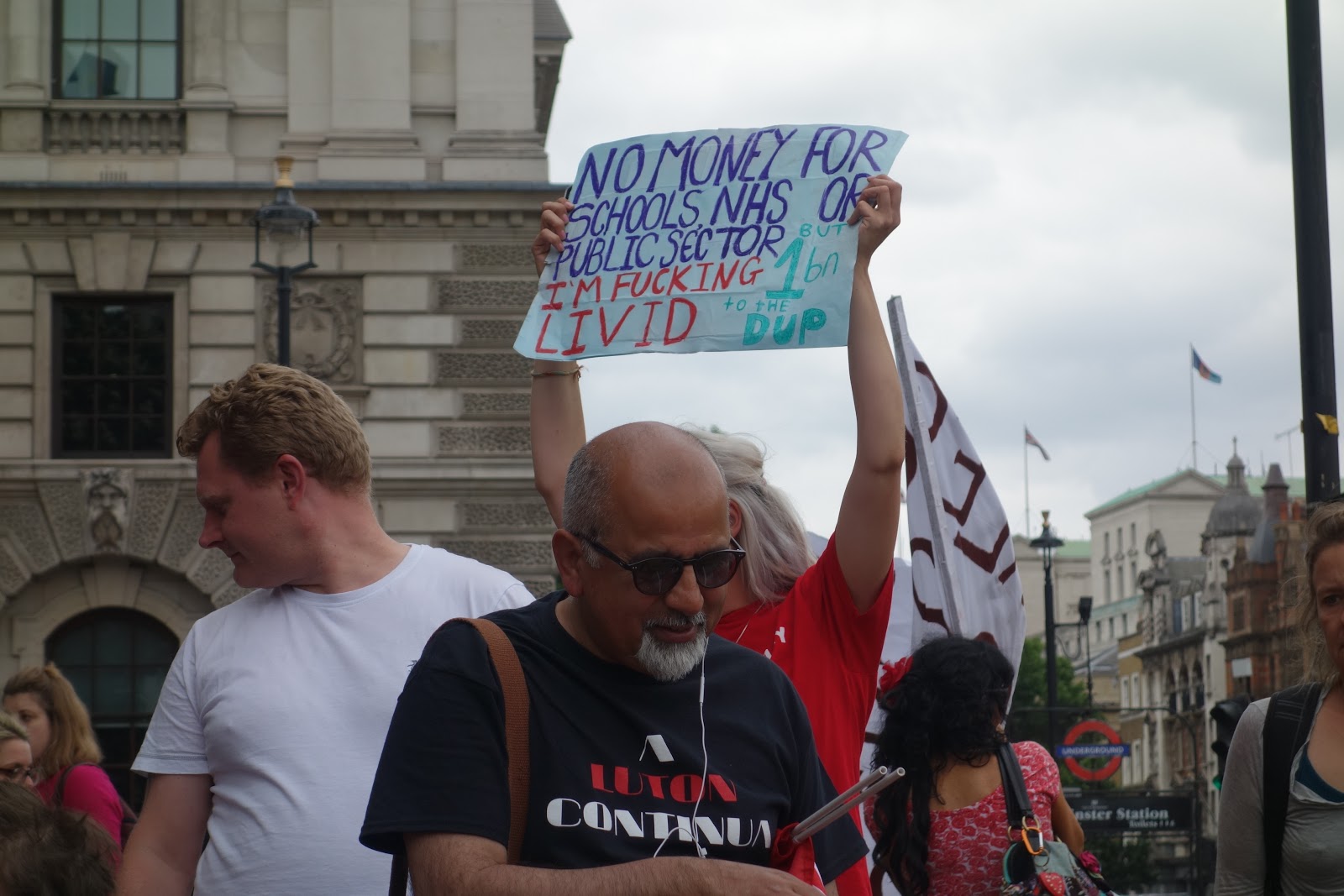
I attended the rally of the Not One Day More protest in central London today, and here are some photos and videos of some of the speeches made. The organisers, The People's Assembly said a hundred thousand people came to demonstrate.


The magic money tree


Captain Ska


Liar, Liar, the hit song of the recent general election campaign


Frances O'Grady, TUC General Secretary


Len McCluskey, Union UNITE General Secretary


John McDonnell, Labour MP and Shadow Chancellor


Sian Berry, Green Party London Assembly Member and Camden Borough Councillor


The man of the moment, Jeremy Corbyn, Leader of the Labour Party. 1/2.


An inspiring day in London, the times are a changing. Tories Out!

Tuesday, 27 June 2017

Seven Years in the Green Party - What Now?


Written by Dave Taylor 

Seven years ago the election of Caroline Lucas as a Green MP gave hope to thousands who had found themselves politically homeless in the face of a New Labour/Tory/Lib Dem consensus for globalisation, privatisation and austerity. Green Party membership grew rapidly, reaching a peak with the Green Surge before the 2015 General Election. This influx included many former Labour Party members and  the subsequent growth of the Green Party Trade Union group and the Green Left, which were influential in changing  party policy. A change which gave equal weight to social justice and environmental justice so that the party could fight the 2015 general election as an anti-austerity party – gaining a record one and a quarter million votes.

The Green Surge saw tens of thousands of people join the party as part of a mass anti-establishment mood which did not stop with the Green Party; within months an even bigger wave had swept Jeremy Corbyn into the leadership of the Labour party. This inspired many Green Party members to join or rejoin Labour in 2016 although most were sorry to leave. As one Brighton member said “Difficult but has to be done.” Another said “it`s a long shot but is what I have been looking forward to for nearly 30 years - a real socialist party with a couple of dozen MP`s and 100,000 members or more.”

That perspective - of a Labour split - seemed the best outcome we could hope for. After news of the snap General Election an article by Graham Bash appeared in Labour Briefing headed “Against the Odds”. Although he said Labour still had a chance the rest of the piece was a list of reasons – media attacks and ridicule; hostile and backstabbing PLP; decades of defeat since the miners strike; dissension within Momentum etc. – which seemed to virtually admit defeat. Six weeks before the election it was hard to disagree with him, which made the election outcome all the more remarkable.

The combination of a radical manifesto, a brilliant tactical campaign and Jeremy Corbyn`s positive and “steady under fire” leadership was able to capitalise on Theresa May`s arrogance and deprive the Tories of the majority they had taken for granted.  Corbyn and McDonnell may not be magicians but they did do two impossible things before breakfast – win back many Labour voters from UKIP (without pandering to xenophobia) and win seats from the SNP in Scotland. Corbyn is now being described as “battle hardened” which is fair enough  and “fireproof” which is just silly. The battle for the Labour Party has only been paused and will continue shortly.

 “Now is the time for all good men to come to the aid of the party
so ran the old typing training exercise (even though most of the trainees were women !) But the question now facing us is  – Which Party ?

The Green Party ?  No doubt the autumn conference will be largely a post mortem on the abysmal election result for the Greens. Many activists, the very people who attend conference, have left to join Labour which leaves those who favour “returning to our green roots” – ie ditching our social justice policies - in a stronger position. Caroline Lucas will probably win the day but what then ?
    
I wrote in a recent issue of Watermelon that “election success [for the Greens] has been steady but modest and at the present rate it is crystal clear that it will be climate crunch time before the party gains any real influence in government.” That day now seems further away than ever and a disturbing pattern can be detected over time. At succeeding  general elections various seats have been tipped as  possible Green wins – Greenwich, Cambridge, Norwich etc – yet ten years later Green candidates in all these seats lose their deposits.

Before the general election, a Green Party councillor commented that “we are right to keep our Green Party identity as the Labour Party has a long way to go and the Green Party needs to be there in case Corbyn is defeated”. Of course, the Green Party is not going to go away; indeed, as the effects of global warming become more evident the party is bound to attract new support. But action on climate damage is needed now – and that means action at government level.  

The Labour Party ?  It is a plain fact that any progressive government will be Labour led and it is now realistic to talk of such a government being elected on a radical agenda for change. A Green parliamentary candidate, (who joined the Greens fifteen years ago at uni and has never been in any other party) has said “Labour`s success is needed if we are going to implement policies to protect the environment because at the moment big business has the whip hand, and as long as it does, nothing is going to change”. He told press reporters  “[this is] a once in a generation – maybe once in a lifetime –chance. It`s time for everyone who wants change to rally around Jeremy Corbyn”

A Labour Party committed to a radical social transformation will face huge challenges from the media, the establishment and not least from the right wing old guard within the party. To stand a chance of success they will need the support of a massive broadly based social movement on the ground right across the country. A “former Tory minister” told the “Observer” last week “You can see real anger. Labour many not be able to form a government without an election, but they could get people out on the streets.” Sections of the ruling class must be thinking that it might not be a bad thing for a Corbyn led government to be plunged into the unholy mess of Brexit and crash and burn; they could then come back with a new set of Tory  mouthpieces.

This seems to me to be a critical moment.  At this point we need to back Corbyn.  Whether by working in the broader social movement on the ground or by actually joining Labour - that is a judgement call for each of us to make. Good luck.    

Dave Taylor is a member of Bridgwater and West Somerset Green Party and a Green Left supporter

Sunday, 8 January 2017

Basic Income: Progressive Dreams Meet Neoliberal Realities


Photo by Eli Christman

Written by John Clarke and first published at Socialist Project

Up until now, the concept of Basic Income (BI) has enjoyed a greater history of being proposed than of being implemented. We may well be approaching a period, however, when this changes. The Ontario Government is holding consultations on setting up a BI pilot project. The Legislature in another Canadian Province, Prince Edward Island, has agreed to test out a version of BI. Pilot projects are also impending in Finland, the Netherlands and Scotland.

Basic Income has been suggested in an exceptionally wide range of forms, often with completely different objectives in mind. In fact, we can draw a line between the models that are concerned with improving lives and raising living standards and those that are focused on intensifying the capacity for capitalist exploitation. Among those in the ‘progressive’ category there is considerable diversity.

There’s the ‘universal demogrant’ that provides an income to everyone and the concept of a ‘negative income tax’ involving some level of means test. BI proposals come from liberal quarters that are responsibly redistributive, reduce poverty and inequality and ease up on bureaucratic intrusion. The above mentioned proposal for an Ontario pilot project would be part of this camp. Then there are the models that have more radical, transformative objectives in mind. These suggest that BI could be used to take from employers the power of economic coercion itself by severing the link between work and income. Often such ideas are tied to the notion of preparing for sweeping technological displacement and a ‘workless future’ by providing secure, adequate and unconditional income. Given the vast extent to which forms of unpaid labour are performed by women in this society, it is hardly surprising that there are also feminist arguments for BI.

I have to say that the one really common thread that I see running through all of the notions of a progressive BI is that they pay great attention to explaining how nice their systems would be but give little if any thought to the concrete prospects of implementation. Before looking further at these deficiencies and proposing an alternative approach, it might be useful to consider more seriously the neoliberal version that is hanging like a sword over all our heads.

Neoliberal Version

The deeply reactionary ideas of Charles Murray have extended to some very sinister proposals for BI. There are two basic elements that shape his system. Firstly, the universal payment, after the compulsory purchase of private health insurance, is set at the dreadfully low amount of $10,000 a year. Secondly, he is utterly insistent that all other systems of provision must be dismantled as a BI is put in place. Canada’s right wing Fraser Institute, recently used its blog to stress the same points as Murray, making clear that the level of provision must not interfere with the supply of low waged workers.

If governments today, as they intensify the neoliberal agenda, are starting to consider the possibilities of BI, I see three factors at work. Firstly, there is the not unimportant issue of legitimacy. Particularly because they are being provided with a generous amount of ‘progressive’ cover, they are able to present their deliberations on BI as a responsible weighing of the common good. The Ontario Liberals stand out as international champions in this regard. Their BI pilot project consultations, have enabled them to put in place yet another round of fake dialogue, with the empty promise of a “better way” diverting attention as they push people even deeper into poverty. The World Bank and the IMF have been worrying out loud about the backlash against their austerity agenda and its devastating impacts. That IMF economists are themselves musing about BI, is perhaps significant in this regard. It advances their agenda but can be dressed up to look progressive. It may be the best thing for the institutions of global capitalism since the myth of ‘poverty reduction’.

The second element of BI that I think is of interest to the architects of neoliberalism is that it can fine tune economic coercion as they create an ever more elastic workforce based on the most precarious forms of employment. The income support systems that emerged out of the Poor Law tradition, stressed intense restrictions and moral policing. Along with horribly inadequate benefit levels, this has been very useful in driving people into low waged work to an unprecedented extent. It may, however, be time to rethink this to a degree. If people are moving between poverty wages and poverty level benefits more frequently in a precarious job market, perhaps they can be more effectively prodded into the worst jobs with less intrusive benefit systems. A less rule bound delivery of poverty income, that gives people a chance of retaining their housing, may be needed to keep them job ready.

Linked to this, of course, is the huge boost to the employers of a BI system that constitutes a form of wage top up. Provided the payment is meagre, it will not impede the flow of low paid workers but it will mean that their employers receive a subsidy that absolves them from having to pay living wages or come under pressure to increase the amount they do provide.

Thirdly, the great advantage of neoliberal BI is that the inadequate and dwindling payment it provides turns those who receive it into customers in the marketplace. In my opinion, BI would be far from the best way to strengthen the social infrastructure at any time but in the context of an intensifying agenda of austerity and privatization, it is a recipe for disaster. It’s really about the commodification of social provision. Your payment may actually be less conditional and somewhat larger but, as you shop through the privatized remains of the social infrastructure, with inadequate means and very few rights, you are dramatically worse off. That, in my view, is what is being prepared by those who will actually implement a system of BI and the hopes and wishes to the contrary of its progressive advocates don’t count for very much.

Progressive Dreams

I said previously that proposals for redistributive or transformative models of BI are generally marked by a tendency to focus on the desirability of what is being advanced while paying much less attention to actual prospects for implementation. I’ve yet to see, quite bluntly, any serious attempt to assess what stands in the way of a progressive BI and what can be done to bring it into existence. It simply isn’t enough to explain how just and fair a given model would be if it could be adopted. In order to credibly advance BI as the solution, there are some questions that must be settled.

Firstly, income support systems came into being because, while employers welcome an oversupply of labour and the desperation that comes with it as something that boosts their bargaining power, the total abandonment of the jobless creates social unrest. Some measure of income support, provided as a reluctant concession, has proved to be necessary. However, the systems of provision that have been put in place have always been as inadequate as possible so as to undermine employer strength as little as possible. A widely delivered or even universal adequate payment would greatly tilt that balance back the other way. What reason is there to think that this is likely to be implemented?

Secondly, over the last several decades, concessions made during the post war years have been taken back. Trade unions have been weakened, workers’ rights undermined and low waged work has increased considerably. The degrading of income support systems has been central to creating the climate of desperation needed to achieve this. Not only have benefits for the unemployed been attacked but other systems, especially for disabled people have been undermined so as to generate a scramble for the worst jobs. This has led to a shift in the balance of forces in society and we are fighting a largely defensive struggle. Given this very unfavourable situation, in which unions and movements are not in the ascendancy, how can it be supposed that those profiting from the present situation are likely to accept a measure of redistributive social reform that is at least as sweeping as anything put in place during the post war boom? What is the plan to make this happen?

Thirdly, as right wing governments and political parties directly linked to the most reactionary business interests consider BI and set up pilot projects that provide meagre payments and focus on how to ensure people on social benefits become low waged workers, what reason is there to imagine that a progressive BI, rather than the neoliberal variant, is being cooked up?

Regardless of these issues, it is sometimes asserted that an adequate system of provision must be put in place simply because we are moving toward a “workless future.” In such a society, it is suggested, masses of people who have been displaced will have to be provided for and the capitalists will have to think like Elon Musk, of Tesla Motors and support BI because it is the only sensible and rational solution. To imagine such responsible provision for the future is to place undue faith in a system based on the making of profit. If they won’t stop building pipelines in the face of environmental catastrophe, there’s little reason to expect them to worry too much about sensible solutions to technological displacement. There simply is no post-capitalist capitalism and no social policy innovation that is going to bring it about.

At a recent panel on Basic Income that I spoke at, the moderator posed a challenge. She accepted that BI might not be a way forward but asked, if that were so, what “bold vision” could be advanced in its place. It’s a fair question but a realistic appraisal of what we are up against is still obligatory, even if that has some sobering aspects to it. The great problem that we have is that the neoliberal years have done a lot of damage. The level of exploitation has been increased and working class movements have been weakened. While what we demand and aspire to is very important, the bigger question is what we can win. What’s disturbing about the left wing turn to BI is that is seems to think there is a social policy end run around the realities of neoliberalism and the need to resist it. There is no such thing.

British Labour Party and BI

With very good reason, there has been considerable excitement internationally around the Jeremy Corbyn leadership in the British Labour Party. His close ally, Shadow Chancellor, John McDonnell, has been paying some attention to adopting BI, as part of a platform that would express a break with the austerity consensus. McDonnell, from a position on the left of a major social democratic party, raises the possibility of a ‘best case scenario’ for progressive BI. For that very reason, the question is posed of whether the ‘bold vision’ I spoke of should be framed around the universal payment concept or devoted to other objectives.

In my opinion, if we are to consider goals we set and demands we put forward in the face of neoliberalism, that are based on the needs of workers and communities and create the conditions for challenging capitalism itself, we sell ourselves well short if we settle for something so limited and inherently conservative as the universal payment. BI, when all is said and done, is a vision for nothing more than the means to be a customer in an unjust society that decides what is for sale. How much bolder and more meaningful to fight for free, massively expanded and fully accessible systems of healthcare and public transportation? How much better to focus on the creation of social housing and try to expand it so that, not only the poorest, but most working class people enjoy its benefits?

There is universal child care and vast array of important community services to pay attention to. Moreover, we can work to wrest as much power as possible out of the hands of the mandarins of state bureaucracy and fight to increase the control working class people exercise over the public services they rely on. When it comes to existing systems of income support, we should not for a moment accept their poverty level benefits, bureaucratic intrusion and forms of moral policing steeped in racism and sexism. There is a fight to be taken forward for living income, full entitlement and programs that meet the real needs of unemployed, poor and disabled people, as opposed to the present ‘rituals of degradation’ they embody. At every point, let’s try to ensure that these expanded services are not paid for by other working class people but by forcing the corporations, banks and those who own them to pay by increasing their tax burden and imposing levies on their wealth.

The struggle to expand and improve public services would have to, of course, be linked to workers’ struggles for living wages, workplace rights and real compensation for injured workers. Beyond this, let’s challenge as much as we can the ‘business decisions’ that deplete resources, pollute and threaten us with ecological disaster.

I am suggesting that our movements need to challenge, rather than come to terms with, the neoliberal order and the capitalist system that has produced it. For all its claims to be a sweeping measure, the notion of progressive BI is a futile attempt to make peace with that system. In reality, even that compromise is not available. The model of BI that governments are working on in their social policy laboratories will not ‘end the tyranny of the labour market’ but render it more dreadful. The agenda of austerity and privatization requires a system of income support that renders people as powerless and desperate as possible in the face of exploitation and that won’t change if it is relabelled as ‘Basic Income’.

John Clarke is an organizer with the Ontario Coalition Against Poverty (OCAP).

Wednesday, 14 December 2016

What Really is Labour's Policy on Brexit?


Days after the referendum, in which Britain voted to leave the European Union (EU), the Labour Party leader, Jeremy Corbyn, called for Article 50 to be triggered as quickly as possible, to set in motion our formal negotiations to leave the organisation.

A couple of months later, Corbyn and John McDonnell, the party's Shadow Chancellor, having seemingly had a bit more time to think about it, stated that we should retain the free movement of people with the EU, but leave the single trading market. This vision had the rare distinction of being a policy position, that displeased both remain and leave voters in equal measures. The worst of both worlds, for everyone but the Labour leadership. Not only not a vote winner, but a massive vote loser.

Then a month ago, John McDonnell told a meeting in London, "Labour accepts the referendum result as the voice of the majority and we must embrace the enormous opportunities to reshape our country that Brexit has opened for us."

He went on to say "It is time we all were more positive about Brexit."

So we come to yesterday's speech by Keir Starmer, Labour's Shadow Brexit Secretary, at the London office of Bloomberg, of all places, which takes a very different view of what Labour's policy position should be.

This is from Labour List:

Laying out Labour’s vision for the future on Brexit, he said that there “are two versions of our future that could be negotiated. The first is a future that tears us apart from our EU partners. Out of the single market. Out of the customs union. Reverting to World Trade Organisation rules which would entail a range of harmful new barriers to trade and a desperate rush to sign new agreements with third party states to compensate.”

“A global race to the bottom which would not only put our economy and jobs at risk, but which would also abandon our shared scientific, educational and cultural endeavours with the EU. A so-called ‘hard’ Brexit.”

“The second version of our future is a version where we exit the EU but build a new and strong relationship with our EU partners based on the principles of co-operation, collaboration and mutual benefit. A future which preserves our ability to trade in goods and services with our biggest market. A future that values joint scientific, educational and cultural work with our EU partners.”

Sounds rather different from McDonnell's "we cannot hide from the fact that too much of the EU also had aspects of the old model, putting the interests of big business over ordinary people."

At least the Tory government are also sending out conflicting signals of their intentions on the kind of Brexit they want. But Labour should really be after the government on this, it is the single biggest political issue for the UK by miles. The government is split, Labour's obvious contradictory confusion is letting the Tories off the hook.

If the government mess this up, then the voters will need to have faith that Labour can do a better job of it, and I don't get the impression that people are too confident of what Labour really thinks about the issue.

I think the membership are nearer to Starmer than McDonnell on this, and certainly Labour MPs are. Not much support for the leadership's position at all as far as I can see it, in Labour.

Monday, 30 November 2015

Labour’s Phoney War is Over – Now the Battle Commences


Since Jeremy Corbyn became the leader of the Labour Party, let’s not forget, with a massive majority in the member’s ballot, there has been constant sniping from the Labour Right. Leaks to newspapers from shadow cabinet Ministers, ‘senior MPs’ and random Blairite ex spin doctors, have abounded. 

Mutterings about how fit Corbyn and his shadow chancellor John McDonnell are for office, poor opinion poll ratings for Labour and stories of splits over policy with shadow cabinet members all are meant to show a party in turmoil. It has all been part of a softening up process, readying the ground for a coup.

The current disagreement between Corbyn and his shadow cabinet has though taken this confrontation to a new level. Ironically, this, what now can only be called a civil war, has been triggered by a real war issue in Syria. As perhaps over a hundred Labour MPs contemplate voting with the government for extending airstrikes into Syria, this is the first full scale rebellion by the Labour Right since Corbyn’s election.

The strategy seems to be at this stage, to try and force Corbyn into resigning, ‘for the good of the party’. How can he be leader when more than half of the shadow cabinet are against him they ask? The damage that this split will do to the party, only goes to make a Tory win in 2020 inevitable, and look at all those working class folk who will suffer. If Labour polls badly in Thursday’s by-election in Oldham West, the pressure will increase even further.

The problem with all of this for the plotters is that Corbyn shows no sign of resigning and even if they can force another leadership election, all the indications are that Corbyn will win again amongst the membership. With Corbyn allowing a free vote for his MPs, and if they vote in large numbers against his position, he will look weakened, and that is a victory for the rebels. Then they will return to the drip, drip of damaging media leaks.

The Labour Left are probably not going to take this lying down though, and I was alerted to this by a blog by David Osland, a well-known figure on the Labour Left. Writing on the Left Futures blog, in a piece titled ‘Time for the Labour Left to debate reselection of MPs’, Osland says:

For the past three months, the very word ‘reselection’ has been unmentionable in Labour left circles, for fear that even talking about it would represent an unwarranted provocation of the Labour right. But as the events of the last 48 hours clearly underline, it’s time to break the taboo.

At the very least, Corbyn supporters now have to – how can I put this gently? – engage in measured debate on how we approach the next round of trigger ballots for sitting MPs.


A member of the Labour Party that I know tells me, that in his south London constituency, the new members are causing tension in the local party as the old guard resist their attempts to get the party behind Corbyn’s new old Labour platform. My friend describes himself as on the Labour Left and voted for Corbyn, but he doesn’t think Corbyn will be Labour leader at the next general election.

The problem for the Labour Left, is that it will take time to organise successfully, many years probably, and time doesn’t seem to be in Corbyn’s favour. The elections next May for the Scottish Parliament and the Welsh and London Assemblies will need to show an improvement in Labour’s electoral appeal, or things could get very bleak for Corbyn.

Labour’s warmongering foreign polices of recent years make this issue totemic for the changed party that Corbyn's leadership signals, many members and supporters left Labour over the Iraq war, me included, and to put behind them those years, Labour needs to oppose a further escalation of our military actions abroad. I think for the Labour Right, it is the best chance yet for them to topple Corbyn.

Labour has traditionally been rather sentimental over its leaders, and unlike the Tories, rarely force their leaders out. I think Corbyn is an exception, and it is just a matter of time before someone plunges the metaphorical dagger into his back (or front).  


Monday, 28 September 2015

Trident - Another Day, Another U Turn by Corbyn’s Labour


We have had the ditching of Jeremy Corbyn’s very sensible approach to the Prime Minister’s cynical negotiations on reform of our European Union membership, at the behest of shadow cabinet members. We have been told by the new shadow Chancellor, John McDonnell, that he is happy to accept George Osborne’s requirements for a balanced current account financial budget, despite all of the rhetoric from McDonnell about the Chancellor’s failed economic policies.

Now it seems, this year at least, Labour’s policy on the Trident nuclear weapons system will not be debated at the party’s autumn conference, leaving in tact Labour’s support for renewing this massive waste of money, white elephant relic from the cold war. It looks as though Labour MPs votes (together with the Tories) will see Trident renewed.

Where will it all end? I suspect in Labour fighting the next general election on a similar manifesto to what lost them this year’s general election. All of the bold claims of change and radical policies that emanated from the Corbyn campaign team during the Labour leadership election are, one by one, falling by the wayside.

The unspun Corbyn, is actually spinning this latest defeat for the policies he has just been elected on by the party’s membership and supporters, as a victory for his pluralistic approach to party management. Pluralism is one thing, but ditching all the policies you have just been elected on is called selling out.

In the 1987 general election, Labour, under Neil Kinnock’s leadership, campaigned to scrap the UK’s nuclear weapons capability. Labour lost the election, gaining only a little ground on the previous 1983 disastrous result. Labour promptly blamed their nuclear weapons stance for the defeat, and the policy was abandoned.

Skip forward some twenty years to 2007. I was talking to a trade union colleague of mine at the time, who had been selected as a Parliamentary Labour candidate for a winnable seat in south London. He probably would have won too, certainly he thought he would, but Gordon Brown’s infamous bottling of calling the general election thwarted my colleague. 

I suggested to my friend, that the world had changed since 1987, no cold war, no Berlin Wall, no Soviet block. I asked why Labour was so wedded to nuclear weapons? He said he agreed with me, but because of 1987, the Labour party just would not campaign against nuclear weapons ever again.

It is hard to see what the benefit of retaining Trident is, where our enemies are not even nation states predominantly. What use is Trident against ISIS? And when there is all round belt tightening on public expenditure, could the vast amounts spent on Trident not be better spent elsewhere?

Trident is not even a truly ‘independent deterrent’, since the nuclear missiles on these submarines cannot be targeted effectively without guidance systems from US satellites. It is only independent if the US agrees that we should use them.

I know the establishment in this country go into a spasm at even the mention of us ridding ourselves of these weapons, so it would not be an easy fight to get rid of them. So, might I suggest a compromise to Labour?

How about replacing Trident with a cheaper, probably land based or airborne nuclear strike capacity? It would be a damn sight cheaper, and it would be truly independent.

Personally, I’ve always been against the UK having any of these weapons, but we may have to proceed slowly in the direction of scrapping them altogether. Either that, or keep paying through the nose for a system we will never use, just so we can affect a macho pose in world politics.

Thursday, 30 July 2015

How will we challenge and resist the Trade Union Bill


Corbyn mania was well in evidence at yesterday's Rally on resisting the Trade Union Bill. Corbyn supporters were leafleting outside the NUT's Hamilton House and pressing JC stickers on anyone and anything in the vicinity.

The Corbyn factor was clear from the beginning when Dave Prentis announced Unison was backing him for Labour leader and ended the rally when John McDonnell pledged that Corbyn would mount real opposition in this Parliament to the Bill and when elected to  power in 2020 would repeal all anti-trade union legislation.

Clearly Corbyn's campaign is still to be won and if he does win the problem of what to do about a Parliamentary Labour Party that failed to make a comprehensive stand against the Welfare Bill will loom large.

If he does not win and an austerity-lite candidate becomes leader what happens to the relationship between Labour and the unions?

Another issue that emerged during the speeches was the extent to which unions would be prepared to break the law. There was a sober warning towards the close about what happened previously when unions found their funds sequestered by a hostile Tory government.

Would the Labour Party back breaking an unjust law?

The details of the Trade Union Bill are still to come and there are likely to be amendments from both sides. The Green Party opposed previous anti-union legislation and are almost certain to oppose these both from within parliament and outside when they meet at Conference in September.