Sunday, 9 August 2015

Saral Sarkar - A Modern-day Classical Greek Tragedy -- a Contribution Toward Understanding The Greek Crisis


Ideologies, Grand Delusions (Lebenslügen) and Misconceptions

Recently, during a popular German TV talk show, the moderator quoted an experienced Brussels correspondent (Mr. Krause) of the channel (ARD) who had said: "Actually, Greece is a Third World country that is living like an advanced industrial country." To this, the Greek participant in the talk show, Mr. Chondros, a member of the Central Committee of SYRIZA retorted angrily, and twice: 

"He is talking nonsense. Convey this opinion to him with my compliments." Later, he added that the Channel ARD was mostly spreading propaganda.

Despite all my sympathies for the Greeks, I must say that the root cause of the current Greek crisis lies here. Greece is certainly not a Third World country. But it has never been as prosperous as, e.g., Germany. From 2002 onward, when Greece joined the Euro Zone, it got much easier terms for borrowing at the international financial market. Whereas previously it had to pay roughly 25 percent effective interest on its state bonds denominated in Drachma, after joining the Euro-Zone it had to pay only 5 percent on its bonds denominated in the highly valued and strong Euro. The difference of 20% was a net gain for the Greeks. But at the same time, the state, perhaps also Greek banks, businesses, and ordinary citizens then became strongly tempted to borrow more than what could be economically justified.

And why shouldn't they have borrowed more? In standard economics borrowing is recommended for creating wealth and increasing income and prosperity. It is argued that an entrepreneur borrows money, invests it in some business, and makes profit. The state borrows, invests in infrastructure development or promotes industries, sometimes state-owned industries, and so the nation becomes prosperous. In both cases, the debt can be serviced or even fully repaid from the increased income.

In this connection it must be said that all those who participated in the media discussions, including Greek economists, failed to say even once that Greece's current problems are not entirely of its own making. The Great Recession that began in 2007–2008, and from which also several other countries are still suffering, exacerbated the plight of the Greek economy which had already been weakened by the debt burden.

Further below, I shall once more take up the economic causes of the present-day crisis in Greece. Here however it first needs to be remembered that the generation of politicians who had applied for and pushed Greece's entry in the Euro Zone had falsified the statistics on the basis of which the country was judged to have satisfied the criteria to become a member. That was the original sin, if you will, the consequences of which the young Greeks of today are bearing.

Ever since January 2015, when the left party SYRIZA came to power, some of its spokespersons and supporters in the other European countries have been repeatedly saying that despite all the troubles Greece is giving the Euro Zone, the place of the country that taught Europe democracy is in Europe and not outside. It has also been reported that in 2001 the EU bosses knew that the statistics were false, but they thought they could not deny Plato the right to play in the first division.

In 2001, Europe did not need to learn democracy from the present-day Greeks. The real reason why Greece wanted to be admitted to the Euro Zone were the economic advantages mentioned above. It is, moreover, dishonest to intentionally obfuscate the difference between the European Union and the Euro Zone. During the present crisis, nobody advised Greece to leave the EU. Only some courageous people, including some serious economists and the German finance minister Mr. Schäuble, said that it would be good for both the Greeks and the rest of the Euro Zone if Greece opted out of the Euro club for a few years. Exasperated at the continued obfuscation in the talk shows, a participant, namely Prof. Hans-Werner Sinn, cried out (in the general sense): but the Euro is only a currency; the Euro Zone is only a currency union and not an economic or political union based on values. A currency union cannot exist if all participants feel free to ignore the rules.

This obfuscation may only have been a tactic, with which the Greeks intended to get better terms for the new credits or even debt forgiveness. And their left and green supporters in Western and Northern Europe perhaps only wanted to show that they value solidarity and sympathize with the suffering Greeks, while the conservatives, like Merkel and Schäuble, were merciless and wanted to punish the Greeks for having elected a left party to power. But neither Tsipras and SYRIZA nor their supporters could suggest any other middle-term solution of the problem than the obsolete Keynesian one: further borrowing and spending and waiting for the time when the economy would again start growing. I shall below come back to these questions of economic policy.

After the referendum of 5th July, when 61.3 percent of the Greek voters said No to further austerity, leftists all over the world waxed eloquent about democracy. But neither before nor after the referendum did anybody know what Tsipras would do if the creditors remained stubborn and refused to give Greece what it wanted unless he agreed to their harsh conditions. Would he in that case lead Greece out of the Euro-Zone? This question, widely discussed outside Greece, was never discussed in Greece, at least not in public. The referendum was therefore no good example of democratic decision making.

In other words, neither SYRIZA nor the Greek government had a plan B, for the majority of the Greeks simultaneously said No to further austerity and (in opinion polls) No to exit from the Euro Zone (Grexit). This question was a hot potato that no Greek politician dared to touch. Most No-voters simply imagined that the other 18 leaders of the Euro Zone would bow to the wish of the majority in a small member country.  Yanis Varoufakis, the then finance minister said (in the general sense): If you have a debt of only 30 million, you are weak, but if it is 300 million, you are strong. This was at best naivety, if not a delusion.


After the overwhelming No vote to austerity, a few young Greeks said to TV journalists, they were very proud of Greece etc. But what exactly were they proud of? Some said they were proud because Greece demonstrated resistance in spite of the very bad situation. But can any people be proud at all, if they are so heavily indebted as the Greeks are, and can they call their No-vote resistance if through it they ask their Prime Minister to go with a begging bowl to the same hated rich creditors and beg for further debt forgiveness and easier repayment terms? They would have had reason to be proud if they had declared: we herewith end this debt-slavery, we exit from the Euro-Zone, and introduce our own new currency. But they didn't take this path.

It is not correct to speak sweepingly of "the Greeks" and for that matter, of any people, e.g. "the Vietnamese". Like any society, Greek society too is divided into classes and interest groups. And particular political proposals are generally supported or rejected on the basis of personal and class interest in the given situation. During the hours long big demonstrations on the days before the referendum, political observers could easily find out that it was mainly young people, workers, students, the unemployed, and people with a low income who would vote No. These were the people who thought they had no future, had nothing more to lose, or things could not become any worse for them. The prospective Yes-voters were mostly teachers, multilingual intellectuals connected with Western.Europe, entrepreneurs, elderly people, pensioners, middle and upper middle class people, people with safe jobs, all of whom wanted to protect what they had.

After winning the referendum, Tsipras went to Brussels in a fighting spirit. But on 13th July he returned with a worse deal than the one he was offered before and which he had asked his countrymen to reject in the referendum. He had to sign the worse deal, because he did not see any way out of the unsolvable dilemma he faced. In the words of Varoufakis, the Greeks “were given a choice between being executed and capitulating. And he (Tsipras) decided that capitulation was the ultimate strategy… ”. So the SYRIZA leader, who had been celebrated on 25th January after winning the election, and again on 5th July, returned to Athens on 13th July as a defeated and humiliated general. After returning home, he said totally contradictory things: he did not believe the deal he accepted would save Greece; it would certainly cause more pain and further recession. But he had to sign it and, what is worse, he must also try to implement it, for “this deal secures for Greece conditions of financial stability, gives it opportunities for recovery”; he promised that after a period of suffering, there would be light. A truly tragic figure, an anti-hero.

After this outcome, some of his radical critics called Tsipras a pseudo-leftist, accused him of betraying the people who had voted for him. This is rather unfair. To use another classical Greek imagery, he, as captain, had to steer his ship, the Greek nation, between Scylla and Charybdis.3 But unlike Odysseus, the hero of the epic Odyssee, who succeded in steering his ship out of the twin dangers with only moderate sacrifices,3 Tsipras has till now failed to achieve anything. Even the third debt relief packet, that the Euro-Zone bosses had dangled before him, may not materialize. Tsipras could not but fail. Why? I shall deal with this question further below.

The Pseudo European Idea and Its Pseudo Values

Before that, I must refer to another delusion. During the whole debate – both in Greece and the rest of the EU – there was a lot of talk about values and the European idea. Tsipras once said – that was, I think, a few days before his humiliating capitulation in Brussels –:"Europe is about democracy and solidarity". It was a mockery of the reality. For throughout the crisis period, many insults were hurled by both Greeks and Germans at each other (e.g. the Greeks want to steal money out of our pocket, lazy, corrupt Greeks. In Greece, many placards depicted Merkel and Schäuble as Nazis. The Greek government demanded reparation from the German state for the destructions and crimes of the German Nazis in the Second World War. etc. etc.)
 
And note the angry tone and language of some Greek ministers. Already before the capitulation, Varoufakis had likened the negotiation positions and style of the creditors to "terrorism". After the capitulation, energy minister Lafazanis said in a statement that the country’s creditors had “acted like cold-blooded blackmailers and economic assassins". Mr. Kammenos, the defence minister, angrily said: "They blackmailed the prime minister, … . This agreement is not close to our values."  He also characterized the deal as "a coup by Germany” and its allies. And in Germany, the opposition leaders, supporters of the SYRIZA government, accused Merkel and Schäuble of destroying the "great European idea".


But the "great European Idea" and its "values" – democracy, solidarity, human rights etc. are just ideology, instances of make-believe, a veil to cover up the reality. In real life, when something becomes a success, or becomes attractive for whatever reason, many opportunists want to belong to that entity, be it a political party, a nation, a football club, or an identity. They either expect to get some material benefit by joining that entity or they want to bask in the glory or good reputation thereof. Thus, in recent German history, I could personally observe how, in the 1980s, hundreds of unsuccessful leftists and members of established parties streamed into the Green Party as soon as the latter scored some electoral success. There, many of them made a political career, became MP or even minister. But there were also people who simply wanted to enjoy the satisfaction of belonging to the avant-garde of environmentalists without themselves being one. 

Or take for example the young woman from Azerbaijan, whom I met sometime in the early 1990s at a youth conference in Germany. In her speech, she grumbled that her Azerbaijani money could not be exchanged anywhere in Western Europe. "How can we build up a united Europe", she said, "if we do not even accept each other's currency?" I was surprised. During a recess, I asked her: "You think Azerbaijan belongs to Europe? I thought it is a Muslim majority country in central Asia!" She replied: "Europe extends from the Atlantic to the Ural and the Caspian Sea." I had a similar doubt when, in the mid 1980s, Gorbachev started talking about "Our Common House Europe". At an international conference of the Green Party of Germany, of which I was a rather conspicuously brown and non-German member, I asked a senior delegate from the Soviet Union, Mr. Kolontai, a Russian, whether he could imagine that also the Kazaks, the Uzbeks, the Turkmens etc. – in those days citizens of the Soviet Union – would also live in that "our common house Europe". Mr. Kolontai hesitated a little before answering: Yes.

So far as Gorbachev's motive behind the idea was concerned, it was certainly not opportunistic. But today we see how hollow this idea in reality is. Not even all citizens of all the member countries of the EU are treated equally everywhere in the EU, e.g. the Romas and Sintis. When e.g. unemployed Romanians and Bulgarians travel to Germany, German officials suspect them of trying to exploit their more generous social welfare system. To take another example, when recently the EU Commission tried to fairly distribute the burden of accommodating the tens of thousands of refugees among all EU member countries, some flatly refused to accept any. They insisted on the original agreement that the burden of accommodating refugees will have to be borne by those EU member countries where the refugees first arrive. Mr. Rentsi, the prime minister of Italy, that is bearing the heaviest burden of this kind, was so angry after the failure of the deliberations that he openly said in the direction of the refusing countries: "If this is your EU solidarity, then you can keep it." The second heaviest refugee burden is being borne, of all EU countries, by the most crisis-ridden Greece. 

Here too no solidarity. But, in spite of the no-bail-out clause in the Euro Zone treaty, member countries showed a lot of solidarity, at least in the beginning, with Greece, Portugal, Spain and Ireland when the issue was saving the Euro. After all, it was also their currency that was in danger, whereas the poor foreign refugees were only burdens. So much for solidarity and values. Crisis times are testing times. Against the background of and due to the economic crisis, this good image of the EU, which was false from the very beginning, is now rapidly unraveling. It is doubtful that in future the EU and the Euro Zone would remain as they are today. For some time now, ideas are circulating which want to see the EU divided into two groups: the Protestant-Calvinistic North EU and the Catholic South EU, EU of "two speeds", the economically strong countries and the economically weak ones.

To come back to the Greek crisis, Time and again, critics of the SYRIZA government pointed out that it is impossible for anybody to demand that poorer EU countries like e.g. Slovakia and Estonia – where the average wage, average pension and average social welfare benefits are lower than those in Greece – should also give surety for the huge credits already given to Greece and new credits that Greece was demanding. To this, the above-mentioned Mr. Chondros once replied: (in the general sense) the ideal of the EU is not to bring about equality among member countries by pushing down the standard of living of the different peoples to the level of Slovakia, Estonia etc., but by raising the standard of living of the poorer member countries to the level of Greece and then further to higher levels.

It seems to me that Mr. Chondros and all the leftists of the EU do not know what the EU in fact is and what it is not. It is not a union of socialist republics, it is only a union of unequal countries, where neo-liberal capitalism, free market economy, and competition prevail. In fact, the rules of the EU and the Euro Zone do not even allow bailing out a member country that is in danger of going bankrupt. The reason why the Euro Zone leaders tried to save Greece was not sympathy, solidarity etc., but the certainty that Grexit would entail loss of trust at the international financial market in the solidity of the Euro. In reality, they wanted to save the Euro, not Greece.


And secondly, they did not want to let Greece get out for geopolitical reasons. Most EU members are also NATO members. And Greece lies in a strategically important area, very close to the Balkan states, the Ukraine, Turkey and the Bosporus Straight through which Russian war ships pass on their way to and from the Mediterranean Sea. This argument was openly articulated by Mr. Röttgen, the foreign policy spokesperson of the German ruling party CDU. It is no secret that geopolitical considerations had been the force behind the creation of the EU and the currency union. (a) Without the EU, every European country would be too small – in comparison to the USA, USSR, and later China – to have sufficient weight in world politics; (b) and it is well known that the then French President Mitterrand pushed the idea of the common currency Euro, because the French were afraid of Germany again becoming the hegemonic power in Europe.

Wrong-headed economic policy

A capitulation is not per se reprehensible. And no capitulator is ipso facto a traitor. When the German generals capitulated on 8th May 1945, it was, in the given situation, the best thing to do to serve the German people. Justifying his capitulation, Tsipras said in his speech in the Parliament: he himself did not believe this deal would solve the problems of Greece. If anybody knew a better solution, he should come and tell him what he should do. But his question was a bit unclear: What should he do to solve which problem or to satisfactorily perform which task? Was it (a) to immediately prevent the impending disaster, i.e. avert state bankruptcy and Grexit, and somehow getting the banks reopened and functioning again? Or was it (b) to overcome the economic crisis in the middle and long term?

I do not know whether any Greek MP came forward that night to present a better solution. But, in fact, already before Tsipras signed the humiliating deal, some serious economists outside the political class of Greece had made two convincing proposals for addressing these tasks: (1) The govt. could have immediately introduced a New Drachma as a parallel currency. Euro would have remained in circulation for foreign trade. And the Greek government would have had the sovereign right to issue the New Drachma. This solution would not have had the immediate negative effects of a formal Grexit. In fact, there is a precedent for this policy, viz. Argentina in the crisis of 2001. (2) The govt. could have formally declared Greece's bankruptcy and the country's exit from the Euro-Zone, what many German economists, and Schäuble, advised them to do. The other members of the Euro Zone would have helped them in making a smooth transition to the New Drachma. And the creditors would have been compelled to agree to grant Greece substantial debt forgiveness.


In both cases the New Drachma would have been a weak currency suffering more or less rapid devaluation. It would have led to inflation by making imported goods dearer for those who would receive their income only in the new Drachma. But the weak New Drachma would also have had the advantage of attracting investors and buyers from outside and promoting exports and thus also export industries. In the short term, of course, there would be no advantage only more pain. Particularly the standard of living would continue to fall, while the advantages would have taken some time to come.

But Tsipras, also SYRIZA, had already rejected both options. Obviously, the majority of the Greeks thought they could not bear the pain any longer, did not want to make any experiment, and opted for the continuation of their debt-servitude – not a sign of a proud people. Only a few said, as far as I could gather, they would prefer to be independent again with a new national currency and were prepared to pay the price for that. What I found so bad in this story was that all the leftists collected in the SYRIZA – including ex-communist Tsipras – had not told the Greek public the truth about their situation. They had sold illusions just to win the general election. Even after winning the election, they did not at all prepare the voters for independence. So they had to capitulate. I have shown in a previous article in this blog4 that even the Vietnamese communists had to capitulate to the capitalists and imperialists soon after defeating the latter on the battlefield. And Tsipras and SYRIZA did not have even a fraction of the real power in Greece that the Vietnamese communists had in Vietnam after 1975.

Bankrupt economic theories

However, it may also be that they were misled by false economic theories. Till now, I have not come across any prominent standard economist from any school of thought who has not given the Greeks the (false) hope that the Greek economy can again grow and the Greek people again prosper. They all have projected for Greece the same perspective: export-led growth. They have only debated about the best path to growth. The economic advisers of the SYRIZA government must have been Neo-Keynesians (like Krugman, Stieglitz, Sachs, Flassbeck and Co.). They roughly said that it was only the austerity policies of Merkel, Schäuble and the sundry supply-side economists (Sinn, Fuest, Schuknecht, for instance), that were responsible for their misery as well as that of the whole Euro Zone, that not only Greece, but also the whole EU could return to the growth path, if they would (were allowed to) spend more on investments and/or stop cutting the incomes and social welfare benefits/services of/for the common people. None of them, however, answered the question how and from where Greece would get the funds for new investments if nobody was prepared to give them more new credits, even if the creditors would write off all its debts.

And the neo-liberal supply-siders, who nowadays dominate economic policy everywhere, also in Brussels and Berlin, went on repeating their Mantra, which are well known: Greece must implement radical reforms: i.e. cut costs of production by reducing wages and deregulating the labor market, i.e. reducing the rights of workers and their trades unions; Greece must reduce pensions and rights of pensioners, must privatize state enterprises etc. They also advised Greece to increase the tax rate – not for the personal income tax or the corporation tax, but only for the value added tax, that everybody has to indirectly pay and by which the poor are more affected than the rich. Only this way, they asserted, could Greece again become attractive for investors and competitive in the world market, and only this way could its economy come back to the growth path.

There are several common points between the views of the devaluationists (let us call them so), i.e. those who were advocating a Grexit, and those of the supply-siders. But the former also argued politically: If the SYRIZA government, for political reasons, cannot themselves impose more austerity on the people, then they should accept the demands for and proposals of their exit out of the Euro Zone. For in this case they can blame the Germans and the world market for the fall in the exchange rate of their new currency. They opined that for countries in a situation like that of today's Greece, devaluation is the only path left to achieve growth. I too would advise the Greeks to take this path, not because I think it would enable the Greek economy to come back to the growth path, but because it would enable the Greek people to free themselves from the shame of debt-servitude of the past five years and regain their independence and dignity.

Whatever path the Greeks may choose to take, their economy would not experience any growth in the near future. When Germany was experiencing a long stagnation at the beginning of the present century, supply-siders were saying that unit costs of German products were too high because wages and social welfare benefits in Germany were too high. Lafontaine, a former leader of the Social Democratic Party of Germany (SPD) replied to that view (in the general sense) that in the matter of wages, Germany cannot compete with China in the race to the bottom. So, Germans must concentrate their efforts on high-tech and sophisticated industrial products like machines, cars etc.

Greece too, with its average wage of about 15 Euro per hour cannot compete with other EU and non-EU countries in the same region, where the average wage ranges between 4 and 5 Euro per hour. And it cannot compete with, e.g., Germany, not even with France and the UK, in the matter of high-tech and sophisticated products or international finance. Low-tech goods are being produced in China etc. Ordinary products like shoes garments etc. have long ago been out-sourced into really Third World countries like Vietnam, Bangladesh, Cambodia etc. And even if a Greek government in the near future succeeds in making the economy competitive by implementing the recommendations of the supply-siders in Brussels and Berlin, where will it find the markets that are not already being supplied by its competitors? It can at most with great effort win a share of the world market in cheap products. That will, to be sure, create some low wage jobs for the Greeks and profit for foreign investors. But Greece will not become a prosperous country again.


There are three fundamental flaws in all the economic theories that were represented in the media discussions: (1) their age-old basic assumption that unlimited economic growth is possible, as if they have never heard of limits to growth –; (2) their ignoring the fact that at the present level of world GDP, any further economic growth can only come at the price of severe, partly irreversible, environmental destruction that might outweigh all benefit that might accrue from the growth; and (3) their basic assumption that capitalist free market economy and competition are together the best way to make the peoples of all countries more and more prosperous.

But since there indeed are limits to growth in the finite world, it is not possible that all peoples of the world can continuously prosper. I think in the middle of the previous decade (around 2007) a new era in the economic history of mankind has begun. It can be called the era of limits to growth and secular stagnation (sluggish growth, falling growth rates). In parts of the world one can even observe economic contraction. Some countries of the EU are examples of this thesis: Greece is only the clearest one. Signs of this change are not clearly discernible yet, because always, there are some economies that are growing and will grow for some time, and there are always some people who are prospering. But they are growing/prospering at the expense of others and at the price of continuous ecological destruction. It has now become a zero-sum game. This is quite evident, even among and within the rich countries. Just a few years ago, Ms. Lagard, then the French finance minister, held against Germany that its economy was growing at the expense of those of France and other EU countries. She said that Germany was purposely keeping the wages low compared to the productivity of its economy. And in countries like the USA, the income of a small stratum at the top (the 1%) is increasing rapidly while the middle class is shrinking.

Even some neo-Keynesians have realized this. One of them, Heiner Flassbeck, rejected the view that Greece can come out of the morass by improving its competitiveness through introducing and devaluing a new currency. He argued that this way Greece can for a short time become competitive, but only at the expense of the other nations that will not have devalued their currency; and these would subsequently also devalue their currency in order to recover their competitiveness. Competitive devaluation is a beggar-thy neighbor policy, which was largely responsible for deepening the Great Depression of the 1930s.
In sum, as Res Strehle wrote two decades ago,

“In the future, supply-side economic policies and demand-oriented Keynesianism will alternate in the major economic centers like fashion trends. They may even be synthesized, because, alone, both have only a limited ability to avert capitalist crises: supply-side economic policies increase the degree of exploitation and thus attract investors; demand-oriented Keynesianism prevents a drop in mass purchasing power, but scares off investors. Keynesianism will only then finally come out of fashion when the interest payments on growing public debts cannot be financed any longer.” 5

This exactly is the situation in Greece for the last few years.

Conclusion, and Prospects for the European Left

All that means, however much Greece may try and whichever economic policy it might pursue, there is little chance that its economy would recover up to the prosperity level of 2007. That means, there is no escape from austerity; austerity, more or less, is unavoidable. But it is not a bad thing, it is even necessary, in both economic and political interest of the Greek people as well as in the interest of the natural environment of Greece and the world. However, the pains and burdens thereof can be shared equally or unequally. Guarantying that these are shared equally or at least "fairly" is not possible without regulating the economy and a great degree of planning. That exactly is the task of a left government today. Pablo Iglesias, the leader of the new Spanish left party Podemos, of course expressed his disappointment at the deal that Tsipras had to accept on 13th July. But he also heaved a sigh of relief on noting that Merkel, Schäuble, and the Troika hawks failed in their objective, namely the overthrow of the [leftist] Greek government.

It is wonderful that in January 2015 the Greeks voted a left party into power. It was not just a protest vote, not just done in desperation. It seems a large section of the Greek people has realized that capitalism is the problem. That is why, in the years and months before this election, in many demonstrations, one could see placards and banners carrying anti-capitalist slogans. That was the case not only in Greece, but also in the other crisis-ridden countries of Europe. But in truth, capitalism is only one half of the problem. The other half is that there are limits to growth. It does not look as if the European Left (including SYRIZA and Podemos) has realized this. They are still talking of solving the problems of their people through economic growth.

But it is possible that they will come into contact with those who are propagating ideas like de-growth, post-growth economy, sustainable society, solidarity-based economy, eco-socialism etc. If that happens, and if they could be convinced of the correctness of these ideas, they may take steps toward realizing them. After all, they now have some political power. 

The first step could be to end the madness that Greeks import 60 percent of what they eat, e.g. Dutch tomato. They could emulate the Dutch and use bicycles rather than cars and buses for local transportation etc. etc.6 Both tomatoes and bicycles could be produced in Greece, thus also creating more employment in the country. These changes would require government action. That would certainly give rise to conflict with the EU watchdogs of a neo-liberal free market economy. That could be the beginning of Greece's latest independence struggle and transition to an eco-socialist society. If all these things happen, then the present crisis may after all have the effect of a catharsis7

The story may then have an happy end.


-----------OOO------------

Notes

1. In this story, King Laius, father of Oedipus, had committed the original sin of trying to sexually seduce a boy, son of another king, who was his friend. The oracle of Delphi prophesied that as punishment for this sin Laius would be killed by his own son who would then marry his widow (mother of his son). In the end, this also happened without any of the protagonists (other than Laius) having knowingly done anything wrong. What is more, through this incestuous relationship with his mother, Oedipus also fathered two children, who were also his siblings.

2. I have expressed this criticism in detail in my book The Crises of Capitalism (Berkeley, 2012, Counterpoint), and in the brochure Understanding the Present-day World Economic Crisis – An Eco-socialist Approach.
     
http://eco-socialist.blogspot.de/search?q=Understanding

3.  Scylla and Charybdis were mythical sea monsters noted by Homer; Greek mythology sited them on opposite sides of the Strait of Messina between Sicily and the Italian mainland. Scylla was rationalized as a rock shoal (described as a six-headed sea monster) on the Italian side of the strait and Charybdis was a whirlpool off the coast of Sicily. They were regarded as a sea hazard located close enough to each other that they posed an inescapable threat to passing sailors; avoiding Charybdis meant passing too close to Scylla and vice versa. According to Homer, Odysseus was forced to choose which monster to confront while passing through the strait; he opted to pass by Scylla and lose only a few sailors, rather than risk the loss of his entire ship in the whirlpool.

4. Victorious in War But Defeated in Peace -- How Development-Socialism Ended in Capitalism    http://www.eco-socialist.blogspot.de/2015/05/victorious-in-war-but-defeated-in-peace.html

5. Strehle, Res (1994) Wenn die Netze reißen: Marktwirtschaft auf freier Wildbahn. Zurich:Rotpunkt.

6. Cuba adopted a policy like this when, after the dissolution of the Soviet Union in 1991, they could no longer get cheap (because subsidized) oil from their former allies.

7. Catharsis (from the Greek κάθαρσις katharsis meaning "purification" or "cleansing") is the purification and purgation of emotions—especially pity and fear—through art or any extreme change in emotion that results in renewal and restoration. It is a metaphor originally used by Aristotle in the Poetics, comparing the effects of tragedy on the mind of spectator to the effect of a cathartic on the body. (from Wikipedia, English)

Friday, 7 August 2015

Tory Attacks on Trade Unions is Escalating a Class War


Ever since Edward Heath’s Tory government was brought down by the National Union of Miners (NUM) in the 1970s, the Tories have been determined to emasculate trade unions in the UK. 

Margaret Thatcher didn’t make the same mistake as Heath in the 1980s, devising a meticulously planned, and ultimately successful campaign to destroy the NUM as a force for working class advancement. All the powers of the state, including violence, were unleashed upon the union by the Thatcher government, which broke the 1984-5 strike and had a devastating affect on all workers’ confidence in the powers of trade unions to influence industrial relations.

Following Thatcher’s fall in 1990, the subsequent Major Tory government rammed home the message with employment legislation severely restricting union’s abilities to operate effectively. Laws on picketing and those requiring postal ballots before industrial action (including tough and expensive rules for record keeping which allow loop holes for employers to gain court injunctions against action) were introduced. New Labour only slightly liberated unions from these laws in 13 years in government.

Trade union membership has more than halved since the high point of the late 1970s in the UK, with the majority of members (around 6 million) employed in a shrinking public sector. The various privatisations and the increasing ‘flexibility’ of labour wrought by employment laws in this country make it difficult for unions to organise, compared to the life long, all working at the same factory model of those now distant days.

Where workers are employed on zero hours contracts, insecure temporary contracts or are involuntarily self employed, with scattered (often in their own homes) workplace locations, it is very difficult to organise and even convince people of the value of union membership.

Some of this changed landscape is down to technological change, internet, telephony etc which also leads to off shoring of some types of work. But mostly it is the legal and economic changes over forty years that have seen to the decline of union membership and effectiveness.

I would say that some of the unions have been slow to adapt to the new labour market and could have done more to recruit this disparate workforce, but this pales into insignificance compared to deliberate politically induced situation faced by them.   


The latest Tory attack is in the shape of the Trade Union Bill (2015), and will once again make even more difficult for unions to operate.


It will require that strikes are made unlawful unless 50% of those being asked to strike vote in the ballot and at least 40% of those asked to vote support the strike in most key public services. This double threshold would have to be met in any strike called in health, education, fire, transport, border security and energy sectors – including the Border Force and nuclear decommissioning.

Further changes to the existing laws will:

Propose that unlawful picketing should become a criminal as opposed to civil offence and new protections should be available for those workers unwilling to strike.

Compel unions to renew any strike mandate with a fresh ballot within four months of the first ballot and give employers the right to hire strike-breaking agency staff as well as require a union to give the employer at least a fortnight’s notice before the industrial action starts.

Empower the government to set a limit on the proportion of working time any public sector worker can spend on trade union duties.

Give the government certification officer powers to fine trade unions as much as £20,000 for breaches of reporting rules including an annual audit on its protests and pickets.

Require a clear description of the trade dispute and the planned industrial action on the ballot paper, so that all union members are clear what they are voting for. This is riddled with loop holes for employers to exploit and get strikes ruled illegal.

End the ‘check off’ system whereby employees can have their union subs deducted from their wages by their employer.

With wages falling for most workers since 2003 in the UK and strikes at an all time low, and union membership in steady decline, and with inequality rising sharply, this is an ideological move by the government, pure and simple.

Rather than address the skyrocketing pay of company bosses, industrial scale corporate tax-avoidance, unscrupulous managers, exploitative employment agencies and the crippling effect of the supermarket monopoly, the government instead turns its fire on trade unions and seeks to regulate them out of all existence.

There appears to be a determination from trade union leaders that this Bill is indeed a ‘die in the ditch’ matter and civil disobedience, direct as well as industrial action is being talked about as a way to fight this assault on working people and their representatives.

All on the left in Britain should support the unions attempting to fight off this blatant opening of a class war by this nasty and vindictive government of the wealthy.   


Wednesday, 5 August 2015

Which Political Parties Might Split Over the EU Referendum?


We have been promised an in/out referendum on the UK’s membership of the European Union within the next sixteen months. What is the potential for splits over the issue in the main UK political parties?

UKIP

The referendum was to some degree forced on David Cameron the Prime Minister by the increasing popularity of UKIP two or three years ago. Conservative Eurosceptic MPs and members panicked by UKIP electoral gains forced Cameron to concede a referendum after he negotiates some minor reforms to our membership.

So, this should be solid ground for UKIP, a clear unifying issue for the party. But it has not quite developed along those lines so far. The fiasco of UKIP leader Nigel Farage resigning then doing a U-turn within a couple days and infighting at the top of party was not a good start.

The issue for UKIP is whether Farage’s style will encourage or discourage voters to vote for our exit? The party is split on this aspect of the campaign and will no doubt rumble on in the coming months. 

However, it is such a central issue for UKIP that I find it hard to see them splitting before the referendum. Afterwards, though is another matter.

Potential split rating 2/10 (before the referendum)

Lib Dems  

Almost the mirror opposite of UKIP. I expect under new leader Tim Farron for the Lib Dems to return to the traditional slightly left of centre political ground, after the disastrous ‘Orange Booker’ experiment under Nick Clegg’s leadership. Traditionally, the most pro-EU party, I think the referendum will have a unifying affect on the Lib Dems as they start to try and re-build the party.

Potential split rating 0/10 

SNP

This is an interesting situation to watch. The SNP are firmly pro-EU because being in the EU is a mainstay of the party’s Scottish independence plan. Remember, the original idea was to adopt the Euro as currency after independence, but this had to be hastily and unconvincingly re-thought after problems in the Eurozone developed in recent years. It would, I suspect, look too risky to leave the EU and UK and if the UK as a whole votes for out of the EU, and Scots do not, there will certainly be a demand for another independence referendum. However, many of the SNP’s newer members are from the political left and I don’t think the Scottish left will be completely immune from the Eurosceptic feeling that has developed amongst the wider British left watching events in Greece.

Potential split rating 1/10

Plaid Cymru

I can’t claim to be any kind of expert on PC’s internal politics but it seems to me as though PC will want to remain in the EU for similar reasons to the SNP, that is national independence. They also do not appear to have had the same influx from the Welsh left as has happened with the SNP in Scotland.

Potential split rating 0/10

Conservative Party

A big potential for a split in the Tory party. The EU has been a divisive issue for the Tories for 30 years now. It was Edward Heath’s Tory government that took Britain into what was then the European Economic Community in 1973, but ever since the mid 1980s there has been a serious split amongst Tories over our EU membership. Eurosceptic Tories now probably out number Europhiles in the party and many sceptic MPs have been dreaming of the day they get the chance to quit the EU.

Of course the Prime Minister, David Cameron, is trying to square this circle by negotiating ‘reforms’ to our membership before the referendum, but few Tories think he will obtain anything significant from the negotiations and many will want out, including in his Cabinet. It would be a surprise if there isn’t considerable turbulence in the Tory party over this and even a split.

The only saving grace is that the Tories always seem to pull through these bouts Europhobia one way or another, but expect trouble.

Potential Split rating 7/10

Labour Party

The Labour party in the 1970s and early 1980s always had a significant minority against EU membership, Tony Benn chief amongst them. But since the late 1980s Labour has been supportive of ‘social Europe’ by and large. But as already mentioned, events in Greece have rekindled Eurosceptic feelings on the British left, and I think Labour now has some potential for a split over the issue. This will become even more likely if TTIP is endorsed by the EU, especially without an exemption for Britain’s NHS in particular.

At the moment the Eurosceptic wing of Labour is small and represented mainly by MP Kate Hoey, but as I say that could all change. Cameron’s ‘reforms’ to UK membership are also likely to increase scepticism in Labour.

Potential split rating 5/10  

Green Party

The Green party has maintained a mild Euroscepticism over the years, preferring to remain in the EU, but try to change the nature of the organisation to a more people friendly Europe, rather than for the multi-national corporations. Caroline Lucas, the Green party MP has already announced she will campaign to stay in a ‘different’ Europe, but I see no plan, credible or otherwise on how this is to be achieved.

But again, like Labour, and depending on Cameron’s reforms and the TTIP issue, many Greens could move towards an out of the EU position. I don’t really see this is a serious split issue though, given the party’s tolerance of members expressing differing views, but there is certainly more potential for a split than I would have imagined a year ago.

For my own part, a confirmed Europhile for as long as I can remember, I’m now an undecided on the issue and am thinking this over very carefully.

Potential split rating 4/10    

Tuesday, 4 August 2015

The Green Party Needs a Joined Up Political Philosophy – Ecosocialism


Green politics comes in many forms, from the far right Malthusian tendency, through deep ecology, ‘localism’ and green liberalism and green social democracy to ecoanarchism and full blown ecosocialism. There are many sub variants of these philosophies, but essentially this is the spectrum.

So, how to describe the political philosophy of the Green Party of England and Wales? Well, according to some at The Guardian newspaper it is ecosocialist, but this displays a woeful misunderstanding of ecosocialism, whether wilful or otherwise. The Green Party’s policies are similar to ‘old’ Labour social democratic ones without the over centralisation of power and with obviously, a concern for environmental matters. What is sometimes termed policies for ‘environmental and social justice’.

This can be viewed as a sensible approach, given that Labour has largely abandoned social democracy (not withstanding Jeremy Corbyn’s current campaign for the leadership of the party) long ago, and there is clearly a huge amount of electoral space to Labour’s left. But does this stack up as a credible platform for fulfilling the goal of a fair and sustainable society?

To some extent I suppose it does, on the social side it could improve the chronic inequality that has remorselessly advanced over the last 35 or so years in the UK. Although, it can be argued that social democracy failed in the end, allowing neo-liberalism the room to supersede it in the 1980s. Social democracy in essence is pro capitalist, but attempts to smooth off the rough edges of market driven outcomes. To save capitalism from itself, you could say. Social democrats would no doubt say something like ‘making the market the servant rather than the master of the people’. Which ever way you choose to view it, it is fundamentally wedded to the capitalist system, which inherently leads to inequality. 

But how about the ecological justice side of this description? ‘One million climate jobs’ is no bad thing, helping the unemployed find jobs whilst at the same time contributing to reducing our carbon emissions. In the end though, capitalism’s voracious appetite for ever increasing ‘growth’ is surely incompatible with ecological concerns. The term ‘sustainable growth’ just papers over the cracks in this argument, as never ending growth is impossible with finite resources. Sustainable growth is only possible for a limited amount of time, and should be viewed more as a transitional demand, not an end in itself.

Caroline Lucas, the Green Party’s only MP, says that the Green Party is socialist in an interview with Owen Jones here, although interestingly she does not use the prefix ‘eco’. Is this intentional? I don’t know, but I think what Caroline terms as socialism (as she alludes to in the interview) is really a form of social democracy.

Because the ‘force field’ of capitalism is so strong, and because first epoch socialism (USSR etc) is such a negative concept, the Green Party (which on occasion will describe itself as ‘anti-capitalist’) has taken the easy route by failing to embrace ecosocialism as the obvious political and philosophical vehicle to realise the party’s radical agenda. Don’t scare the horses type of thing, and it doesn’t help that the party is inhabited by so many lifestyle greens and eco-liberals.

I have even heard Green Party people say they prefer terms like ‘egalitarian’ to ‘socialist’, but I think we should call a spade, a spade, and anything else is vague or even dishonest.

All of this leads to a well intentioned shopping list of policies, renationalision of public services, Green Deal climate jobs, a living wage, cuts in carbon emissions and social housing building, but no overall joined up ideology to fall back on when times are tough and is unconvincing to the public at large. 

The fact of the matter is, if we really do want to stand for social and ecological justice, then the only way to achieve this is through ecosocialist policies and eventually there comes a point when capitalism will have to go. We should be open about this and explain what this means to people. It is a truly inconvenient truth.    


Sunday, 2 August 2015

How the Paris Communards made their lives luxurious


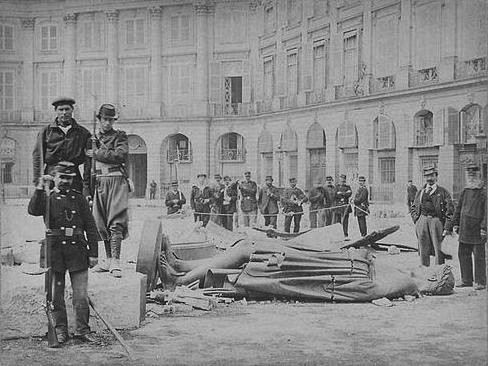
Demolition of the Colonne Vendôme by Paris Communards, 16 May 1871. The 44-metre-high column, which had a statue of Napoléon in Roman dress at the top, was rebuilt under the Third Republic. (Contemporary drawing, reproduced on UC Press site.)

Repost from People & Nature

In her new book Communal Luxury: The Political Imaginary of the Paris Commune, Kristin Ross argues that a rich legacy of ideas and practices developed during the Commune – the workers’ democracythat ruled Paris for two-and-a-half months in 1871 before being violently suppressed –needs to be recovered for the twenty-first century. Here she discusses the book with Gabriel Levy.

Gabriel Levy: You urge the readers of Communal Luxury to look at the Paris Commune not as a precursor to the Soviet Union, and not as a precursor to the Third Republic in France. If it was not those things, what was it?  

Kristin Ross: Extricating the Commune from those two stories is an enormous challenge, in part because those two histories were the principal ways we had of understanding the Commune. They were the histories that claimed it. In each of these narratives the Commune was made to play an essentially edifying role, as though the Communards were martyrs to state socialism or martyrs to the French Republic. If you stop seeing what the insurgents did in this way – if you stop seeing them as martyrs, sacrificing themselves to the future – then suddenly a
whole new vista becomes available and you can begin to see their self-emancipation at a daily level. You are radically in their present. If you dislodge the event from those two historiographies, you are back in the day-to-day of the Communards, and it becomes possible to see, perhaps for the first time, the kinds of political inventions and experimentations that they performed.

GL: When you spoke at the recent Planetary Natures conference at Binghamton University in the USA, you reacted very sharply to the suggestion that our relationship to the Commune is one in which we “learn from its defeat”. And you complained about the widespread habit of political back-seat driving practised on the Commune (all of it back-seat driving after the event, and therefore especially useless). Where does that false critique come from and how can it be countered?

KR: The false critique is associated particularly with these historiographies that I have mentioned. The Bolsheviks [who took power in Russia in 1917] needed a very strong myth of the Commune as the anticipation of their own revolution. They needed to have some sort of historical precedent to reassure their own people about their own transformations. So even what they considered to be the failure of the Commune – the aura of the martyrs – was supposed to, in their view,  generate its contrary. So right away you have the idea of errors serving as lessons, this notion of the pedagogical role that the past is supposed to play, as though there were some sort of progressive, linear temporality: that we, by coming after, are obliged to do it better, or we will do it better—despite the fact that our circumstances are not at all the same!

What this shows is the unshakeable desire we seem to have that the past teach us a lesson, or that we have to teach the past a lesson … it doesn’t matter which, it comes to the same thing! It shows the extent to which progressive thinking about emancipation still operates as though there were some sort of blueprint of ends to be attained; and as though those ends could be precisely determined and then we could measure objectively whether they have been achieved, or not achieved, according either to time-worn and timeless standards, or to criteria that we have drawn up on the fly in 2015.  It’s obviously very pleasurable to put yourself in the position of being the one who can establish what’s possible or what’s impossible, or decide when people acted too soon, when they acted too late, when they were being passé or outmoded or unrealistic.  But when you adopt that position you lose any sense of the experimental dimension of politics, or of art for that matter.

GL: Could I ask you about the chapter in the book devoted to the Communards’ efforts to remake education and to remake cultural production – or rather to break down the division between creative activity and alienated production (i.e. work)?  

KR: It’s significant that a large percentage of the Communards were art workers – they worked in the arts and crafts industries, they were artisans, they had an artisanal formation. There is a primacy of arts-and-crafts labour at the centre of the Commune; that model of a useful production is at the centre of their culture. And that is what [the English socialist writer and activist] William Morris would take up and develop at great length in his own thinking and in his attempt to transmit some of the political ideas of the Commune. This working culture was, incidentally, profoundly internationalist. These were people who, like many young people today, spent most of their time not working, but looking for work … and that meant moving not only from town to town but also from country to country. There were Spaniards, Italians, Poles and other nationalities who participated actively in the Commune.

In the book I use the example of the way they set about overcoming the division between high art and decorative, or industrial, art. Who counts as an artist? Who has the right to that status? Because painters and sculptors could sign their work, they were able to exert a certain amount of economic control over what they produced. This was not at all the case with songwriters, for example, or ceramicists. The Manifesto for an Artists’ Federation, read aloud at a mass meeting for “all artistic intelligences” at the university of the Sorbonne in April 1871 concludes: “We will work cooperatively toward our regeneration, the birth of communal luxury, future splendours and the Universal Republic.” (Communal Luxury, p. 58.) It was written by Eugene Pottier, a decorative artist, who also wrote the song The Internationale. Decorative artists and fine artists assembled together under the same name, the same status, and went about establishing a federation in which to work cooperatively to extend art education. I take my title, Communal Luxury, from their text and use it to refract a number of Communard ideas and practices. In this context it refers to those practices that overcome the division between those who have, and those who do not have, the luxury of playing with words or playing with images.

GL: I had the impression from the book that these issues were not a sideshow or a minority interest; this was central to the Commune’s activity.

KR: Yes, these transformations in the status of the artist were very much part of the means by which the Communards went about emancipating themselves. And this is what Karl Marx meant, by the way, when he said that the Commune’s greatest achievement was “its own working existence.” No great laws, no utopian blueprints—just the step-by-step dismantling of the bureaucratic hierarchies that govern life under capitalism in a centralized state.  When Marx looked at the Commune he saw for the first time in his life an unscripted example of non-capitalist existence – he saw what non-alienated or associative labour actually looked like.

GL: You also write in Communal Luxury about education. When the Communards confronted the issue of transforming the state, some of them tried to get to work right away by transforming school education – breaking down the division between the education of people who work with their brains and of those who work with their hands. In other books I have read about the Commune, these efforts don’t get paid much attention.

KR: Yes. The reason you don’t see much about that in many books about the Commune is because of the obsession of many historians with the street fighting or with the legislative quarrels that were taking place. But in fact there were people out in the neighbourhoods getting to work directly on what they saw as the central question, which was how to transform education in a city where one-third of children didn’t go to school at all, another third were in Catholic school … and of course there was a fierce anti-clericalism in the Commune, so religious schooling came under particular attack. The Communards actually invented the idea of mandatory free public education for all children. But it was different from the way public education looks now.

Paris Communards, photographed by Auguste Braquehais during their action in the spring of 1871

Paris Communards, photographed by Auguste Braquehais during their action in the spring of 1871 twist – that every child, regardless of gender and regardless of class, would have the same education, and that this education would include both what we would think of as theoretical education (science, maths, history, and so on) and a training in a trade or two trades. The idea was that everyone would have both types of formations—intellectual and manual.

GL: To open up the road to a world where there would not be that division of mental and manual labour that is characteristic of capitalism?

KR: Yes.

GL: You write about the Commune as a revolt in a city surrounded by the countryside, and more broadly as a project to remake human society that is surrounded by the natural environment. You draw attention to the very rich discussions of the issues of city-country and humanity-nature, that took place in the decades after the Commune, in large part inspired by it.

KR: Yes, I spend a lot of time in the book on the prolongation of Communard thought when the Communards who survived the massacre and who avoided imprisonment met up [in exile, in the 1880s and 1890s] with people like [the Russian anarchist and geographer] Petr Kropotkin, Morris and Marx, who were all enormously supportive of the Commune but who were all—just as importantly– transformed by its example. When these people met up with each other in London and Switzerland, the central theoretical problem that they were trying to think through was that city-country divide, which was, of course, an important factor in the demise of the Commune. [Many Communards saw the lack of a movement in rural France alongside the action in Paris as one of the factors that contributed to its eventual defeat.] How do you think the realisation of non-alienated labour in a major metropolitan centre like Paris together with the remnants of agrarian communist forms in the countryside? How do you think an urban insurrection like the one that occurred in Paris with those residual formations like the obshina in the Russian countryside?

William Morris posed the problem by considering the impossibility under capitalism of that kind of solidarity that existed among crafts workers engaged in useful production. In the case of Kropotkin and [the French geographer and anarchist] Elisée Reclus … these were geographers, people who had what was considered then a very scientific formation. Following a different path, they arrived at the same kind of uncompromising anti-capitalist and ecological (though they didn’t call it that)  analysis as Morris. They all believed that the principle factors in the degradation of nature were the centralized state and the capitalist system. And they believed that a systemic problem demanded a systemic solution.

GL: You refer to them as anti-Malthusians, and for example you describe Kropotkin’s critique of [the biologist] T.H. Huxley’s Malthusian reading of Darwin.

KR: Yes, they were fiercely anti-Malthusian. They believed, on the basis of empirical fact, that the earth contained riches enough for all and that all that was needed to enhance nature and humanity simultaneously was to dismantle commerce and private property.

GL: Could you say more about the 19th century socialists’ view of the city-country divide. You quote Morris, writing about pre-capitalist rural social forms: “a vision of non-alienated labour and pre-class society is placed to contemporary times – ‘the artificial poverty of covilisation’ – as a way of recruiting past hopes to serve present needs” (Communal Luxury, p. 75). Then there was the discussion between Marx, the Russian socialist writer Nikolai Chernyshevsky, and others, about what could be learned from the rural communes in Russia.

KR: One of the things I find so exciting about these thinkers is their ability to work with, and treasure, forms of uneven temporality. The Russian rural communes were not models for the future in some simplistic way. They were, for example, patriarchal, and oppressive in other ways. But what fascinated Kropotkin, Reclus and others was their sheer persistence: the fact that they had endured in the midst of modern industrialization, and as such constituted an alternative path at a moment that was already narrowing itself down to the single temporality of capitalism. These thinkers, influenced by the Commune, were able to see the value of the outmoded – what Walter Benjamin calls the “revolutionary potential of the outmoded” – and to use it as a resource. They could see these [rural, non-capitalist] forms [of social organisation] as anchored in the past and yet as possible prefigurations of another route.

GL: You refer to Marx’s contention that “what Thiers and company [i.e. the reactionary government that fought the Commune] fear most, even more than the emancipation of the urban proletariat, is the emancipation of the peasants” (Communal Luxury, p. 88). I think this is a thought that has been largely lost in the 20th century reworking of this history: that, for the other side too, this is not just about the industrial proletariat.

KR: I think that thought disappeared because of the way that Marx was read during the Second International and beyond, a reading that held sway for so long: a stagist Marx , a Marx who was focused on the centrality of the state, who gave primacy to the industrial worker. I think there is a new reading of Marx that has become available, beginning in the 1980s, perhaps, with books like Teodor Shanin’s Late Marx and the Russian Road. This is a Marx who, precisely because of the Paris Commune, becomes far more interested in the world outside of Europe, and far more interested in tribal and peasant societies, both ancient and contemporary—this is what preoccupied him during the last ten years of his life.

Marx makes the remark about Thiers and company fearing the emancipation of the peasants in the context of Algeria. One of the tangents that I was unable to follow in the book because of not knowing Arabic or Berber, is that, at precisely the same moment as the Commune, there was an enormous uprising in eastern Algeria, France’s foremost colony. Thiers and company were essentially fighting two battles at the same time – against the workers in the capital and against the revolt in Algeria. And the prisoners from both actions ended up in New Caledonia together.

GL: Could we talk about the group of people, that included former Communards, who you refer to in the book as “anarchist communists”. You are suggesting not that the polemic between Karl Marx and Mikhail Bakunin is not worth following, but that there were many others, this group among them, who also deserve our attention.

KR: There has been too much focus on the rivalry between Marx and Bakunin. People say that their dispute is what brought down the First International. Perhaps. But there was also the continental-wide counter-revolution that set in after the crushing of the Commune. If you broaden your focus a little beyond the tedious “political theory” discourse, you can see – especially in the people that I studied – a group of thinkers and militants who are slavishly beholden neither to Marx or to Bakunin, but who

The head of the toppled Vendome column. A contemporary photo by Bruno Braquehais

are busy performing a bricolage of anarchist and marxist ideas—a creative mixture that resonates very strongly with militant culture today. They were not locked into a battle about establishing the primacy of analyses based on economic exploitation over those based on political domination or vice versa. So they were able to move freely in both contexts and use both intellectual and political camps as a resource.

I sense that we’re in a similar period now, one that is not obsessed with political purity or theoretical purity of some kind.

GL: You are not trying to deliver “a message” to activists in 2015, but you do direct our attention to the way that a wide range of people in the movement at that time shared “a vision of social transformation predicated on a large federation of voluntary associations at the local level” (Communal Luxury, p. 111), notwithstanding their different approaches to theory or to history or to the analysis of capitalism.

KR: Right. And that included people who might have called themselves Marxists or called themselves anarchists: it didn’t matter. What the free commune meant to these thinkers, no matter what they called themselves, was the simultaneous dissolution of capital, state and nation. 28 July 2015.

Kristin Ross is a professor of comparative literature at New York University. Her other books include Fast Cars, Clean Bodies: Decolonization and the Reordering of French Culture and May ’68 and its Afterlives. The publisher’s information about Communal Luxury is here, and an extract here.

Saturday, 1 August 2015

Will a Corbyn Leadership Win Steal the Greens Thunder?


I’ve not commented until now on Jeremy Corbyn’s campaign to become the Labour party leader, preferring to leave it as a Labour party matter. But it is becoming clear, that if Corbyn wins, it will have a big impact on the Green party’s fortunes.

I wouldn’t have given him a prayer of winning a couple of months ago, but he seems to now have the momentum running his way, with several large unions (some not all that left wing), supporting him, and polls putting him ahead amongst the somewhat strange electorate that is allowed to vote. The bookmakers now say Corbyn is odds on favourite to triumph in the contest.

There has been a trend dating back as far as 2010 with Cleggmania, through events in Greece and Spain, the Scottish referendum, the Green surge and now Corbyn’s astonishingly popular campaign. Incidentally, all this passed Left Unity by as though they weren’t there, and they may possibly not be for much longer. It is an expression of dissatisfaction with the status quo of politics here and around the world. Bernie Sanders Presidential campaign in the US is another example.

He may not win of course, but it is now looking as though he will, although if he was smart he would oppose our EU membership when Cameron’s expected reforms actually make our terms worse and with TTIP looming. He seems to have passed up an opportunity to split the Tory party wide open, but we will see.

Should we celebrate a win for policies lifted straight out of the Green party manifesto of 2015? A proper living wage, relax anti-trade union laws, renationalise the railways, fighting austerity; are all policies we fought this year’s general election on, and if another party implements them, so what?

Well, it would likely kill off our growth in membership if Corbyn wins and take away our unique selling point of anti-austerity party in England and we may suffer a similar fate to Left Unity. It is bound to affect the Green party’s popularity, not in a good way, at least at first.

Corbyn may win, but then be deposed by his MPs, hardly any of who support him. I would not bet against David Miliband making a return to the House of Commons during this parliament if opinion polls continue to show Labour trailing the Tories after a year or two. In which case we will be back in business, big time, as some of the unions may want to jump ship at that point.

Interviewed in today’s Guardian Andy Burnham, one of Corbyn’s rivals for the leadership warns of a 1980s SDP type split in Labour party. He is careful not to blame Corbyn, but the message is clear, his win could lead to the exodus of many MPs on the right of the party. Personally, I think this is best option for Greens and the Labour left as we could come together as a genuine electoral force on the left of British politics.

To hold Labour together though, Corbyn, if he wins, will need to back track on some if not all of his left policies and he has already made an appeal for ‘unity’. He may become a sort of English Tsipras as he disappoints all of those he has inspired, which would be a boost for the Greens if we play our cards correctly.

I my view, Labour will never again be a proper party of the left, whatever the membership thinks, and one way or another, Corbyn will be neutered by still powerful forces in the party. 

So to all of those Greens and others cheering Corbyn on, I say expect to be disappointed. And to those fearing a Corbyn win for the detrimental effect it may have on the Green party, just hold on. Let us see exactly how all this pans out.