Showing posts with label capitalism. higher education. Show all posts

Friday, 9 September 2016

Return of Grammar Schools Will Further Entrench Inequality in England


The Prime Minister, Theresa May, announced today that the government will remove the ban on schools selecting pupils on ability, as defined by some new 11 plus examination, marking a return to the Grammar/Secondary Modern set up that existed in parts Britain until the 1970s.

This move is being spun by May as a way to improve social mobility, and so reduce inequality in society. May seems to believe that the increased social mobility of the 1960s and 70s was driven by having selective education policies in schools, but many things were different in the 1960s and 70s, from the situation we have today.

The BBC quotes Ofsted's chief inspector of schools, Sir Michael Wilshaw saying, the idea that poor children would benefit from a return of grammar schools was "tosh" and "nonsense". Kevin Courtney, leader of the National Union of Teachers, said opening new grammars was a "regressive move and a distraction from the real problems" of funding pressures and teacher shortages, in another quote from the teaching profession.

Grammar Schools have always had their champions within reactionary political circles, and are often greeted with the nostalgia reserved for things like compulsory military national service (which ended in the late 1950s in the UK). Their proponents allege it not only improves the life chances of the brightest pupils, but also instilled some form of discipline and order (and is often bound up with beating pupils, which was banned in British schools in 1986). Although, Harold Wilson, Labour Prime Minister in the 1960s and 70s, a Grammar Schoolboy himself, famously said that Grammar Schools would be abolished, ‘over his dead body.’    

I went to a Grammar School (single sex) myself in Manchester in the early 1970s, and you could say that it helped me to become upwardly socially mobile, since I now live in north London and am reasonably comfortably off. But it wasn’t really the Grammar School that helped me, it was day release further education from my job, and subsequently going to university, or polytechnic as some higher education establishments were known as, at the time. Also, I went to an excellent primary school.

I hated Grammar School. At that time, Catholic secondary schools in Manchester were split into Grammar and Secondary Modern, depending on whether you passed the 11 plus examination. State schools were all comprehensives in Manchester at the time. I should have gone to a comprehensive school, but bound up with the religious stuff I ended up at Grammar School. I am sure I would have done better at comprehensive school, but stuck it out at the Catholic Grammar, until I was 16, and then left to get a job, relieved I could put it all behind me.

I didn’t like the pseudo public school ethos of the Grammar, and I had long stopped believing in Catholicism and indeed religion generally, so it was completely unsuitable for me. But in some ways, I was lucky. The people I knew who went to Secondary Modern, told stories of how rubbish their schools were, and they didn’t achieve much in the way of examination success. It sounded as though they had just been parked there, to keep them out of trouble, until they could leave at 16 and get a job. It must have been a considerable knock to their confidence too, to be labelled a failure at age 11.

On rare occasions, and I can only remember one example from my days at school, someone would be allowed into the Grammar at 13 or 14 years of age, after retaking the 11 plus, when they had demonstrated academic ability in the their Secondary Modern school. Most were cast into the trash can, destined for manual labour types of jobs, of which there were a lot at the time. May wants to allow access to the new Grammar Schools at 11, 14 and 16, so it looks like a repeat of the old system, but I’ll wager it will be rare for people to move between the different levels of schooling.

May also claims that it will give pupils from poorer backgrounds a better chance of attending a ‘good’ school, as at present it often comes down to whether parents can afford to live within catchment areas, which for good schools are expensive to buy or rent properties in.

I can’t see Grammar Schools making much difference to poorer pupils, as surely those with wealthier parents will purchase extra private tuition for their children, to ensure they pass the 11 plus, so this is just a smokescreen to make it seem fairer, but will just reinforce inequality.

If May really wanted to improve social mobility through education policy, then she should start by putting more money and resources into all schools, reintroduce Education Maintenance Grants and the Adult Learning Grant for further education, abolish private schools and abolish university tuition fees and reinstate maintenance grants for students.

None of this will be done of course, and instead we will have ridiculous claims that Grammar Schools will make us a more equal society. To echo Ofsted's chief inspector of schools, this is tosh and nonsense. It is a return the policies that failed so many young people in the past.

I leave you with a song by The Smiths, about Manchester schools in my era. ‘The Headmaster Ritual’ gives you a good idea of what it was like.


Monday, 8 June 2015

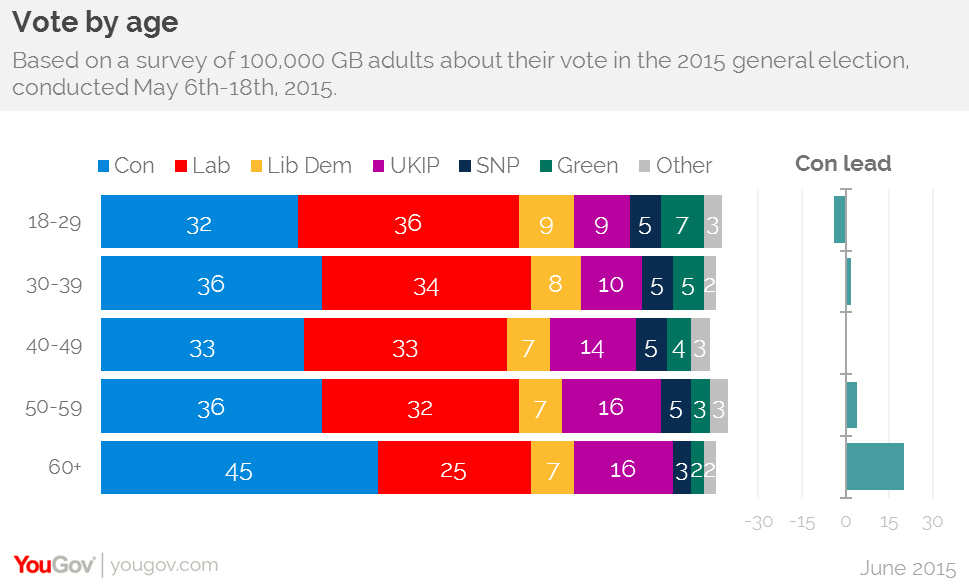
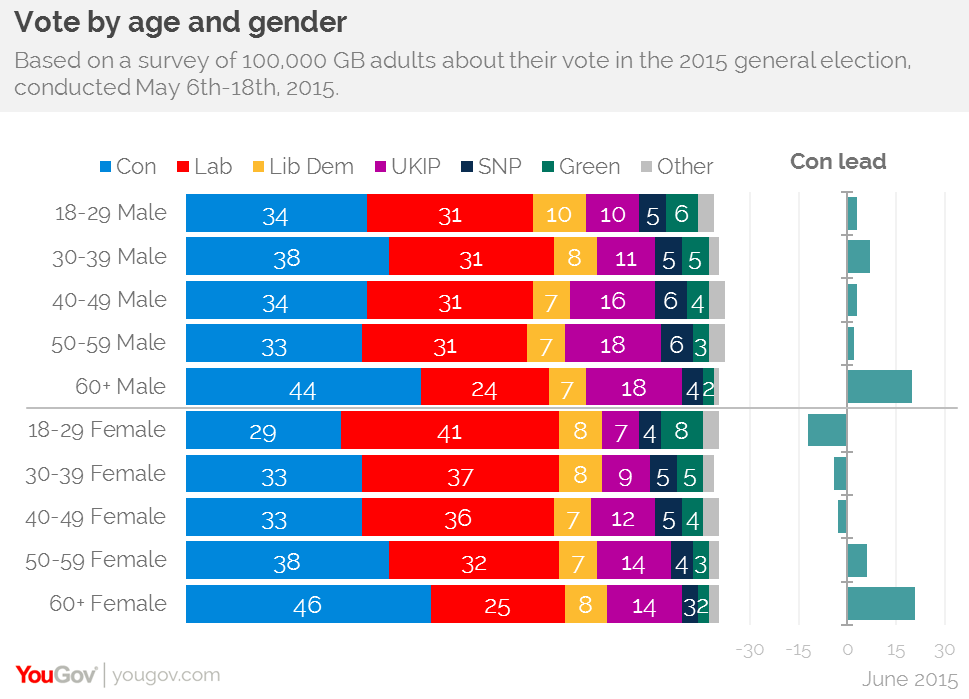
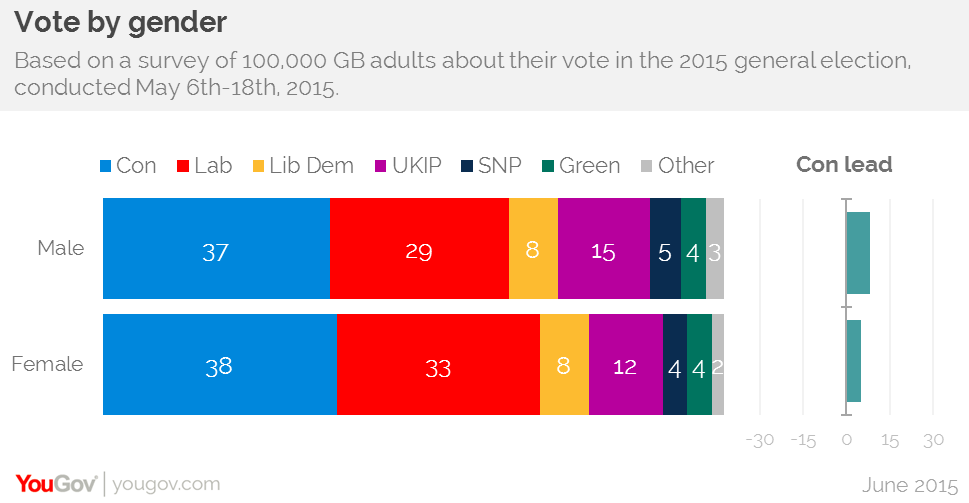
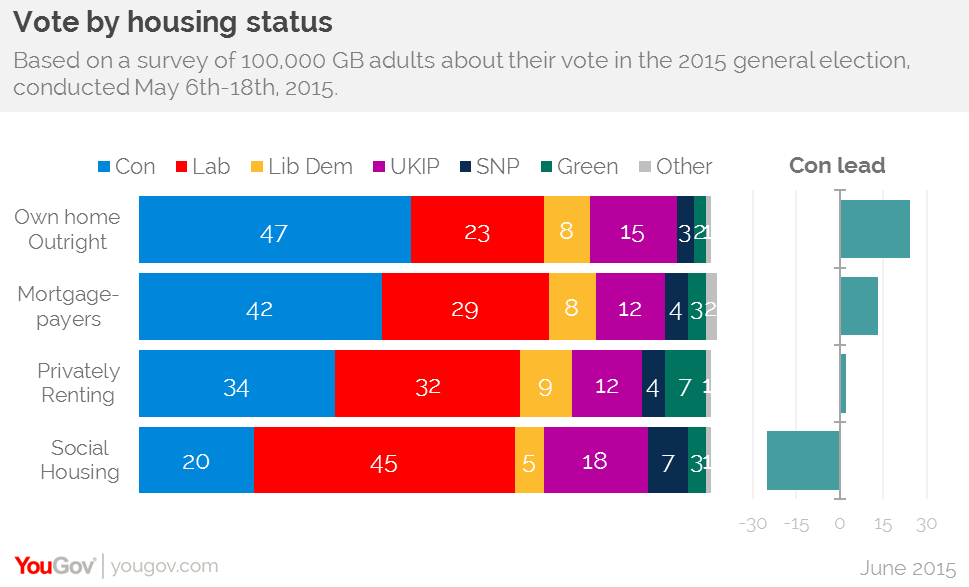
Who Voted Green at the General Election?

The opinion pollsters got their General Election forecasts hopelessly wrong. So, one of them, YouGov has changed tack and asked after the event who they voted for, which is a safer bet! Seriously though, this study is a massive survey of 100,000 voters, and should have a large degree of accuracy.

We'll look here at Green voters, but the graphics here give the full results of which party got votes from which demographic groups.

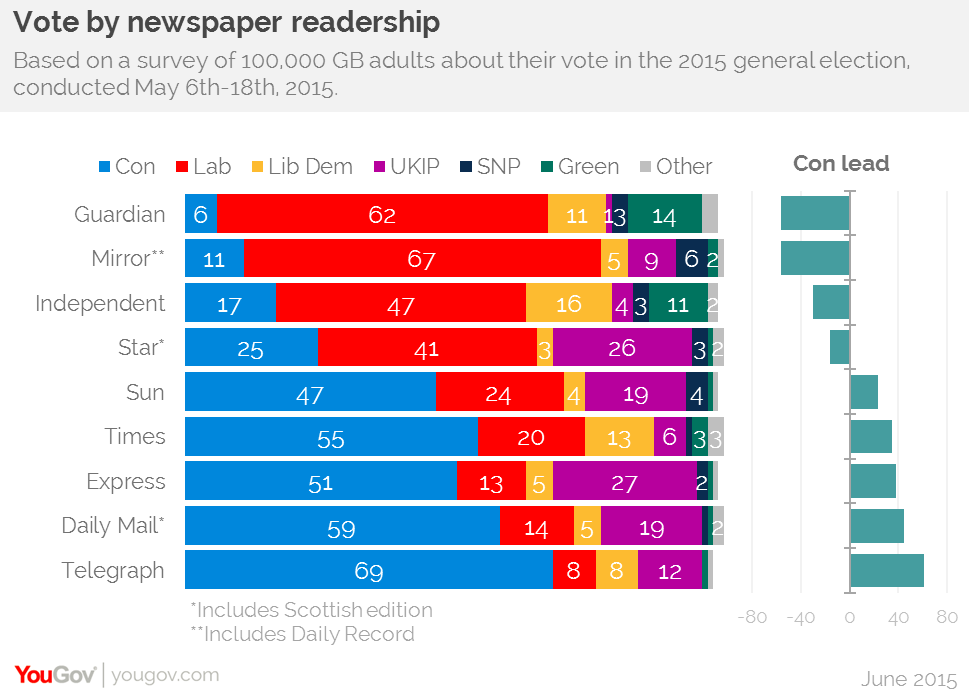
Not unsurprisingly, Green voters tended be young, educated and readers of the Guardian and Independent newspapers.

 
The largest group of Green voters are women aged 18 to 29 at 8%. This group was the largest section of the population that voted Labour too.

Across all age groups Green voters were evenly split on gender basis, which is a slight surprise to me as I have thought that our vote was more female than male.

Given that Greens tend to be younger voters, unsurprising they tend to live in privately rented accommodation, with little hope (in London at least) of buying their own home.
 
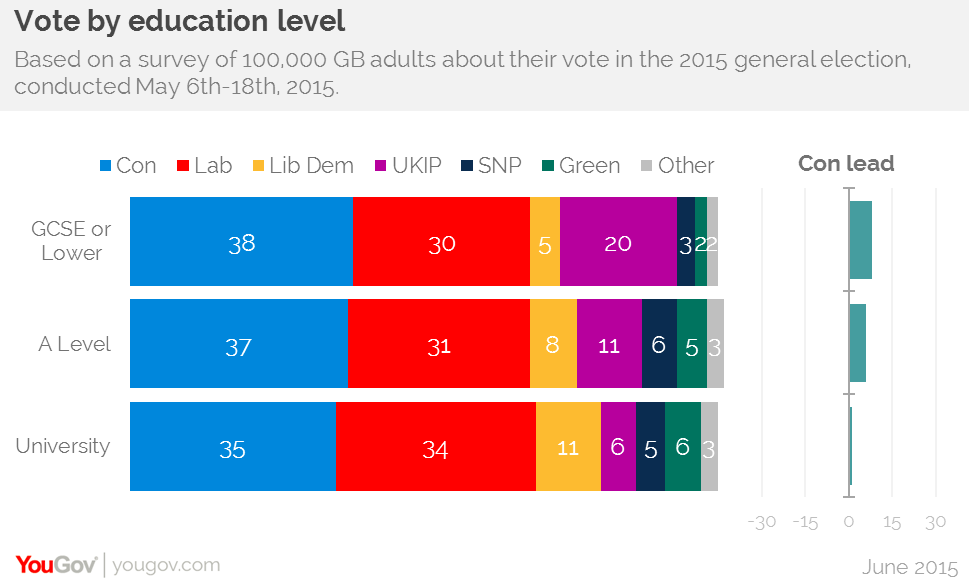
No surprises here, Green voters are more educated than those, for example, who are attracted to Ukip.
The Greens and Ukip appealed to opposite groups. Ukip’s strongest support came from readers of the Express (27%) and Star (26%) and from people with no qualification beyond GCSE (20%). Green support for these groups was 1-2%. The Greens’ strongest groups were Guardian readers (14%), Independent readers (11%). Ukip support among these groups was 1%, 4% and 6% respectively.

All of this is a concern for the Greens, for although attracting younger voters, bodes well for the future (if they continue to vote Green as they get older), it also demonstrates that we need to break out of our middle class heartlands and gain support from older working class voters. We do have the policies, Living Wage, Building council housing etc. But I feel this will only come once we start fielding more working class candidates.

First published at YouGov

Sunday, 19 April 2015

How capitalism is destroying education


Capitalism has ripped the heart out of education’s fundamental principles.’ Bradley Allsop discusses how the focus on employment above learning,  the rise of ‘lad culture’ in universities, and stifling of creativity through curricula devoid of passion are all interlinked with the growing influence of market ideology into education.

First published on  Bright Green LINK


Students not consumers!’ Students at a Free Education Demonstration in Birmingham in March. Photo: William Pinkney-Baird
Remember the story of the woman who swallowed a fly? This unfortunate lady ended up with quite the menagerie within her stomach because of her ever-escalating ‘solutions’ to her dietary dilemma. On both sides of the Atlantic the higher education sector has ingested a whole lot more than a simple fruit fly, and it’s efforts to rectify things look set to swallow up my generation’s wealth, time, and ultimately their future. Bizarrely this old wive’s tale is becoming a new generation’s nightmare.

As a sector, there is now tens of millions of pounds spent on ‘marketing’ in UK higher education, a figure that rose by 22% in 2013 despite a 7% drop in applications due to fee rises. Marketing professor Chris Hackley claimed that such expenditure for large swathes of mid-level universities was likely to be ineffective, as for many students locality, variety of courses and grade requirements are the determining factor- something advertising can do little about. It is pointed out in the article that this is expenditure likely to only increase due to the ‘circular logic of the market’- if one university does it their competitors feel compelled to as well.

The documentary ‘Ivory Tower’ explores how this circular logic has reached truly epic proportions in the US, with plasma TV’s, swimming pools and saunas being offered at many universities, with a constant search for bigger and better that serves only to push costs up. In many ways this is divorced from student interests and the founding principles of higher education, yet it is the student that will end up picking up the bill.

I experienced this for myself when I recently attended a UCAS fair in London. Each university was squeezed into little boxes (with those with larger budgets being able to pay for extra space and fancier gizmos) piled high with prospectus’, usually standing in front of a TV screen with a student saying something vaguely inspiring on loop. The hall was one big procession of ‘one-up-manship’, universities competing against each other, no friendly academic spirit, just unabashed hostile competition. The little ‘careers’ section of the hall was populated by the likes of KPMG and Deloitte, ensuring that only the very best and least moral capitalist enablers were on show for young and impressionable students and this is the point. University is no longer about learning, it’s about employment.

As Noam Chomsky once said: “If you burden students with large amounts of debt, they are unlikely to think about changing the world”. Most of the students I know quite readily admit that they came to university to ‘get a better job’, that they’re doing their degree because ‘it’ll pay well’, and that they’re going to their lectures because ‘they have to’. Very few people actually enjoy education anymore, and even less are thinking about how to change the world.

Not only is the loss of academic passion beset by the employability agenda of successive neoliberal governments, it also suffers from a psychological onslaught best captured by the phrase ‘lad culture’. Increasingly universities seem to be little more than chauvinistic playgrounds rather than critical paradises. This is partly due to the profound ways in which paying for your own education distorts the relationship between lecturer and student: no longer is the student humbly learning and being challenged by their tutor, they are a customer, and the customer is always right. On some unconscious level the enormous debt we are saddled with seems to give us our entitlement to a good grade in the place of hard work and academic rigour.

David Hartley foresaw this back in 1995 in his piece: ‘The McDonaldisation of Higher Education’, arguing that increasingly education would have a focus on “efficiency,” “calculability,” “predictability,” and “control”, and that in all probability teaching in classrooms would become a thing of the past. Why bother with lighting and heating a room and paying an hour’s wages to a lecturer when you can just put the slides up online for the student to peruse from the comfort of their own home? In many institutions now the priority is not on quality but quantity, with many online courses having dreadful pass rates but lovely profit margins.

The problems are not just limited to higher education either, far from it. One anonymous blogger describes the painful experiences of their adopted children who have come through abuse and neglect to be met with an inflexible curriculum. They talk passionately about an educational system devoid of that very thing: passion. Where arbitrary lines are drawn between successes and failures, where a ‘one size fits all’ and ‘teach to the test’ approach stifles creativity and erodes self-esteem, and constant assessment of students and staff alike breeds stress and anxiety. This is no system that can help their vulnerable children, instead it only adds to their problems.

The Green Party’s Martin Francis also highlights the disastrous attempts by Michael Gove to introduce elements of competition and market ideology into the schooling system. Not content with putting intolerable amounts of pressure on staff and enforcing rigid and restrictive criteria for success, Ofsted have been used as a tool for ushering in more academies under Gove’s reforms. As Francis puts it, Gove’s reforms have fragmented the sector, pitting school against school (much like the UCAS fair I attended) creating a ‘corporate’ rather than a public service identity for education. This fundamentally undermines the cooperative nature of education.

Whether it be ever-escalating marketing wars, a customer mentality, or obsession with efficiency and employability, all have their roots in capitalist ideology, an ideology aggressively expanding into the education sector. The inevitable logic of ‘austerity’ as well, leading to cuts to students support and higher education funding and the tripling of tuition fees is the only real answer capitalism has to the deficit, an answer clearly not in the interests of students or anyone else without a Swiss bank account.
Capitalism has not killed education in the obvious senses that its proponents attempt to highlight—more and more attend university each year. What it is slowly doing is a much more subtle and lamentable death—it has ripped the heart out of its fundamental principles. It is confining the imaginations and the aspirations of a generation. It is offering a bleak and debt-ridden future to millions.