Saturday, 21 March 2015

Ukip - 7 fraudsters, one forger, one kidnapper


This week Ukip MEP Janice Atkinson is in the news for alleged fraud, trying to get a restaurant to issue a false invoice so that she could claim more in expenses.

Last year I did a post on UKIP's record in office, their sums, and other mishaps. I confess that that old post has not kept up. I found it a bit difficult to keep up, tbh, because their errors and misdemeanors come thick and fast. They are the party that just keeps on giving. 

However, Janet has made me update the headliners, the real biggies.

So here they are : 4 Fraudsters, 1 forger, 1 kidnapper, 1 MEP uncomfortably cosy with police

UKIP was embarrassed by the jailing of two of its former MEPs.

In 2007, Ashley Mote, who represented South-east England, was jailed on 21 counts of benefit fraud, totalling £65,000.

In 2009, Tom Wise, former MEP for East of England, was jailed for two years after falsely claiming thousands in expenses.

2011 Derek Clark, Ukip MEP was investigated by OLAF, the EU anti-fraud office, and forced to repay £31,800 for money he had claimed for UKIP work.

2014, Peter Lagoda UKIP Councillor in Peterborough, defrauded the benefits system of £25,000 over 2 years. He is due to be sentenced on 28 March 2014.

2015, Janice Atkinson, see above.

Graham Booth, (d 2011)  former Ukip MEP, was forced by OLAF to repay £5,555 in overclaimed expenses, again salaries paid to people who should have been doing EU Parliament work but who were in fact working for UKIP.

In 2010 MEP Nikki Sinclaire lost the UKIP whip because she had refused to join the EFD (Europe of Freedom and Democracy, the European Parliamentary group with whom UKIP sits) on the grounds that it had "extreme views".

She was due to be charged with money laundering and misconduct in public office on September 17th 2014 at Birmingham Magistrate's Court. No record has been found of the result of this hearing.


Forger
Hugh Mennie, a UKIP electoral candidate forged three out of eight signatures on his nomination form[6]. He was found guilty, fined, and banned from politics for 5 years.

Kidnapper
Mujeeb Bhutto, UKIP’s Commonwealth spokesman left the party (reportedly to rejoin the Tories) when Nigel Farrage discovered that he had form as leader of a kidnap for ransom gang in Pakistan[7].

Snouts in Trough
Trevor Coleman Ukip MEP admitted that he only goes to Brussels to claim his expenses and allowances.

Nigel Farage boasted to journalists that he had taken £2million in expenses from the EuroParliament.

See also here

Written by Richard Lawson who blogs regularly at Mabinogogiblog

Thursday, 19 March 2015

Labour’s Triangulation Strategy for Welfare Benefit Claimants


Interviewed by The Guardian newspaper this week, Rachel Reeves, Labour shadow Secretary of State for Work and Pensions, said Labour did not want to be seen to be the party of the welfare state.

We are not the party of people on benefits. We don’t want to be seen, and we’re not, the party to represent those who are out of work,” she said. “Labour are a party of working people, formed for and by working people.”

I think this statement must have the Labour party’s 1945 founding fathers of the welfare state turning in their graves. The post World War 2 Labour government, as well setting up the NHS and extending free school education was also responsible for introducing social security payments for all those in need of it.

Working people, often through no fault of their own, find themselves in periodic bouts of unemployment, which is what the contributory nature of National Insurance was designed to alleviate. Like any insurance policy, you pay into the scheme to insure yourself against future spell of unemployment. National Assistance was also extended to all those who had used up NI based payments or those who didn’t have cover, if they were in need.

The very idea of the welfare state was to provide a safety net for those who through cyclical unemployment or disability were unable to work. This notion has been abandoned by the current coalition government, and true to form, Labour is attempting to steal their opponents political clothes. 

This tactic has become known as ‘triangulation’, first pioneered by Bill Clinton, US Democratic party president in the 1990s.

In a classic example of this tactic, Reeves went onto say “The role of the Jobcentre was to help. Now people are made to feel that they are trying to get something that they are not entitled to,” and “We have had a tenfold increase in the number of people being sanctioned. This government says that they don’t have targets for sanctions but they clearly do.” 

The point with triangulation is to steal your opponent’s policies, but to claim that you can manage them better, by making small changes to the way you implement them. Reeves also said just after taking on her current role eighteen months ago, that Labour will be tougher than Tories on benefits.

I know myself from working at a Jobcentre for a period that straddled the end of the last Labour government and the start of the Coalition government, that sanctions are used much more frequently now than under Labour. But the same Labour government began the task of pushing people off disability benefits and onto Jobseekers Allowance, using the dubious target driven assessments by private healthcare provider Atos. I saw people who were passed fit for work by Atos, who clearly were not fit for work, even in an abundant labour market, which we didn’t have at that time.

The Coalition government hasn’t altered the benefit sanction rules introduced by Labour, but has merely enforced them much more enthusiastically.

In one of Labour’s most shameful episodes of the current Parliament, leader Ed Miliband ordered his MPs to abstain when the Coalition introduced retrospective benefit sanction legislation, after the Court of Appeal had ruled the regime was illegal in 2013. Retrospective legislation is hardly ever used in the UK, because of the inherent unfairness of it. Can you imagine the outcry if a government tried to introduce retrospective legislation to catch the corporate tax dodgers?   

Reeves’ comments are a clear signal, if anyone still needs it, that new Labour is alive and well, and has changed not one iota from the Blairite script of the 1990s, despite quietly dropping ‘new’ prefix. 

Here’s an idea Labour can have for free from me, a slogan for the election. Drop all that hackneyed ‘hard working families’ stuff and use this instead:

Labour: Crap – but not as crap as the other lot!   

Wednesday, 18 March 2015

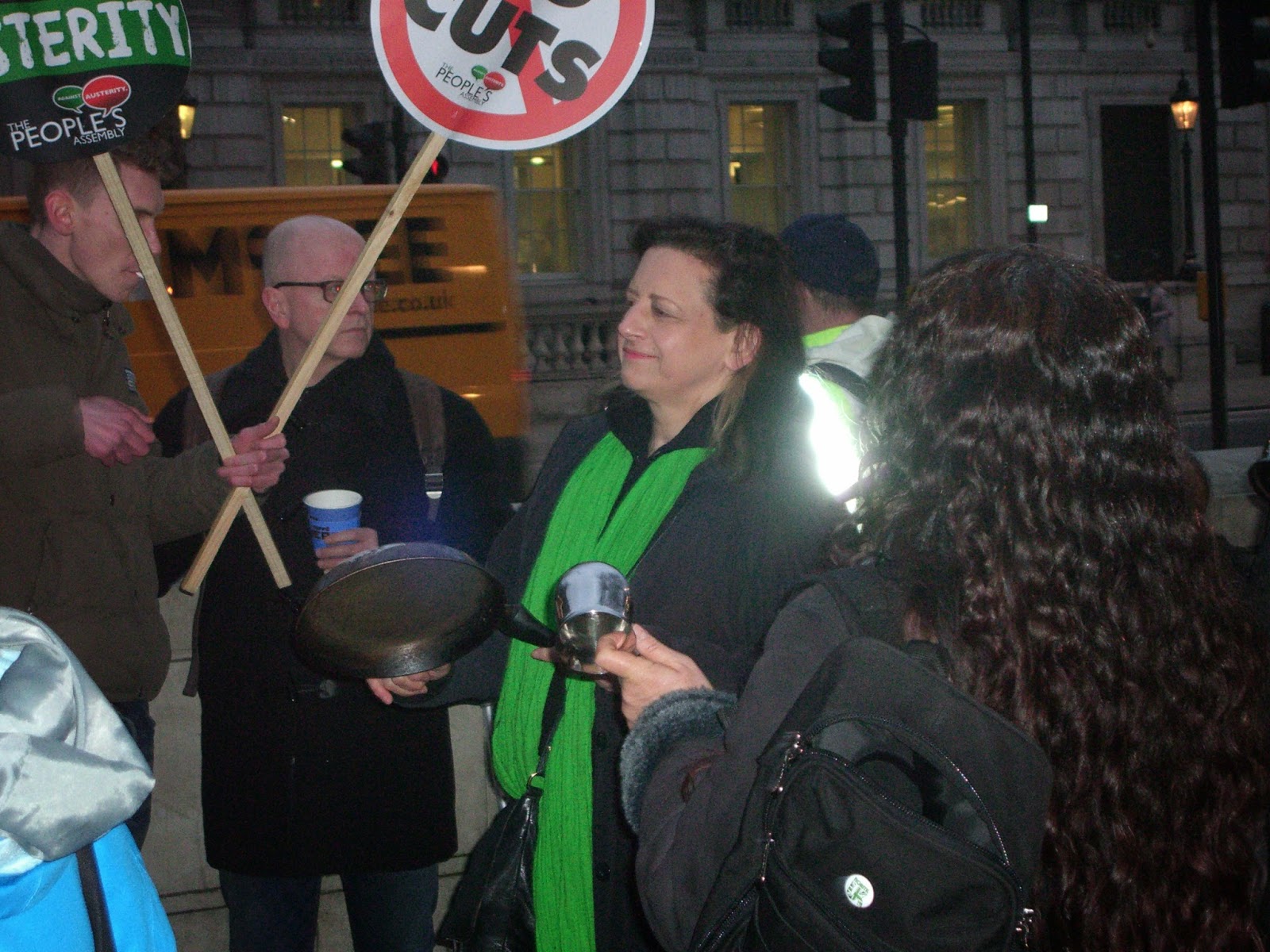
Budget Day Protest Photos


A fairly small but lively demonstration in London outside Downing Street this evening. Organised by the People's Assembly.

Peter Murry


Romayne Phoenix


Pots and pans were banged and a lot of noise made.


Tuesday, 17 March 2015

If We Get One Thing from the General Election – It Must be a Proportional Voting System


British party politics has changed massively over the last 50 or 60 years. In the 1951 general election, the Tories and Labour scooped up 97% of the votes cast (on a record high turn out of 84%). Looking at the opinion polling for the 2015 general election, the Tories and Labour are likely to command only around two thirds of the votes cast, on a probable turn out of around only 65%.

Yet on this prediction the Tories and Labour will likely win more than 85% of the seats in Parliament. Clearly, this is a far from a democratic state of affairs which surely is a factor in the lower turn out at elections these days. What is the point of voting for a party that has no chance of winning in most constituencies in the country?

So from a fairness perspective and if we are serious about encouraging an increase in participation in elections, it is a no brainer that we should change to a fairer system which gives all votes some meaningful value.

But there are powerful vested interests who will oppose any changes to a system that delivers power to the effective duopoly of either Labour or the Tories. One argument that is usually trotted out in defence of the status quo is that the First Past The Post (FPTP) system delivers a clear winner and therefore stable government. Well, the last election in 2010 under FPTP didn’t deliver a clear winner and 2015 looks even less likely to provide an overall majority to one of the duopoly, so this argument doesn’t hold much water anymore.

We will certainly be told that as recently as 2011 the electorate was given the opportunity of changing the voting system in a referendum and decisively rejected the idea.  Of course, the Alternative Vote system that we were offered was not a proportional one, and in my view was no better than FPTF. I think the public also associated endorsing AV as a reward for the Lib Dems, and so were reluctant to give a prize to the party of betrayal, after propping up a minority Tory government.


The more votes that the smaller parties get, the greater will be the public pressure for a change to a system that better reflects the voter’s wishes. Although, maybe not all of the smaller parties.

Labour and the Tories obviously benefit from FPTP as they can argue a vote for anyone else lets the other party in and so is not only wasted, but dangerous to boot. I wouldn’t expect much help from either of these parties in moving to a proportional system. There may be some individual MPs though who would see the unfairness of the current arrangement and might support a change.

To be fair to Labour, when in government they did introduce proportional elections to the Scottish Parliament and Welsh and London Assemblies. For the Tories, I remember speaking to the chair of the local Conservative association just after the 2010 council elections, (when the Tories won 15% of the borough vote, but no seats on the council), who said that locally there was sympathy for proportional voting but central office would have none of it.

The Lib Dems are an interesting case here. For many years they have supported a change in the electoral system, but I just wonder after this year’s general election when they may get only 7% of the vote but win 25 to 30 seats. Whereas the Greens, with a similar percentage of the popular vote, would win only two or three seats, at most. Will the Lib Dems want to change the system? This seems unlikely, but you never know.

The SNP likewise. FPTP is better for them because their vote is concentrated (in Scotland) and they would get only about 5% of the national vote, but end up with around 40 seats under FPTP.

Plaid Cymru may be more willing to support a proportional voting system, as they would probably gain more representation. The Northern Ireland parties would either gain nothing from a proportional system or very little, so not much sympathy there I think.

All of which leaves UKIP who may well get twice as many votes as the Lib Dems, but only a fifth of the seats that the Lib Dems look to be on course for. So it would certainly be in UKIP’s interest to support a change.


The preferred system of voting for the Green party is of the ‘additional member’ type. This is the system used for elections to the Scottish Parliament and Welsh and London Assemblies.

Electors would vote on two ballots: one for the party of their first choice and the other for their constituency MP. MPs would be elected from constituencies as at present, but each party's representation would be topped up on a regional basis by additional members to bring its number of seats up to its proportion of votes polled, provided that proportion was above a minimum qualifying level of 3% of votes polled. There would be a requirement that each party's list has to be elected by a system of 'one member one vote' of the party's membership.  

What is undeniable is that the FPTP system is not fit for purpose with the diversity of voter’s allegiances these days, so we must make sure that we seize the opportunity that the May election will no doubt offer.

This could be a once in lifetime chance to change our representative politics, for the common good.

Monday, 16 March 2015

Interview - Green Party Candidate for the General Election - Gordon Peters, Hornsey and Wood Green, London


In the fourth of a series of interviews with Green Left supporting candidates at the General Election, Mike Shaughnessy talks to the Green Party's Gordon Peters, candidate for Hornsey and Wood Green, London.

Tell me a bit about your background and how you came to join the Green party?

I grew up on the banks of the River Clyde where I saw ships being built above tenement height each day as I went to school in Greenock. The second part of childhood was on the edge of Galloway, in Burns country, where my father ran a pub which had seen the Covenanters – religious revolutionaries of the seventeenth century – as well as the bard himself where he had been an exciseman. So you could say I absorbed living history and something of the struggles against powerful overlords.

I got to university in Edinburgh, then LSE and Essex, spent a year in Cuba, came back to London and went into social work, led a strike for London Weighting and got a lot of political attention as a result, then taught social work and social policy and helped found a journal called Critical Social Policy. I spent most of the 1980s in the frontline against Thatcher’s attack on the welfare state, as director of social services in Hackney. Then after a spell at the Kings Fund, I went into international development work and lived abroad for some years. All this time my politics were more expressed through work and life, in combining intervention in struggles against exploitation of people with those against exploitation of nature. I had read, among others, McKibbin. Kovel, Bookchin, Bellamy Foster and once back in the UK I got more time to relate to organised political activity. I then noticed that Greens were moving beyond environmental lobbyism and their analysis was now linking social justice to planetary conservation.

Why did you decide to join Green Left?

I had been in the Scottish Green Party for a couple of years before returning to live in London in 2010 to 2011. That had been a renewal of political engagement for me as during the years I was working in international development [1992 to 2010] I had either been living and working in other countries [Romania, Latvia, Ukraine, Russia and Bangladesh], or being much more nomadic than settled, my politics were part of what I did rather than any expression through party or place. Since the sixties in fact I had considered myself an eco-socialist and at various times and in various ways sought to integrate thinking and struggles against exploitation of people with those against exploitation of the planet. On joining the Green Party of England Wales I was conscious of its having been regarded [by me as well] as a rather comfortable middle class environmentalist lobby and I was aware of a developing tide --- which I hoped was present in the GPEW ---on the need to challenge the way corporate capitalism is responsible for planetary degradation

What are the main issues that you will campaign on?

I am campaigning on an ‘end to austerity’ – or put more simply ‘no cuts’ platform – and the need for institutions in politics which will challenge the power of the big corporate lobbies and the craven way in which all the mainstream parties yield to their priorities. Our institutions have been shown one by one to be corrupted, yet business as usual carries on. I want to put up a serious challenge to this, as Caroline Lucas has done – but a few more Green MPs would really help change the culture.

I am advocating the full re-instatement of the NHS, an end to Council house sales, rent control for fair rents and an end to land and property speculation in London, a Green New Deal with investment in local jobs and widespread retrofitting houses along with local and municipally controlled energy generation, putting an end to fuel poverty, and a Living Wage for all, funded from a wealth tax, strong regulation of tax avoidance and evasion, and the cancellation of Trident.


How are the cuts to local authority budgets affecting Haringey?

The £70 million cuts budget for the next three years which Haringey Council has just announced will rapidly accelerate the decline of public services over the last four years to such an extent that people with learning disabilities and frail older people, for instance, will be left without day care places to go to and the last publicly owned nursing home to be run down. Over 600 jobs will be lost, including about one third of social workers in a borough which as not yet recovered from all the hostile publicity it got over the death of Baby Peter. They are frankly leaving social work – which was my profession – adrift. There is a much longer list, including parks which the Council now see as revenue producers through closing off in part for days at a time to hold large concerts or other events with all the disruption, waste and social cost of these.

I know you were in involved with the Scottish referendum ‘yes’ campaign, what effect has this had on English politics?

I think it took awhile for folks in England, and maybe more so in London, to realise the extent and the nature of the changes which have come about in Scottish politics. The old Labour fiefdoms have disintegrated and people who thought voting never made much difference have become fired up for an alternative to cynicism and manipulation. The Referendum has become a social movement [the 45, and growing] and it’s not just about the SNP, although clearly they are the main vehicle which can move into Westminster and change the dynamic there. The UK pro-union parties seem frightened and reduced to defending their own institutional decay when confronted by demands for change and an end to austerity politics which harms and exploits the majority and blames people who are poor or vulnerable. The Green Party has chimed much more with this movement and in England is now the only viable social and political force which can have that kind of momentum here.

How do you rate your chances in Hornsey and Wood Green – and the Green party more broadly in England?

Well, we may be still outsiders in this constituency, although I think the odds against are reducing from now till the election, and we had 16% in last year’s Council election. Lynn Featherstone, a Lib Dem minister, stands to lose it, and Catherine West, ex-Labour leader in Islington, may expect to win it – but we are a genuine third force now and the only alternative to austerity and cuts, and for a future younger people can believe in. If everyone who wants that change comes out then we’ll win -- but yes that’s quite a big ask.


I know that you are interested in the issue of adult social care. Why do you think this is such an important matter?

I’m getting on a bit now myself, and have become involved with the Older Peoples Forum in the borough, and seen and talked to folks and their carers who are going to lose out drastically with the cuts to day centres and much more. But as well as that I have a background in having been a director of social services in Hackney in the 1980s which I left when I could do no more to stave off Thatcher’s cutbacks to welfare, and I have long been concerned with the political economy of social care. We could turn round the discourse about welfare and social care, for instance, if people learned that well over £30 billion is contributed to the English economy every year through the employment, interactions and induced effects of adult social care taking place. Yet it’s talked about in media and elsewhere as unaffordable!

There appears to be new Left emerging in Europe, as a reaction to governments’ austerity policies, Syriza in Greece and Podemos in Spain at the forefront. Can the Green party here in the UK be part of this trend?

Yes I undoubtedly think the Green Party can be part of the emerging European left and the social and political movement required to unseat the vested interests of corporate power and the political establishments which are now so wedded to that power that they are incapable of seeing any alternative.

If elected to Parliament, would you vote for a Labour austerity budget?

I could never vote for a continuation of austerity and a Labour budget which went down that road. Public investment must come first and deficits dealt with in relation to that. So let’s have a budget for the common good.

Saturday, 14 March 2015

The Politics of Green Transformation


Talk of transformation is back in vogue. This time the call is for a green transformation. Recent and recurrent financial and environmental crises have drawn attention to the ecological, social and economic sustainability of the global economy. This has prompted calls for a new green industrial revolution, transitions to a low carbon economy or for more radical restructuring for de-growth or the pursuit of prosperity without growth. While calls for radical transformations are often made, but mostly ignored, this one has captured attention at the highest levels, whether through the launching of the Sustainable Development Goals, heightened mobilization around a ‘make-or-break’ climate agreement for Paris 2015, or renewed calls for a World Environment Organisation at the time of the Rio+20 summit in 2012.

But what would a green transformation look like and who will bring it into being?  Most emphasis is placed on technology and markets: the need for massive public and private investment in new technological revolutions or on greening capitalism through pricing nature. But it is also political. What makes it so, and which and whose politics will shape the sorts of transformations that are desirable and possible? These key questions are addressed by a newly published volume on The Politics of Green Transformations which brings together leading thinkers on the politics of sustainability based at the University of Sussex.

Questions surrounding what counts as green, what is to be transformed, who is to do the transforming, and whether transformation, as opposed to more incremental change, is required are all deeply political. For many, the green transformation is like no other we have witnessed so far. While history has witnessed numerous waves of disruptive economic and social change, brought about by technology, war and shifts of cultural values, none has been primarily driven by the goal of rendering the economy and existing model of development more sustainable.

The political nature of the green transformation is heightened because change is needed quickly. A sense of urgency pervades current debates about sustainability amid talk of tipping points, thresholds and planetary boundaries. But though prefacing the word ‘transformations’ with ‘green’ focuses on the environmental dimensions of change, these almost inevitably raise questions of social as well as environmental justice. In many contexts, especially of developing countries, there is unlikely to be any green transformations if questions of social justice — jobs and access to resources such as land and water — are not part of the debate.

The volume challenges conventional assumptions that green transformations can be either solely market or technology-driven. Politics create markets, enforce their rules and deal with questions of access. Likewise, politics determine which technologies are supported and neglected and whose needs take priority. We highlight a key role for green entrepreneurial states, willing to take risks, invest, subsidise and promote technologies neglected by the private entrepreneurs who are often assumed to lead innovation. But we also highlight a vital role for movements in driving change, resisting disruption to their livelihoods (increasingly also driven by green goals of protection and conservation) and articulating alternatives. They also play a key role in grassroots innovation and building alternatives from below.

In practice, green transformations — whether state-led, citizen-led, marketized or technocratic — are produced by differing combinations of actors and drivers from ‘above’ and ‘below’. Green transformations must be both ‘top-down’, involving elite alliances between states and business, but also ‘bottom up’, pushed by grassroots innovators and entrepreneurs, and part of wider mobilisations among civil society. Each of these forms, styles and sites of politics combine, and play out in different ways in different places. Which pathways predominate will depend on the context: in China there is a stronger role for the state while marketized and technocratic pathways may be privileged in North America and Europe. They take a different form again in sub-Saharan Africa. But none are protected from the contested politics of who sets the goals of green transformations (whose knowledge counts), who wins, and who loses from particular ways of pursuing them. Current debates about the green economy and the transition to a low carbon economy would well to recognise this.

Peter Newell is professor of international relations at the Centre for Global Political Economy, University of Sussex, and author, with Ian Scoones and Melissa Leach, of The Politics of Green Transformations, Routledge, 2015.

This article appears in the excellent Le Monde Diplomatique, whose English language edition can be found at mondediplo.com. This full text appears by agreement with Le Monde Diplomatique. 

Also published at Counterpunch

Thursday, 12 March 2015

A Short History of Green Left


Green Left was formed in 2006 when a small number of members of the Green Party of England and Wales met at spring conference and drafted the Headcorn Declaration. Later in the year in June, thirty seven members met in London to formally adopt the name Green Left (the original prototype grouping was called Green Revolution) and amended and adopted the Headcorn Declaration. I was one of those members.

The thinking behind the need for such a grouping within the Green party, was that the party should ‘raise Green Party politics to meet the demands of its radical policies’ and to ‘act as an outreach body that will communicate the party’s radical policies to socialists and other anti-capitalists outside the party.’ GL would also promote ecosocialism as a solution to our social and ecological ills. 

The ensuing nine years has seen members come and go from Green Left but supporters’ numbers have risen steadily, so now Green Left is bigger than it has ever been before. It should be noted that by far the commonest reason for people leaving GL has been over actions taken by the Green party and has had little to do with GL itself.

Events on Brighton Council post the 2011 election of a minority Green party administration imposing public service cuts, is chief amongst the reasons cited by erstwhile comrades for heading for the exit.

Within the first year GL adopted the (first) Ecosocialist Manifesto written by Joel Kovel and Michael Lowy in Paris in 2001. The manifesto is onto its third version now, but the original is still my favourite. Check it out, it's really inspiring I think.

The early years of GL saw attacks from some elements within the Green party, but on the whole as people have gotten use to us, this has fallen away somewhat, although we certainly still have our detractors.

The first big test for GL was the decision within the Green party to hold a referendum in 2007 on whether to replace our ‘principal speaker’ set up with a leader and deputy leader(s). GL opposed the change, quite rightly I think, and campaigned strongly in the ‘no’ camp. Unfortunately, the vote went the other way, but we dusted ourselves off and got on with the more important business of changing the way the party projected itself, as a party of the political Left.

GLs main contribution to the evolution of the party has been made at national conferences, putting forward motions and debating issues firmly from the Left and holding fringe meetings on matters of interest to this constituency. ‘The Watermelon’ magazine is written, produced and distributed at conference by GL supporters and less frequently, ‘The Ecosocialist’ newspaper (together with Socialist Resistance) is likewise handed out on demonstrations and protest marches.

The regional (and later sub regional) structure of GL was first introduced in 2009, and although this has achieved only limited presence, with sporadic spikes in West Midlands and the South West, recent indications from Brighton and London in particular, appear to show a growth of local level organisation and activity.

Increasingly, GL is focusing on working with trade unions and has been busy encouraging GL regions to appoint/elect trade union liaison officers (TULOs), and the success of this is shown most spectacularly in the recruitment of the RMT union president, Peter Pinkney to the Green party and his candidacy at the general election.   

Several GL supporters have done and do continue to hold senior positions within the Green party and positions in the wider social, political and peace movements.


‘With Caroline and then Natalie out in front, and with the (left leaning and very influential) Young Greens and groups like Green Left organising among the activists, the image presented in recent years has been much more consistently left. Gone are the days of “not left or right but forwards”. The party is now clearly an electoral expression of the emerging new left.’

And that sums up what GL is all about. When Green party members ask me why they need to join GL, my short answer is; ‘to keep the Green party honest,’ i.e. on the Left.

You can join Green Left (one year’s free membership and only £5 per year thereafter) by emailing the membership secretary at malcolmbailey@millersbridge.co.uk. If you are from London please copy me in also at mike.shaughnessy@btinternet.com

You must be a Green party member.