Showing posts with label Equality. Show all posts

Wednesday, 20 April 2022

Digital Ecosocialism – Breaking the Power of Big Tech


Written by Michael Kwet, and first published at ROAR Magazine

We Can No Longer Ignore The Role Of Big Tech In Entrenching Global Inequality.

To curtail the forces of digital capitalism, we need an ecosocialist Digital Tech Deal.

In the space of a few years, the debate on how to rein in Big Tech has become mainstream, discussed across the political spectrum. Yet, so far the proposals to regulate largely fail to address the capitalist, imperialist and environmental dimensions of digital power, which together are deepening global inequality and pushing the planet closer to collapse. We urgently need to build a ecosocialist digital ecosystem, but what would that look like and how can we get there?

This essay aims to highlight some of the core elements of a digital socialist agenda — a Digital Tech Deal (DTD) — centered on principles of anti-imperialism, class abolition, reparations and degrowth that can transition us to a 21st century socialist economy. It draws on proposals for transformation as well as existing models that can be scaled up, and seeks to integrate those with other movements pushing for alternatives to capitalism, in particular the degrowth movement.

The scale of needed transformation is massive, but we hope this attempt at outlining a socialist Digital Tech Deal provokes further brainstorming and debate over how an egalitarian digital ecosystem would look and the steps we might take to get there.

Digital Capitalism And The Problems Of Antitrust

Progressive criticisms of the tech sector are often drawn from a mainstream capitalist framework centered around antitrust, human rights and worker well-being. Formulated by elite scholars, journalists, think tanks and policymakers in the Global North, they advance a US-Eurocentric reformist agenda that assumes the continuation of capitalism, Western imperialism and economic growth.

Antitrust reformism is particularly problematic because it assumes the problem of the digital economy is merely the size and “unfair practices” of big companies rather than digital capitalism itself. Antitrust laws were created in the United States to promote competition and restrain the abusive practices of monopolies (then called “trusts”) in the late 19th century.

Thanks to the sheer scale and power of contemporary Big Tech, these laws are back on the agenda, with their advocates pointing to how big companies not only undermine consumers, workers and small businesses, but even challenge the foundations of democracy itself.

Antitrust advocates argue that monopolies distort an otherwise ideal capitalist system and that what is needed is a level playing field for everyone to compete. Yet, competition is only good for those with resources to compete with.

More than half the global population lives on less than $7.40 per day, and nobody stops to ask how they will “compete” in the “competitive marketplace” envisioned by Western antitrust advocates. This is all the more daunting for low and middle-income countries considering the largely borderless nature of the internet.

At a broader level, as I argued in a previous article, published at ROAR, antitrust advocates ignore the globally unequal division of labor and exchange of goods and services that has been deepened by the digitalization of the global economy. The likes of Google, Amazon, Meta, Apple, Microsoft, Netflix, Nvidia, Intel, AMD and many other firms are so big because they own the intellectual property and means of computation that is used across the world. Antitrust thinkers, especially those in the US, end up systematically erasing American empire and the Global South from the picture.

European antitrust initiatives are no better. There, policymakers who huff and puff about the ills of Big Tech are quietly trying to build their own tech giants. The UK aims to produce its own trillion-dollar behemoth. President Emanuel Macron will be pumping €5 billion into tech startups in the hope that France will have at least 25 so-called “unicorns” — companies valued at $1 billion or more — by 2025.

Germany is spending €3 billion to become a global AI powerhouse and a world leader (i.e. market colonizer) in digital industrialization. For its part, the Netherlands aims to become a “unicorn nation.” And in 2021, the widely-lauded European Union’s competition commissioner, Margrethe Vestager said that Europe needs to build its own European tech giants. As part of the EU’s digital targets for 2030, Vestager said the EU aims to “double the number of European unicorns from 122 today.”

Instead of opposing Big Tech corporations in principle, European policymakers are opportunists seeking to expand their own portion of the pie.

Other proposed reformist capitalist measures, such as progressive taxation, the development of new technology as a public option, and worker protections still fail to address root causes and core problems. Progressive digital capitalism is better than neoliberalism. But it is nationalist in orientation, cannot prevent digital colonialism, and it retains a commitment to private property, profit, accumulation and growth.

The Environmental Emergency And Tech

Other major blindspots for digital reformists are the twin crises of climate change and ecological destruction that imperil life on Earth.

A growing body of evidence shows that the environmental crises cannot be fixed within a capitalist framework predicated on growth, which is not only increasing energy use and resulting carbon emissions but also putting enormous stress on ecological systems.

UNEP estimates emissions must fall by 7.6 percent every year between 2020 and 2030 to meet the goal of keeping temperature increases under 1.5 degrees. Scholarly assessments estimate the sustainable worldwide material extraction limit at about 50 billion tons of resources a year, yet at present, we are extracting 100 billion tons a year, largely benefiting the rich and Global North.

Degrowth must be implemented in the immediate future. Slight reforms to capitalism touted by progressives will still destroy the environment. Applying the precautioonary principle, we cannot afford to risk a permanent ecological catastrophe. The tech sector is not a bystander here, but now one of the leading drivers of these trends.

According to a recent report, in 2019, digital technologies — defined as telecommunications networks, data centers, terminals (personal devices) and IoT (internet of things) sensors — contributed 4 percent of greenhouse gas emissions, and its energy use has increased by 9 percent per year.

And as high as that may seem, it likely understates the use of energy by the digital sector. A 2022 report found that Big Tech giants are not committed to reducing their full value-chain emissions. Companies like Apple claim to be “carbon-neutral” by 2030, but this “currently includes only direct operations, which account for a microscopic 1.5 percent of its carbon footprint.”

In addition to overheating the planet, mining for minerals used in electronics — such as cobalt, nickel and lithium — in places like the Democratic Republic of Congo, Chile, Argentina and China is often ecologically destructive.

And then there is the pivotal role of digital companies in supporting other forms of unsustainable extraction. Tech giants help corporations explore and exploit new sources of fossil fuels and digitize industrial agriculture. Digital capitalism’s business model revolves around pushing ads to promote mass-consumption, a key driver of the environmental crisis. Meanwhile many of its billionaire executives have a carbon footprint thousands of times higher than average consumers in the Global North.

Digital reformists assume that Big Tech can be decoupled from carbon emissions and resource-overuse and as a result they focus their attention on each corporation’s particular activities and emissions. Yet the notion of “decoupling” growth from material resource use has been challenged by scholars, who note that resource use tracks tightly to GDP growth across history. Researchers recently found that shifting economic activity to services, including knowledge-intensive industries, has limited potential to reduce global environmental impacts due to the increase in levels of household consumption by service workers.

In sum, the limits to growth changes everything. If capitalism is ecologically unsustainable, then digital policies must accommodate this stark and challenging reality.

Digital Socialism And Its Building Blocks

In a socialist system, property is held in common. The means of production are directly controlled by the workers themselves through worker coops, and production is for use and need rather than exchange, profit and accumulation. The role of the state is contested among socialists, with some arguing that governance and economic production should be as decentralized as possible, while others argue for a greater degree of state planning.

These same principles, strategies and tactics apply to the digital economy. A system of digital socialism would phase out intellectual property, socialize the means of computation, democratize data and digital intelligence and place the development and maintenance of the digital ecosystem into the hands of communities in the public domain.

Many of the building blocks for a socialist digital economy already exist. Free and Open Source Software (FOSS) and Creative Commons licenses, for example, provide the software and licensing for a socialist mode of production. As James Muldoon notes in Platform Socialism, city projects like DECODE (DEcentralised Citizen-owned Data Ecosystems) provide open source public interest tools for community activities where citizens can access and contribute data, from air pollution levels to online petitions and neighborhood social networks, while retaining control over data shared. 

Platform coops, such as the Wings food delivery platform in London, provide a prominent workplace model whereby workers organize their labor through open source platforms collectively owned and controlled by the workers themselves. There is also a socialist social media alternative in the Fediverse, a set of social networks that interoperate using shared protocols, that facilitate a decentralization of online social communications.

But these building blocks would need policy change to thrive. Projects like the Fediverse, for example, are not able to integrate with closed systems or compete with the massive concentrated resources of the likes of Facebook. A set of radical policy changes would therefore be needed to force big social media networks to interoperate, decentralize internally, open up their intellectual property (e.g. proprietary software), end forced advertising (advertising people are subjected to in exchange for “free” services), subsidize data hosting so that individuals and communities — not the state or private companies — can own and control the networks and perform content moderation. This would effectively strangle tech giants out of existence.

The socialization of infrastructure would also need to be balanced with robust privacy controls, restrictions on state surveillance and the roll-back of the carceral security state. Currently the state exploits digital technology for the means of coercion, often in partnership with the private sector. Immigrant populations and people on the move are heavily targeted by a mix of cameras, aircraft, motion sensors, drones, video surveillance and biometrics.

Records and sensor data are increasingly centralized by the state into fusion centers and real-time crime centers to surveil, predict and control communities. Marginalized and racialized communities and activists are disproportionately targeted by the high-tech surveillance state. These practices should be banned as activists work to take down and abolish these institutions of organized violence.

The Digital Tech Deal

Big Tech corporations, intellectual property and private ownership of the means of computation are deeply embedded into the digital society, and cannot be turned off overnight. Thus, to replace digital capitalism with a socialist model, we need a planned transition to digital socialism.

Environmentalists have proposed new “deals” outlining the transition to a green economy. Reformist proposals like the US Green New Deal and European Green Deal operate within a capitalist framework that retains the harms of capitalism, such as terminal growth, imperialism and structural inequality. In contrast, ecosocialist models, such as the Red Nation’s Red Deal, the Cochabamaba Agreement and South Africa’s Climate Justice Charter, offer better alternatives. These proposals acknowledge the limits of growth and incorporate the egalitarian principles need for a just transition to a truly sustainable economy.

However, neither these red nor green deals incorporate plans for the digital ecosystem, despite its central relevance to the modern economy and environmental sustainability. In turn, the digital justice movement has almost entirely ignored degrowth proposals and the need to integrate their assessment of the digital economy into an ecosocialist framework. Environmental justice and digital justice go hand-in-hand, and the two movements must link up to achieve their goals.

To this effect, I propose an ecosocialist Digital Tech Deal which embodies the intersecting values of anti-imperialism, environmental sustainability, social justice for marginalized communities, worker empowerment, democratic control and class abolition. Here are ten principles to guide such a program:

1. Ensure The Digital Economy Falls Within Social And Planetary Boundaries

We face a reality that the richest countries in the North have already emitted more of their fair share of the carbon budget — and this is also true of the Big Tech-led digital economy that is disproportionately profiting the richest countries. It is therefore imperative to ensure the digital economy falls within social and planetary boundaries. We would need to establish a scientifically-informed limit on the amount and types of materials that can be used and decisions could be made about which material resources (e.g. biomass, minerals, fossil energy carriers, metal ores) should be devoted to which use (e.g. new buildings, roads, electronics, etc.) in which amounts for which people. Ecological debts could be established which mandate redistributive policies from North to South, rich to poor.

2. Phase Out Intellectual Property

Intellectual property, especially in the form of copyrights and patents, give corporations control over knowledge, culture and the code that determines how apps and services work, allowing them to maximize user engagement, privatize innovation and extract data and rents. Economist Dean Baker estimates that intellectual property rents cost consumers an additional $1 trillion per year compared to what could be obtained on a “free market” without patents or copyright monopolies. Phasing out intellectual property in favor of a commons-based model of sharing knowledge would reduce prices, widen access to and enhance education for all and function as a form of wealth redistribution and reparations to the Global South.

3. Socialize Physical Infrastructure

Physical infrastructure such as cloud server farms, wireless cell towers, fiber optic networks and transoceanic submarine cables benefit those who own it. There are initiatives for community-run internet service providers and wireless mesh networks which can help place these services into the hands of communities. Some infrastructure, such as submarine cables, could be maintained by an international consortium that builds and maintains it at cost for the public good rather than profit.

4. Replace Private Investment Of Production With Public Subsidies And Production.

Dan Hind’s British Digital Cooperative is perhaps the most detailed proposal for how a socialist model of production could work in the present context. Under the plan, “public sector institutions, including local, regional and national government, will provide venues where citizens and more or less cohesive groups can assemble and secure a claim on the political.” Enhanced by open data, transparent algorithms, open-source software and platforms and enacted through democratic participatory planning, such a transformation would facilitate investment, development and maintenance of the digital ecosystem and broader economy.

While Hind envisions rolling this out as a public option within a single country — competing with the private sector — it could instead provide a preliminary basis for the complete socialization of tech. In addition, it could be expanded to include a global justice framework that provides infrastructure as reparations to the Global South, similar to the way climate justice initiatives pressure rich countries to help the Global South replace fossil fuels with green energy.

5. Decentralize The Internet

Socialists have long pushed for decentralizing wealth, power and governance into the hands of workers and communities. Projects like FreedomBox offer free and open source software to power inexpensive personal servers that can collectively host and route data for services like email, calendaring, chat apps, social networking and more. Other projects like Solid allow people to host their data in “pods” they control. App providers, social media networks and other services can then access the data on terms acceptable to users, who retain control over their data. These models could be scaled up to help decentralize the internet on a socialist basis.

6. Socialize The Platforms

Internet platforms like Uber, Amazon and Facebook centralize ownership and control as private intermediaries that stand between users of their platforms. Projects like the Fediverse and LibreSocial provide a blueprint for interoperability that could potentially extend beyond social networking. Services that cannot simply interoperate could be socialized and operated at cost for the public good rather than for profit and growth.

7. Socialize Digital Intelligence And Data

Data and the digital intelligence derived from it are a major source of economic wealth and power. Socialization of data would instead embed values and practices of privacy, security, transparency and democratic decision-making in how data is collected, stored and used. It could build on models such as Project DECODE in Barcelona and Amsterdam.

8. Ban Forced Advertising And Platform Consumerism

Digital advertising pushes a constant stream of corporate propaganda designed to manipulate the public and stimulate consumption. Many “free” services are powered by ads, further stimulating consumerism precisely at the time that it imperils the planet. Platforms like Google Search and Amazon are built to maximize consumption, ignoring ecological limits. Instead of forced advertising, information about products and services could be hosted in directories and accessed on a voluntary basis.

9. Replace Military, Police, Prisons And National Security Apparatuses With Community-Driven Safety And Security Services

Digital technology has increased the power of police, military, prisons and intelligence agencies. Some technologies, such as autonomous weapons, should be banned, as they have no practical use beyond violence. Other AI-driven technologies, that arguably have socially beneficial applications, would need to be tightly regulated, taking a conservative approach to limit their presence in society. Activists pushing to curtail mass state surveillance should join hands with those pushing for abolition of police, prison, national security and militarism, in addition to people targeted by those institutions.

10. End The Digital Divide

The digital divide typically refers to unequal individual access to digital resources like computer devices and data, but it should also encompass the way digital infrastructure, such as cloud server farms and high-tech research facilities, are owned and dominated by wealthy countries and their corporations. As a form of wealth redistribution, capital could be redistributed through taxation and a process of reparations to subsidize personal devices and internet connectivity to the global poor and to provide infrastructure, such as cloud infrastructure and high-tech research facilities to populations that cannot afford them.

How To Make Digital Socialism Reality

Radical changes are needed, but there is wide gap between what must be done and where we are today. Nevertheless, there are some critical steps we can and must take.

First, it is essential to raise awareness, promote education and exchange ideas within and across communities so together we can co-create a new framework for the digital economy. In order to do this, a clear critique of digital capitalism and colonialism is needed.

Such a change will be difficult to bring about if concentrated knowledge production is left intact. Elite universities, media corporations, think tanks, NGOs and Big Tech researchers in the Global North dominate the conversation and set the agenda around fixing capitalism, limiting and constraining the parameters of that conversation.

We need steps to strip their power, such as abolishing the university ranking system, democratizing the classroom and terminating funding from corporations, philanthropists and Big Foundations. Initiatives to decolonize education — such as the recent #FeesMustFall student protest movement in South Africa and Endowment Justice Coalition at Yale University — provide examples of the movements that will be needed.

Second, we need to connect digital justice movements with other social, racial and environmental justice movements. Digital rights activists should be working with environmentalists, abolitionists, food justice advocates, feminists and others. Some of this work is already being done — for example, the #NoTechForIce campaign spearheaded by Mijente, a grassroots migrant-led network, is challenging the supply of technology to police immigration in the United States — but more work is required still, especially in relation to the environment.

Third, we need to ramp up direct action and agitation against Big Tech and the US empire. Sometimes it is hard to mobilize support behind seemingly esoteric topics, such as the opening of a cloud center in the Global South (e.g. in Malaysia) or the imposition of Big Tech software into the schools (e.g. in South Africa).

This is especially difficult in the South, where people must prioritize access to food, water, shelter, electricity, health care and jobs. However, successful resistance to developments like Facebook’s Free Basics in India and the construction of Amazon’s headquarters on sacred Indigenous land in Cape Town, South Africa show the possibility and potential of civic opposition.

These activist energies could go further and embrace the tactics of boycotts, divestment and sanctions (BDS), which anti-apartheid activists used to target computer corporations selling equipment to the apartheid government in South Africa. Activists could build a #BigTechBDS movement, this time targeting the existence of giant tech corporations. Boycotts could cancel public sector contracts with tech giants and replace them with socialist People’s Tech solutions. Divestment campaigns could force institutions like universities to divest from the worst tech companies. And activists could pressure states to apply targeted sanctions to US, Chinese and other countries’ tech corporations.

Fourth, we must work to build tech worker cooperatives that can be the building blocks for a new digital socialist economy. There is a movement to unionize Big Tech, which can help protect tech workers along the way. But unionizing Big Tech is like unionizing the East India companies, arms manufacturer Raytheon, Goldman Sachs or Shell — it is not social justice and is likely to deliver only mild reforms.

Just as South African anti-apartheid activists rejected the Sullivan Principles — a set of rules and reforms for corporate social responsibility that allowed American companies to keep profits flowing from business in apartheid South Africa — and other mild reforms, in favor of strangling the apartheid system, we should aim to abolish Big Tech and the system of digital capitalism altogether. And this will require building alternatives, engaging with tech workers, not to reform the unreformable, but to help work out a just transition for the industry.

Finally, people from all walks of life should work collaboratively with tech professionals to develop the concrete plan that would make up a Digital Tech Deal. This needs to be taken as seriously as current green “deals” for the environment.

With a Digital Tech Deal, some workers — such as those in the advertisement industry — would lose their jobs, so there would have to be a just transition for workers in these industries. Workers, scientists, engineers, sociologists, lawyers, educators, activists and the general public could collectively brainstorm how to make such a transition practical.

Today, progressive capitalism is widely seen as the most practical solution to the rise of Big Tech. Yet these same progressives have failed to acknowledge the structural harms of capitalism, US-led tech colonization and the imperative of degrowth. We cannot burn down the walls of our house to keep ourselves warm.

The only practical solution is to do what is necessary to prevent us from destroying our one and only home — and this must integrate the digital economy. Digital socialism, made reality by a Digital Tech Deal, offers the best hope within the short time frame we have for drastic change, but will need to be discussed, debated and built. It is my hope that this article might invite readers and others to build collaboratively in this direction.

Sunday, 3 April 2022

Dealing with Climate Catastrophe – The Metabolic Rift


 Written by Josh O'Sullivan and first published at iso aotearoa

On 16 March 2022 the Otago University Politics Programme hosted an online panel discussion on ‘Global Warming, Global Warning: The Politics of Climate Change’. The panelists were: James Shaw, Minister for Climate Change; Prof. Lisa Ellis; Assoc. Prof. Brian Roper; Sina Brown-Davis, Ngāti Whātua, Indigenous and climate activist; Adam Currie, Generation Zero; Jack Brazil, community activist; and Josh O’Sullivan, International Socialist Organisation. Here we publish Josh O’Sullivan’s speech. 

Kia ora tātou. Ko Josh O’Sullivan taku ingoa, ko Tāmaki Makaurau ahau, and I am here from the International Socialist Organisation to present the case for ecosocialism.

I am also a high school science teacher. This topic is the hardest to teach to our ākonga. It is a complex topic for sure, but more importantly it’s hard to present such a dire situation and only talk about miniscule individual actions. The urgency of this crisis and what we are being told to do are obviously counter-posed.
 

Our individual contributions are a drop in the bucket when it comes to dealing with climate change and proposed technological solutions lack the scale and speed necessary to actually deal with the problem. Even these solutions are only viable as long as we can make profit from them.

The scale of the crisis is overpowering, and it is nothing less than patronising to tell people to ride their bike or buy local seasonal foods to reduce their carbon footprint when the vast majority of emissions come from industry. Just 100 companies and the commodities they have produced are responsible for 71 percent of the world’s historical emissions. Collective action is the only thing that can even make a dent in our woefully unprepared society. A planned economy that provides for the needs of people to ensure a just transition to a liveable future is desperately needed, as has already been stated by Professor Roper.

Previous and current governments in New Zealand have been hesitant to disrupt the economic paradigm adopted since the 1980s to have government-funded work programs. But it is still the state that has the capability to marshal the productive forces in society.
 

We could look at even more radical options like nationalizing extractive industries to prevent further extraction of carbon we cannot burn; building mass transit that actually works, rather than setting out a tender process to get the lowest bidder; renationalising the electricity system; ensuring water is used for human consumption here, rather than bottled and sold by a private company on the other side of the world; ensuring that we have a working food plan so that we are not building housing on the only place in the country that can grow our vegetables; or trying to run irrigation through a desert to farm dairy cows. 

Beyond that we would need banks to be nationally owned in order to fund these transitions away from things that bear the most profit into other areas that bear the most sustainability. 

But even all of these radical ideas do not change the fundamental nature of our economic system that ensures that environmental concerns are secondary to profit.

The conversation around climate change always seems to focus on our emissions, but the full reality of what we face is far larger than the amount of carbon dioxide being produced and put into the atmosphere. Our entire relationship with nature over the past 200 years has been predicated on an economic system that sees environmental damage as someone else’s problem and profit as the only solution.
 

From plastic and chemical pollution, open pit mining, deforestation, mono agriculture, overfishing, ocean acidification, the loss of biodiversity; all of these issues compound each other. At risk with the worsening climate crisis is not just our comfort, but access to the earth’s collective resources – water, land, and clean air – as well as the mass displacement of millions of people who will become known as climate refugees. 

There are no wilds left unconquered, everywhere we have transformed the last vestiges of nature into something man made in order to extract profit. The common link between all of these issues is the fundamental relationships in the economics of our society, namely capitalism. 

Capitalism’s disregard for the environment can be linked through a concept called the metabolic rift. In the simplest terms, the metabolic rift is a breakdown in the healthy functioning of the metabolic process human society depends on, in both its external aspect, the exchange of material between human society and nature, and its internal aspect, the circulation of material within society. 

The making of goods, of objects, occurs from people working, labouring, on the natural world. In pre-class societies, the two ends of that process – the natural resources and the end product – are related in a more or less direct and transparent way.

The raw materials required for the production of basic necessities like food, shelter and so on were mostly sourced from the immediate surroundings of settlements.
 

In this context, it would be very obvious if the metabolism had broken down in some way—say by an area of land being eroded due to the excessive clearing of trees. And it would be similarly clear if the process of exchange of goods within the community broke down, and the health of one section of the population began to suffer as a result. 

With the emergence of class society, when a minority of the population came to live off the surplus produced by others, the link between the natural basis of human society and the lives of those who made the important decisions became more tenuous. 

As Marx saw it, however, it’s only with the emergence of capitalism from the seventeenth century onwards that the link is severed completely. Even the wealthiest of feudal lords still had some connection to the land. Their power was bound with a particular estate. If the feudal lord failed to manage the land sustainably, if he logged all the forests, poisoned the waterways and so on, he would undermine not only the source of his material wealth, but his identity and being as a lord. 

The alienation of the land—its reduction to the status of property that can be bought and sold—is what for Marx constitutes the foundation stone of the capitalist system. The wealth and power of the capitalist class doesn’t depend on their possession of this or that particular piece of property, but rather on their control over capital. Capital can include physical property, such as farmland, machinery, factories, offices, but it is by its very nature fluid and transferable. If a capitalist buys up some land and then destroys it, they can simply take the profits they’ve made from it and move their money elsewhere. 

At the same time as it completely severs any semblance of connection with the land among the ruling class, capitalism also severs it among workers. The peasants under feudalism had a direct and transparent dependence on the land for their subsistence. But with this came a degree of independence that isn’t afforded to workers under capitalism. 

The peasants had to give up a portion of their produce to the lord, but outside of that they were relatively free to labour as it best suited them. And no matter how unfree they were in a political sense, their capacity to sustain themselves was at least guaranteed by their direct access to the land and their possession of the tools necessary to work it. 

For capitalism to be put on firm footing, this direct relationship of the peasants to the land had to be severed. They were, over a number of centuries, forcibly “freed” from the land in order that they could be “free” to be employed in the rapidly expanding capitalist industries. Workers, for Marx, were defined by their lack of ownership of the means of production. They were no longer dependent on the land for their subsistence, but rather on the preparedness of a capitalist to give them a job and pay them a wage. 

This process of replacement of feudalism by capitalism is also the same process repeated wherever capitalism found new lands to covet and new populations to become workers; this is the story of colonisation. In Aotearoa this same process of the alienation of land occurred, starting with the purchasing of land through the New Zealand Company, then the invasion of the Waikato, and then, the most effective method, through the Native Land Court. 

All of this to turn land into capital, something that can be traded, sold and worked on; and also to force the Māori population into a low-wage workforce on their own land. Everywhere capitalism has sprouted it has reforged the social relationships that existed previously into a division between those that have capital and those that only have their labour to sell. 

The fact that the capitalist class has no real incentive to protect the environment, and the working class has no control over it, lies at the heart of capitalism’s unique destructiveness. The “logic” of capitalism is one in which maintaining the health of society’s metabolism, either externally in its relationship with nature, or internally in its distribution of goods among the population, only features to the extent that it assists the accumulation of wealth by the ruling class. 

The one thing the capitalist class cares about above all else is profit. No matter what the consequences, whether on the natural environment, human health or anything else, if business owners can continue to expand their pool of capital, they will see it as a success.  

Infinite growth on a finite planet is impossible, yet nowhere is this tautology being acknowledged.

We cannot allow politicians to convince us to compromise so that the engines of profit and accumulation can continue to turn. Because there is no compromise with the laws of nature. Paraphrasing a tourism business leader I heard on RNZ today, businesses can’t turn green unless they are in the black. 

That is exactly the problem. We cannot bargain with Papatūānuku to make sure our economy survives, or to give us more time to adapt. Change needs to happen now. Land back to indigenous cultures and their self-determination is an essential element for this –b for these colonised peoples have the memory of living before capitalism twisted all our relationships with nature. 

It is a stark choice for our species in the next few decades; either we radically transform the very nature of society or we suffer the eventual extinction of our species. We need to talk about radical solutions, because we don’t have time for anything less. We need to dismantle capitalism.

Thursday, 17 February 2022

Interview - Max Ajl author of ‘A People’s Green New Deal’

Interviewer: İbrahim Erkol first published at Polen Journal

1) Could you first briefly introduce yourself to Polen Ekoloji and your to-be Turkish-speaking readers? 

I am a postdoctoral fellow at Wageningen University, and an associate editor at Agrarian South. I have been living in Tunisia for the last eight years, doing research on the history of decolonization and development, the intellectual history of heterodox regional thinking about alternatives to the dominant development paradigms, and Tunisian and Arab agrarian questions. I have also been very involved with supporting efforts to end US support for Israel as part of broader work in support of national liberation in the Arab region.

2) How did you get engaged with climate change as a researcher who has focused only mostly on rural sociology and post-colonization in his previous PhD studies? What was your starting point when you decided to write on such a topic as burning as it is itself? 

I have been very interested in ecological issues since I was a child, and spent around two years doing public-facing science journalism on climate change. So, the topic is not new for me. Furthermore, the way I learned about sustainable and ecologically restorative agriculture was very much connected to climate change. My doctoral supervisor, Philip McMichael, has been one of the scholars making those linkages for over a decade. That research has been often in support of the movements around food sovereignty and agroecology in Latin America and elsewhere, which have put climate issues front-and-center when it comes to the relative merits from an emissions and resilience perspective when it comes to climate change.

So overall Cornell was a very propitious place to blend the study of agrarian development/underdevelopment with understanding agrarian questions of ecology, particularly as they connect to climate change. Overall, agrarian questions related to the role of peasant/smallholder wellbeing, ecology, and national liberation are central to just climate transition in the Third World. Almost ten years ago  now I wrote an essay on this topic entitled “Planet of Fields,” which first appeared in Jacobin and then Neil Brenner encouraged me to develop it for a volume which he edited. There, I first put forward some of the ideas I developed in A People’s Green New Deal.

The pressure to write the book, however, came from my maybe-naïve shock at how quickly the discussion about a Green New Deal was becoming an arena to smuggle in a very hardened economistic, industrial-fetishizing, reformist, and usually imperialist northern climate “justice,” and thinking through how we could connect a more international internationalist northern climate discussion to burning questions of southern national liberation to lead to world-wide development convergence.

3) How do you think “A People’s Green New Deal” can be achieved? In this sense, what kind of a political organization models do you think is necessary for achieving “A People’s Green New Deal”.  Do you see the necessity of a political avant-garde to canalize and guide the movements throughout the process of transition that you thoroughly described and explained in your book? 

We need political vehicles that can suture the North-South ideological and developmental divide, mobilize the poor portions of the North in clear and explicit support of national liberation and ecological development in the periphery, and block northern interference with southern national liberation. This is a tall task, and the system is designed to prevent it from happening. I am sympathetic to the classical Leninist project of party building, and I am apprehensive of the various alternatives which have been proposed.

However, I am not sure we can expect one political vehicle in the core, certainly in the US, to canalize the movements I described; something akin to a coalition of political parties might be more reasonable to expect, which gain political clarity by being directly accountable to popular parties, movements, and states in the South, perhaps through “A New Bandung.”

4) As in the rest of world, ecological movement is brimmed with in-systemic and “at best” reformist organizations, NGOs and discourses in Turkey. And at a historical period, the studies like yours is of utmost importance to us. Could you briefly explain us why we need to dismantle the liberal and compromising stances in climate change context?

The liberal and compromising stances are neither just on a global level nor feasible on their own terms. No revolutionary movement in history has ever achieved all of its aim, even when taking state power. Aiming for allegedly “easier” horizons means not even hitting them. So, why would any person who believes in the good life for everyone (communism) accept such a strategy or an outcome? I believe everyone has the right to be free of exploitation, a right to ecologically appropriate development, equivalent per capita access to energy and other physical resources, etc. No one can deny that imperialism and uneven accumulation are ways of preventing people in the South from accessing those rights.

Logically and morally we need to dismantle the liberal stances which do not target those patterns of exploitation, and which are generally propped up by northern capital, whether through the leftist foundations which gate-keep the ecological discourse, or through publication outlets which rely on capitalist funding and recognition to have their ideological impact. These compromising stances are deliberately-engineered mechanisms of ideological control, and it is important to be crystal-clear about their nature and purposes. 

5) I believe the reason why AOC and her so-called “associates” get so popular and are seen as kind of “saviors” is that people do want to hold onto anything that resembles to hope for things even as small as they pledge. How do you think the hope of the masses can be directed into socialism again?  

In the US, in Latin America, and elsewhere, many people, or at least, many more people than previously, have a hope in socialism. But it is true that hope works alongside some acceptance of more “moderate” change from “saviors” like AOC (it is not clear to me that AOC is very popular amongst the US working class, however). So people do find hope where they can and where they may see it as reasonable. The best way to convince people who do not believe that socialism is on the agenda is victories achieved by forces which advocate socialism. That is an organizational task. But there is also the task of intellectual combating reformism and imperialism within “the left.”

We need to simply insist that socialism is on the agenda, that a class-attentive internationalism aware of the need for serious attention to the national question is on the agenda, and for those of us in the privileged position of disproportionately producing analysis must reject any and all forms of opportunism. That includes, really, especially, amongst our peers, the self-identified left. That does not mean a position which rejects the strategic use of left-liberal anti-racist legislators taking office, wherever that may be, or even strategic engagements with parliamentary or electoral politics more broadly.

But to conflate that with socialism, as has been done throughout the US social democratic left, is to insist on something which is not true. And to create an actual publishing industry devoted to blurring that distinction is also not helpful. Why would anyone have hope in eco-socialism if prominent self-identified defenders of socialism paint those who vote to send weapons to colonial Israel as socialists? 

6) How do you think “imperialism-proof” international alliances can be formed in the Third World countries and how “historical” defeats of revolutionaries can be avoided in the following periods? In this sense, some leftist organizations claim that we may even have to disrupt and utilize ecological services to be able to fight against the enemy. Their primary argument is that their governments have to be economically much more powerful than those of capitalist states. What’s your position in this sort of a discussion? 

The only imperialism-proof international alliance is one which follows the Maoist dictum that class struggle continues amidst socialist construction: “never forget class struggle,” and one which wins. This might seem obvious point, but imperialism as the political practice of the ruling class on a world scale will not relinquish its power. Nor can imperialism be reasoned with or conciliated. Look what happened to Saddam Hussein or Muammar Qadhaffi who accepted disarming, or the Islamic Republic and its acceptance of the so-called “Iran Deal.”

All of these decisions on the part of these republics which traced back to radical-nationalist coup d’états or revolutions, often with extremely severe democratic failures internally, did not palliate imperialism, because imperialism seeks the constant expansion of its power. The reverse-side of this problem is that in the US/European left, there are varying degrees of support for these processes. So we have serious ideological deficiencies North and South which need to be dealt with. Venezuela, however, has for the most part proved coup-proof not just because of the party-military alliance, but also because of the degree of ideological commitment amongst its people, at least in the past. That’s another lesson, linked to the first one, since class struggle means popular empowerment. 

To more precisely respond to you question about the need to build up the forces of production for national self-defense: This was the explicit position of the Soviet leadership, and was part of the reason for headlong Soviet industrialization, which was necessary to destroy the Nazi armies. It also accounted for China’s partially urban-biased developmental strategy, which likewise was based on the desperate need to industrialize for self-defense, the shadow of the US apocalypse in Korea.

We cannot know in advance if those levels of development of the forces of production are in excess of what is required for national self-defense and deterrence; we can realistically only know if they have been sufficient for those purposes. In the absence of effective anti-war and anti-imperial movements in the North, it is clear that southern states will have to continually devote massive portions of their industrial plant to defense at the expense of more narrowly-defined social and ecological needs. New comparatively “light” technologies such as those developed in Iran may provide an equal deterrent capacity. But they also might not. Who would want to risk it?

7) Your book has rather “unfamiliar” terms in itself for new readers such as “Environmentally Unequal Exchange”, “semi-periphery” that you frequently use. Would you explain the terms for beginners? 

Environmentally unequal exchange is a theory which refers to a range of physical phenomena linked to capitalist market exchange. One: damage to the environment and human health through commodity production. Those damages have been systematically exported to the poorer countries through the relocation of the most polluting industries from North to South. Second is that insofar as commodity exchange produces CO2 emissions, the impacts from those emissions almost universally fall harder on the periphery.

Since those “externalities” are already priced into the world-wide system of prices and global patterns of commodity exchange, there is an “unequal” exchange of vulnerability to climate damages. Finally, there is a question of raw materials: the price system ensures that the northern countries have a greater access to world-wide natural resources. Some of this work really adds quantitative flesh to arguments long made by Latin American or other scholars like Samir Amin working on the uneven terms of trade, but it is nevertheless valuable, and the work on the re-siting of polluting industries and unequal exposure to pollution is new and valuable. 

Semi-periphery is a loose term referring to those countries which have much higher per-capita incomes than the poorest countries and may indeed import value/labor-hours from poorer countries, but which are in a position of subjugation with respect to the North, and which overall export value: consider Brazil or China, which even apart from size are very developmentally different from Haiti or Yemen.

8) Lastly, as any other academic discussion prevailing academic thought, eco-socialist ideology is one of those that has lately begun to be discussed in Turkey We can call this case as some kind of “delay”. So, for readers being able to understand more out of the book, would you explain what is eco-socialism in your perspective and how it is relevant to today’s climate change discussions? 

Eco-socialism is a slight modification of Marx’s conception of socialism as “socialized man, the associated producers, rationally regulating their interchange with Nature, bringing it under their common control, instead of being ruled by it as by the blind forces of Nature; and achieving this with the least expenditure of energy and under conditions most favorable to, and worthy of, their human nature.”

By eco-socialism we mean rationally regulating to the extent possible our interchange with nature, and producing the use-values we collectively need, while also ensuring that the non-human world is no longer being damaged by human productive activities, but rather is slowly being restored: toxic metal concentrations remediated, forests sustainably managed, fisheries recovered, etc. Eco-socialism is just a reminder that Marxism has to be attentive on a world-scale to the conditions of reproduction of labor, which includes the natural environment, or non-human nature, and taking care of it has to be part of a transition to humane social relations which are not ruled by capitalism, or the law of value.

9) How do you think climate justice and reparations can be achieved? After all, the capitalist countries will not one day decide out of blue to “right” the historical wrongs. What kind of a political empowerment you consider is necessary for said goals in this sense?

Revolutionary movements in the North will only be able to seriously put a committed internationalism on the agenda on a wide scale when southern movements are more consolidated than they currently are, especially around demands for reparations. One can imagine two scenarios in which reparations flow from North to South. One, there is a revolutionary movement in the North which has as one of its demands climate debt, and the northern ruling class grants this demand to try to demobilize that movement. The second is that the revolutionary movement takes power. Both scenarios are quite far off. 

10) Do you think alternative movements such as Glasgow agreement are promising in the sense that they can help the people’s voice raised in climate justice issue? Moreover, we know that the demands such as climate justice, reparation, and ecological struggles were originally born on the Third World. Nevertheless, what we’re currently observing is that many articles focusing on these issues are from the Global North. So, in a sense, voice of the Third World is suppressed. What are your opinions on this change? 

More and more I am convinced that national liberation needs to be the departure point for first world-third world eco-developmental convergence. Keep in mind that for Amilcar Cabral, national liberation was basically coterminous with a socialist planned economy. No matter what agreements are made on the international stage, climate justice concords can only take policy form within the nation-state system, and against the background of, and trying to resist, uneven accumulation.

That is, climate justice has a nation-class aspect which structures the initial strategy. The reason I take the Cochabamba People’s Agreement as such an important touchstone is that it developed in the context of a re-assertion of national sovereignty on the part of Bolivia, linked to the Chavista project of putting national-popular socialism back on the agenda in the South. I think some important technical work may come from movements such as those in Glasgow, but it is critical that the national liberation framework is the anchoring point.

There is often excellent work on eco-socialism in the North, but building on what I just said, the importing of northern ideas can often come with unexamined Eurocentrism and inattention to the national question. Furthermore, they may reflect a sort of academic dependency, where the North theorizes and the South gathers empirical data. This division of labor is not acceptable on several fronts. Critically, these “northern” ideas – including my own, if the term applies – have to be examined and very possibly re-tooled before they can be re-deployed for purposes of southern eco-socialist organizing.

I am thinking of some of Archana Prasad’s critiques of northern eco-socialist discourse, for example. Another problem is that the northern work, while often “theoretically” sophisticated, often does not engage in a serious way with planning. Furthermore, there is a need to return to the classic work which came from the South. There is no shortage of research on eco-development in Latin America from the 1980s, or appropriate technology in the Arab region, or people’s science in China and India. Those are all past and present lines of investigation which need to be re-invigorated or simply become points of reference for more South-South theoretical work on eco-socialism.

Monday, 14 February 2022

The Global Tapestry of Alternatives: Stories of Resilience, Existence, and Re-Existence

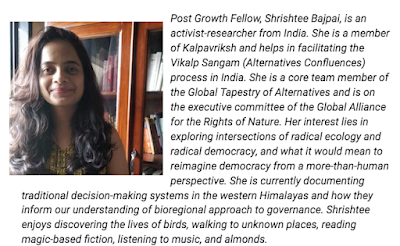
Written by Shrishtee Bajpai and first published at Medium

Our food systems are not just the work of humans. They are the work of the mountains, of Pachamama [Mother Earth], of the sacred, the whole community which is centered on reciprocity, solidarity, and respect for elements of life. This is buen vivir (‘living well’) for us.

That’s according to Quechua residents of Potato Park in the Peruvian Andes, where the community has for the last three decades been involved in an inspiring process of conserving and sustaining their own livelihoods over the vast landscape where the potato originated. They were speaking to us through the dialogue series initiated by the Global Tapestry of Alternatives (GTA) to highlight stories of community resilience and wellbeing in the face of Covid.

The pandemic has shown the deep fractures and baseless promises of wellbeing that the capitalist model made to the whole world. Of course, several other crises pre-exist Covid, from the climate, biodiversity loss, and pollution, to inequality, conflicts, authoritarianism, and right-wing fascism across the globe.

Occurring alongside all this is a long process of colonization or post-colonial hegemony, and the domination of certain cultures and knowledge systems. Combinations of these interconnected challenges have significantly impacted our individual lives, whether it’s alienation from nature and from each other, or a heightened sense of meaninglessness or hopelessness.

It’s in the context of these multiple crises that GTA attempts to foster a dialogical space to show that there are alternative ways of being, knowing, working, dreaming, and of doing things — that the modern capitalist or nation-state dominated system is not the only system around.

Along with processes of resistance, across the world there are tens of thousands of attempts to construct alternative realities, either through sustaining things from the past which are still relevant, equitable, and just, or creating new ones — especially from within industrial systems or the so-called ‘developed’ systems of the world.

The Global Tapestry of Alternatives is a network that was seeded through experiences of networks of alternatives in India, Mexico, and Colombia. After several conversations and endorsements of movements across the world, GTA was officially launched in 2019 as a horizontal process of weaving with non-hierarchical ways of functioning.

With a strong commitment to highlighting the emergence and visibility of an immense variety of radical alternatives to this dominant regime rooted in capitalist, patriarchal, racist, statist, and anthropocentric forces, GTA seeks to create solidarity networks and strategic alliances amongst all networks of alternatives on local, regional, and global levels.

Over the last two years, GTA has organized over 22 sessions ranging from the responses to Covid by indigenous communities in Peru, Mexico, India, and Bolivia, to the responses of women in Rojava to Black Lives Matter and eco-socialist organizing for radical transformations.

Sessions have also included dialogues on techology and alternatives, economies of wellbeing, a commons future, the degrowth movement, alternative models by women farmers, feminist realities and alternatives, artistic resistance in Palestine, the Karen community’s alternatives to state authoritarianism in Myanmar, mining and alternatives by women in Africa, among many others.

Through these dialogues and conversations, the attempt has been to show how communities across the world have responded to contemporary crises with resilience, care, innovation, and adaptability — however desperate the last two years have been. The resurgence of life that we see in innumerable actions of solidarity, cooperation, love, and care in these times are rooted in the aeons-old articulations of indigenous peoples and local communities, both rural and urban.

This spirit circulates among many grassroots expressions of collectives and networks, as dignified rage against systems of oppression as well as the affirmation of their resolve to defend their dignity by articulating a pluriverse of alternatives.

In furtherance to this effort, GTA has also recently launched its first volume of various narratives from around the world weaving solidarity and hope in the times of crises. Together, they provide multifaceted expressions of resistance to dominant forms of oppression — to defend local ways of life, strengthen local autonomy, and reconstruct societies.

The first volume has contributions from Africa, Latin America, South and South-east Asia and Central America. Our two inspiring contributions from Latin America speak to the need of keeping care of Mother Earth at the center of building resilience. The Nasa people of the north of Cauca, Colombia are working towards recovering their territories to grow toxic-free food and in the process heal the earth and themselves.

Another example is from Cauca valley, Colombia, where communities are building water and food sovereignty to supply those in need during the pandemic. From Costa Rica, we learn how the local fishing communities re-launched small-scale fisheries to ensure dignified livelihoods for themselves in times of crises.

From Tharakans in Kenya, we learn how the revival of rituals, ceremonies, and traditional governance helped cope with the crises that the pandemic posed — in turn revealing how traditional knowledge systems act as a counterweight to the hegemonic paradigm of modernity.

From another corner of the world, in Indonesia, the Confederation of Indonesia Peoples Movement (consisting of federations of women, workers, peasants, fisherfolk, indigenous people, and the urban poor) have been building a solidarity economy through various alternative community projects and practises. Their processes helped them respond to the crises by readily organizing community kitchens, engaging with fundraising, and distributing essential amenities within the community.

Not too far from Indonesia, in Bangladesh, the farmers have been leading a New Agriculture Movement that is building innovative farming practises based around ‘seed’, providing an inspiring example of resistance to a globalized food chain by using minimal external inputs, building on local knowledge, facilitating local markets, and practising biodiverse agricultural techniques.

From central India, we learn how communities who were in control of their local means of production could not only counter market forces but also guard themselves against the insecurities of the mainstream economic system. While cities, with their heavily- guarded top-down governance, have been at the epicentre of the pandemic and the economic fallout, empowered grassroots communities fared much better.

These examples show that communities, initiatives, and civil society already have approaches that effectively counter the systemic problems highlighted by the pandemic. They give important insights and pathways for just, equitable, and ecologically resilient futures, and provide hope at a moment when it’s easy to feel hopeless, by showing concrete pathways towards a better future where “many worlds fit,” as the Zapatistas of Mexico put it. It is crucial to tell these stories, to hear them and re-hear them, as they have important lessons for all of us.

The question is: are we truly ready to hear them? Are we ready to constructively challenge each other, offer active solidarity to each other whenever needed, interweave the initiatives in common actions, and support the conditions for the radical systemic changes we need? More than ever, we need to work together and stand in solidarity with each other’s resistances and re-constructions.

As we walk this path, it’s always useful to revisit the famous words of Argentinian film director and theorist, Fernando Birri: “Utopia is on the horizon. I move two steps closer; it moves two steps further away. I walk another ten steps, and utopia runs ten steps further away. As much as I may walk, I never reach it. So what’s the point of utopia? The point is this: it makes us continually advance.”

Three things you can do right now

  1. Take a look at GTA’s webinar series, resilience documents, and recent periodical on Climate Change and Alternatives, and share them among your friends, family, and colleagues.
  2. Help promote this article by sharing these posts on Twitter, Facebook, and LinkedIn. Sign up here for email alerts when articles like this are shared on social media.
  3. Are you involved with a community resilience project or interested in starting or joining one? Get in touch with the GTA to collaborate.

Thursday, 18 November 2021

Rojava - Call for International Action-Days 26th - 28th November, 2021


In Kurdistan 2021 has been a year marked by resistance and struggle so far. On all fronts, from Rojava to the cities and mountains of Southern and Northern Kurdistan the Turkish fascist state has continued its attacks against the people and the freedom movement on all levels.

In Rojava the Turkish state is cutting off the water from the region, forcing demographic change in the occupied territories of Efrîn, Serêkaniyê and Girê Spî, continuously bombing Şehba, Minbic, Eyn Îsa and Til Temir and threatening new major invasions. In Şengal, Rojava and Southern Kurdistan the Turkish state is continuously targeting leaders of the resistance and civilians with killer-drones.

Since the beginning of the year the Turkish army has started a massive operation against the Medya Defense Zones, which have been guerrilla controlled regions for decades. With thousands of soldiers and mercenaries, massive use of artillery, ceaseless air-surveillance and air-raids they are trying to advance on the ground. Despite all difficulties, the daily usage of chemical weapons by the Turkish army and the KDP supporting the invasion from the other direction, for more than half a year the guerrilla has successfully resisted and held its positions.

A history of uncompromised anti-fascist resistance is being written, so many great women and men lost their lives and so many more are putting their lives on the line everyday, with one goal: Smash Turkish Fascism!

This Turkish Fascism can only operate due to the support it gets internationally. This support is sometimes open and active, sometimes hidden and passive. In any case, this support is the reason for the continuous existence of occupation, exploitation, killing and war in the region. Together we can make the AKP-MHP government fall – if we stand with the guerrilla and rise up for Rojava, if we put serious pressure on the international profiteers of the fascist regime in Turkey, then the last days of the regime will soon be counted.

Target the Occupation in Efrin

Since March 2018 Efrîn has been under Turkish occupation. Since then the Turkish state has been exploiting the wealth of Efrîn. One of the examples is olive oil from Efrîn that is being exported elsewhere in the world. Take a look at this list (https://riseup4rojava.org/face-therobbery-of-efrins-resources-and-the-responsibles) to see if and where in your country oil from Efrîn is being sold to finance Turkish occupation and Islamist gangs in the region. Now, get active and creative to stop those who take advantage from the occupation!

Target the International Weapon Industry

Many companies and governments declared in the past they would not continue selling arms to Turkey, but we have to realize that many weapons and different kinds of advanced war-technology are still being given to Turkey. Let us put an end to this and Block, Disturb and Occupy the Weapon Industries places and offices! To do so, have a look at our updated Target Map and take action: https://riseup4rojava.org/take-action/  and https://riseup4rojava.org/weaponindustry/

Target the Political and Diplomatic Support for Turkish Fascism

The Erdoğan regime takes its legitimacy, which it never had or lost long ago among the people of Turkey and Kurdistan, from international diplomatic and political support. Wherever you live, there are some political factions, institutions and parties which either openly or covertly support Erdoğan and the Turkish fascist state. Denounce them, confront them and make them regret their collaboration with a fascist regime!

Denounce Turkish Army Use of Chemical Weapons

In the past there have been several occasions on which the Turkish state has been accused of using chemical weapons, but since the beginning of this year they have started to do so on a daily basis. The HPG guerrilla has called more than once for an international investigation on this topic and international condemnation.

It is obvious that the use of chemical gas against the guerrilla is for one reason and that is the inability of the Turkish army to advance on the ground by using common weaponry. To put an end to this, let us support the call of the movement for an international condemnation. At the same time support the guerrilla more directly and raise money for gas-masks: https://widnet.org/

Stand with the Guerrilla and the Resisting People

The guerrilla, the YPG and YPJ, the people in Rojava and Northern Kurdistan are resisting with everything they have. We have to see, that every defeat there will negatively influence all of our struggles, but on the other hand every victory there will strengthen our struggles against fascism and for freedom all around the world.

To stand with the guerrilla means to stand with PKK

The 27th November marks the 43rd anniversary of the Kurdistan Workers Party (PKK) foundation. We congratulate all fighting comrades and the people of Kurdistan and call on everybody to show their solidarity with the PKK on this day. Their struggle is a legitimate one for self-determination and freedom that deserves support from oppressed people around the world.

Under these topics we call on everybody to take action in their countries on the 26th, 27th and 28th November this year. Be creative! Block, Disturb and Occupy! Demonstrate and Protest! Target the profiteers of the war! Show your solidarity with the anti-fascist resistance in Kurdistan!

Together we will #SmashTurkishFascism, we will #RiseUp4Rojava and we will #StandwithGerîla!

Coordination of #RiseUp4Rojava – Campaign

 Internationalist Commune of Rojava