Showing posts with label Farming. Show all posts

Sunday, 27 March 2022

Cuba Prepares for Climate Disaster

Written by Don Fitz

The September 2021 Scientific American included a description by the editors of the deplorable state of disaster relief in the US.  They traced the root cause of problems with relief programs as their “focus on restoring private property,” which results in little attention to those “with the least capacity to deal with disasters.”  The book Disaster Preparedness and Climate Change in Cuba: Adaptation and Management (2021) came out the next month. 

It traced the highly successful source of the island nation’s efforts to the way it put human welfare above property.  This collection of 14 essays by Emily J. Kirk, Isabel Story, and Anna Clayfield is an extraordinary assemblage of articles, each addressing specific issues.  

Writers are well aware that Cuban approaches are adapted to the unique geography and history of the island.  What readers should take away is not so much the specific actions of Cuba as its method of studying a wide array of approaches and actually putting the best into effect (as opposed to merely talking about their strengths and weaknesses).  The book traces Cuba’s preparedness from the threat of a US invasion following its revolution through its resistance to hurricanes and diseases, which all laid the foundation for current adaptions to climate change.

Only four years after the revolution, in 1963, Hurricane Flora hit the Caribbean, killing 7000-8000.  Cubans who are old enough remember homes being washed away by waters carrying rotten food, animal carcasses and human bodies.  It sparked a complete redesign of health systems, intensifying their integration from the highest decision-making bodies to local health centers.  Construction standards were strengthened, requiring houses to have reinforced concrete and metal roofs to resist strong winds.

Decades of re-designing proved successful.  In September 2017 Category 5 Hurricane Maria pounded Puerto Rico, leading to 2975 deaths.  The same month, Irma, also a Category 5 Hurricane, arrived in Cuba, causing 10 deaths.  The dedication to actually preparing the country for a hurricane (as opposed to merely talking about preparedness) became a model for coping with climate change.  

Projecting potential future damage led Cubans to realize that by 2050, rising water levels could destroy 122 coastal towns.  By 2017, Cuba had become the only country with a government-led plan (Project Life, or Tarea Vida) to combat climate change which includes a 100 year projection. 

Disaster Planning 

Several aspects merged to form the core of Cuban disaster planning.  They included education, the military, and social relationships.  During 1961, Cuba’s signature campaign raised literacy to 96%, one of the world’s highest rates.  This has been central to every aspect of disaster preparation – government officials and educators travel throughout the island, explaining consequences of inaction and everyone’s role in avoiding catastrophe.

Less obvious is the critical role of the military.  From the first days they took power, leaders such as Fidel and Che explained that the only way the revolution could defend itself from overwhelming US force would be to become a “nation in arms.”  Soon self-defense from hurricanes combined with self-defense from attack and Cuban armed forces became a permanent part of fighting natural disasters.  By 1980, exercises called Bastión (bulwark) fused natural disaster management with defense rehearsals.

As many as 4 million Cubans (in a population of 11 million) were involved in activities to practice and carry out food production, disease control, sanitation and safeguarding medical supplies.  A culture based on understanding the need to create a new society has glued these actions together.  

When a policy change is introduced, government representatives go to each community, including the most remote rural ones, to make sure that everyone knows the threats that climate change poses to their lives and how they can alter behaviors to minimize them.  Developing a sense of responsibility for ecosystems includes such diverse actions as conserving energy, saving water, preventing fires and using medical products sparingly. 

Contradictions 

One aspect of the book may confuse readers.  Some authors refer to the Cuban disaster prevention system as “centralized;” others refer to it as “decentralized;” and some describe it as both “centralized” and “decentralized” on different pages of their essay.  The collection reflects a methodology of “dialectical materialism” which often employs the unity of opposite processes (“heads” and “tails” are opposite static states united in the concept of “coin”).  As multiple authors have explained, including Ross Danielson in his classic Cuban Medicine (1979), centralization and decentralization of medicine have gone hand-in-hand since the earliest days of the revolution.  

This may appear as centralization of inpatient care and decentralization of outpatient care (p. 165) but more often as centralization at the highest level of norms and decentralization of ways to implement care to the local level.  The decision to create doctor-nurse offices was made by the ministry which provided guidelines for each area to implement according to local conditions. 

A national plan for coping with Covid-19 was developed before the first Cuban died of the affliction and each area designed ways to to get needed medicines, vaccines and other necessities to their communities.  Proposals for preventing water salinization in coastal areas will be very different from schemas for coping with rises in temperature in inland communities. 

Challenges for Producing Energy: The Good 

As non-stop use of fossil fuels renders the continued existence of humanity questionable, the issue of how to obtain energy rationally looms as a core problem of the twenty-first century.  Disaster Preparedness explores an intriguing variety of energy sources.  Some of them are outstandingly good; a few are bad; and, many provoke closer examination.

Raúl Castro proposed in 1980 that it was necessary to protect the countryside from impacts of nickel mining.  What was critical in this early approach was an understanding that every type of metal extraction has negatives that must be weighed against its usefulness in order to minimize those negatives.  What did not appear in his approach was making a virtue of necessity, which would have read “Cuba needs nickel for trade; therefore, extracting Cuban nickel is good; and, thus, problems with producing nickel should be ignored or trivialized.”

In 1991, when the USSR collapsed and Cuba lost its subsidies and many of its trading partners, its economy was devastated, adult males lost an average of 20 pounds, and health problems became widespread.  This was Cuba’s “Special Period.”  Not having oil meant that Cuba had to abandon machine-intensive agriculture for agroecology and urban farming.

Laws prohibited use of agrochemicals in urban gardens.  Vegetable and herb production exploded from 4000 tons in 1994 to over 4 million tons by 2006.  By 2019, Jason Hickel’s Sustainable Development Index rated Cuba’s ecological efficiency as the best in the world.

By far the most important part of Cuba’s energy program was using less energy via conservation, an idea abandoned by Western “environmentalists” who began endorsing unlimited expansion of energy produced by “alternative” sources.  In 2005, Fidel began pushing conservation policies projected to reduce Cuba’s energy consumption by two-thirds.  Ideas such these had blossomed during the first few years of the revolution.

What one author refers to as “bioclimatic architecture” is not clear, but it could include tile vaulting, which was studied extensively by the Cuban government in the early 1960s.  It is based on arched ceilings formed by lightweight terra cotta tiles.  The technique is low-carbon because it does not require expensive machinery and uses mainly local material such as terra cotta tiles from Camagüey province.  Though used to construct buildings throughout the island, it was abandoned due to its need for skilled and specialized labor.  

Challenges for Producing Energy: The Bad  

Though there are negative aspects to Cuba’s energy perspectives, it is important to consider one which is anything but negative: energy efficiency (EE).  Ever since Stanley Jevons predicted in 1865 that a more efficient steam engine design would result in more (not less) coal being used, it has been widely understood that if the price of energy (such as burning coal) is cheaper, then people will use more energy.

A considerable amount of research verifies that, at the level of the entire economy, efficiency makes energy cheaper and its use goes up.  Some claim that if an individual uses a more EE option, then that person will use less energy.  But that is not necessarily so.  Someone buying a car might look for one that is more EE.  If the person replaces a non-EE sedan with an EE SUV, the fact that SUVs use more energy than sedans would mean that the person is using more energy to get around. Similarly, rich people use money saved from EE devices to buy more gadgets while poor people might not buy anything additional or buy low-energy necessities.

This is why Cuba, a poor country with a planned economy, can design policies to reduce energy use.  Whatever is saved from EE can lead to less or low-energy production, resulting in a spiraling down of energy usage.  In contrast, competition drives capitalist economies toward investing funds saved from EE toward economic expansion, resulting in perpetual growth.

Though a planned economy allows for decisions that are healthier for people and ecosystems, bad choices can be made.  One consideration in Cuba is the goal to “efficiently apply pesticides” (p. 171).  The focus should actually be on how to farm without pesticides.  

Also under consideration is “solid waste energy capacities,” which is typically a euphemism for burning waste in incinerators.  Incinerators are a terrible way to produce energy since they merely reduce the volume of trash to 10% of its original size while releasing poisonous gases, heavy metals (such as mercury and lead), and cancer-causing dioxins and furans.

The worst energy alternative was favored by Fidel, who supported a nuclear power plant which would supposedly “greatly reduce the cost of producing electricity.” (p. 187)  Had the Soviets built a Chernobyl-type nuclear reactor, an explosion or two would not have contributed to disaster prevention.  

Once when I was discussing the suffering following the USSR collapse with a friend who writes technical documents for the Cuban government, he suddenly blurted out, “The only good thing coming out of the Special Period was that, without the Soviets, Fidel could not build his damned nuclear plant!” 

Challenges for Producing Energy: The Uncertain 

Between the poles of positive and negative lies a vast array of alternatives mentioned in Disaster Preparedness that most are unfamiliar with.  There are probably few who know of bagasse, which is left over sugar cane stalks that have been squeezed for juice.  Burning it for fuel might arouse concern because it is not plowed into soil like what should be done for wheat stems and corn stalks.  Sugar cane is different because the entire plant is hauled away – it would waste fuel to transport it to squeezing machinery and then haul it back to the farm.

While fuel from bagasse is an overall environmental plus, the same cannot be said for oilseeds such as Jatropha curcas.  Despite the book suggesting the they might be researched more, they are a dead end for energy production.

Another energy positive being expanded in Cuba is farms being run entirely on agroecology principles.  The book claims that such farms can produce 12 times the energy they consume, which might seem like a lot.  Yet, similar findings occur in other countries, notably Sweden.  In contrast, at least one author holds out hope of obtaining energy from microalgae, almost certainly another dead end.

Potentially, a very promising source for energy is the use of biogas from biodigesters.  Biodigesters break down manure and other biomass to create biogas which is used for tractors or transportation.  Leftover solid waste material can be used as a (non-fossil fuel) fertilizer.  On the other hand, an energy source which one author lists as viable is highly dubious: “solar cells built with gallum arsenide.”  Compounds with arsenic are cancer-causing and not healthy for humans and other living species.

The word “biomass” is highly charged because it is one of Europe’s “clean, green” energy sources despite the fact that burning wood pellets is leading to deforestation in Estonia and the US.  This does not seem to be the case in Cuba, where “biomass” refers to sawdust and weedy marabú trees.  It remains important to distinguish positive biomass from highly destructive biomass.

Many other forms of alternative energy could be covered and there is a critical point applying to all of them.  Each source of energy must be analyzed separately without ever assuming that if energy does not come from fossil fuels it is therefore useful and safe. 

Depending on How You Get It 

The three major sources of alternative energy – hydroturbines (dams), solar, and wind – share the characteristic that how positive or negative they are depends on the way they are obtained.

The simplest form of hydro power is the paddle wheel, which probably causes zero environmental damage and produces very little energy.  At the other extreme is hydro-electric dams which cross entire rivers and are incredibly destructive towards human cultures and aquatic and terrestrial species.  In between are methods such as diverting a portion of the river to harness its power. 

The book mentions pico-hydroturbines which affect only a portion of a river, generating less than 5kW and are extremely useful for remote areas.  They have minimal environmental effects.  But if a large number of these turbines were placed together in a river, that would be a different matter.  The general rule for water power is that causing less environmental damage means producing less energy.

Many ways to produce energy start with the sun.  Cuba uses passive solar techniques, which do not have toxic processes associated with electricity.  A passivehaus design provides warmth largely via insulation and placement of windows.  Extremely important is body heat.  

This makes a passivhaus difficult for Americans, whose homes typically have much more space per person than other countries.  But the design could work better in Cuba, where having three generations living together in a smaller space would contribute to heating quite well. 

At the negative extreme of solar energy are the land-hungry electricity-generating arrays.  In between these poles is low-intensity solar power, also being studied by Cuba.

The vast majority of Cubans heat their water for bathing.  Water heaters can depend on solar panels which turn sunlight into electricity.  An even better non-electric design would be to use a box with glass doors and a black tank to collect heat, or to use “flat plate collectors” and then pipe the heated water to an indoor storage tank.  As with hydro-power, simpler designs produce fewer problems but generate less energy.

Wind power is highly similar.  Centuries ago, windmills were constructed with materials from the surrounding area and did not rely on or produce toxins.  Today’s industrial wind turbines are toxic in every phase of their existence.  In the ambiguous category are small wind turbines and wind pumps, both of which Cuba is exploring.  What hydro, solar and wind power have in common is that non-destructive forms exist but produce less energy.  The more energy-producing a system is, the more problematic it becomes. 

Scuttling the Fetish 

Since hydro, solar and wind power have reputations as “renewable, clean, green” sources of energy, it is necessary to examine them closely.  Hydro, solar and wind power each require destructive extraction of materials such as lithium, cobalt, silver, aluminum, cadmium, indium, gallium, selenium, tellurium, neodymium, and dysprosium.  All three lead to mountains of toxic waste that vastly exceed the amount obtained for use.  And all require withdrawal of immense amounts of water (a rapidly vanishing substance) during the mining and construction.

Hydro-power also disrupts aquatic species (as well as several terrestrial ones), causes large releases of greenhouse gases (GHGs) from reservoirs, increases mercury poisoning, pushes people out of their homes during construction, intensifies international conflicts, and have killed up to 26,000 people from breakage.  

Silicon-based solar panels involves an additional list of toxic chemicals that can poison workers during manufacture, gargantuan loss of farm and forest land for installing “arrays” (which rapidly increases over time), and still more land loss for disposal after their 25-30 year life spansIndustrial wind turbines require loss of forest land for roads to haul 160 foot blades to mountain tops, land loss for depositing those mammoth blades after use, and energy-intensive storage capacity when there is no wind.

Hydro, solar and wind power are definitely NOT renewable, since they all are based on heavy usage  of materials that are exhausted following continuous mining.  Neither are they “carbon neutral” because all use fossil fuels for extraction of necessary building materials and end-of-life demolition.  The most important point is that the issues listed here are a tiny fraction of total problems, which would require a very thick book to enumerate.

Why use the word “fetish” for approaches to hydro, solar and wind power?  A “fetish” can be described as “a material object regarded with extravagant trust or reverence”  These sources of energy have positive characteristics, but nothing like the reverence often bestowed upon them.

Cuba’s approach to alternative energy is quite different.  Helen Yaffe wrote two of the major articles in Disaster Preparedness.  She also put together the 2021 documentary, Cuba’s life task: Combatting climate change, which includes the following from advisor Orlando Rey Santos:

“One problem today is that you cannot convert the world’s energy matrix, with current consumption levels, from fossil fuels to renewable energies.  There are not enough resources for the panels and wind turbines, nor the space for them.  There are insufficient resources for all this.  If you automatically made all transportation electric tomorrow, you will continue to have the same problems of congestion, parking, highways, heavy consumption of steel and cement.”

Cuba maps out many different outlines for energy in order to focus on those that are the most productive while causing the least damage.  A genuine environmental approach requires a Life Cycle Analysis (LCA, also known as cradle-to-grave accounting) which includes all mining, milling, construction and transport of materials; the energy-gathering process itself (including environmental disruption); along with after-effects such as continuing environmental damage and disposal of waste.  

To these must be added social effects such as relocating people, injury and death of those resisting relocation, destruction of sacred cites and disruption of affected cultures. 

A “fetish” on a specific energy source denotes tunnel-visioning on its use phase while ignoring preparatory and end-of-life phases and social disruption.  While LCAs are often propounded by corporations, they are typically nothing but window-dressing, to be pitched out of window during actual decision-making.  With an eternal growth dynamic, capitalism has a built-in tendency to downplay negatives when there is an opportunity to add new energy sources to the mix of fossil fuels. 


Is It an Obscene Word? 

Cuba has no such internal dynamics forcing it to expand the economy if it can provide better lives for all.  The island could be a case study of degrowth economics.  Since “degrowth” is shunned as a quasi-obscenity by many who insist that it would cause immeasurable suffering for the world’s poor, it is necessary to state what it would be.  

The best definition is that Global Economic Degrowth means (a) reduction of unnecessary and destructive production by and for rich countries (and people), (b) which exceeds the (c) growth of production of necessities by and for poor countries (and people).

This might not be as economically difficult as some imagine because …

1. The rich world spends such gargantuan wealth on that which is useless and deadly, including war toys, chemical poisons, planned obsolescence, creative destruction of goods, insurance, automobile addiction, among a mass of examples; and,

2. Providing the basic necessities of life can often be relatively cheap, such as health care in Cuba being less than 10% of US expenses (with Cubans having a longer life expectancy and lower infant mortality rate).

Some mischaracterize degrowth, claiming that “Cuba experienced ‘degrowth’ during its ‘Special Period’ and it was horrible.”  Wrong!  Degrowth did not immiserate Cuba – the US embargo did.  US sanctions (or embargo or blockade) of Cuba creates barriers to trade which force absurdly high prices for many goods.  

One small example: If Cubans need a spare part manufactured in the US, it cannot be merely shipped from the US, but more likely, arrives via Europe.  That means its cost will reflect: [manufacture] + [cost of shipping to Europe] + [cost of shipping from Europe to Cuba].

What is amazing is that Cuba has developed so many techniques of medical care and disaster management for hurricanes and climate change, despite its double impoverishment from colonial days and neo-colonial attacks from the US. 

Daydreaming 

Cuba realizes the responsibility it has to protect its extraordinary biodiversity.  Its extensive coral reefs are more resistant to bleaching than most and must be investigated to discover why.  They are accompanied by healthy marine systems which include mangroves and seagrass beds.  Its flora and fauna boast 3022 distinct plant species plus dozens of reptiles, amphibians and bird species which exist only on the island. 

For Cuba to implement global environmental protection and degrowth policies it would need to receive financing both to research new techniques and to train the world’s poor in how to develop their own ways to live better.  Such financial support would include …

1. Reparations for centuries of colonial plunder;

2. Reparations for the 1961 Bay of Pigs invasion, multiple attacks which killed Cuban citizens, hundreds of attempts on Fidel’s life, and decades of slanderous propaganda; and,

3. At least $1 trillion in reparations for losses due to the embargo since 1962

Why reparations? It is far more than the fact that Cuba has been harmed intensely by the US.  Cuba has a track record proving that it could develop amazing technologies if it were left alone and received the money it deserves. 

Like all poor countries, Cuba is forced to employ dubious methods of producing energy in order to survive.  It is unacceptable for rich countries to tell poor countries that they must not use energy techniques which have historically been employed to obtain what is necessary for living.  It is unconscionable for rich countries to fail to forewarn poor countries that repeating practices which we now know are dangerous will leave horrible legacies for their descendants.

Cuba has acknowledged past misdirections including an economy based on sugar, a belief in the need of humanity to dominate nature, support for the “Green Revolution” with its reliance on toxic chemicals, tobacco in food rations, and the repression of homosexuals.  Unless it is sidetracked by advocates of infinite economic growth, its pattern suggests that it will recognize problems with alternative energy and seek to avoid them. 

In the video Cuba’s Life Task, Orlando Rey also observes that “There must be a change in the way of life, in our aspirations.  This is a part of Che Guevara’s ideas on the ‘new man.’  Without forming that new human, it is very difficult to confront the climate issue.”

Integration of poor countries into the global market has meant that areas which were once able to feed themselves are now unable to do so. Neo-liberalism forces them to use energy sources that are life-preservers in the short run but are death machines for their descendants.  The world must remember that Che’s “new man” will not clamor for frivolous luxuries while others starve.  

For humanity to survive, a global epiphany rejecting consumer capitalism must become a material force in energy production.  Was Che only dreaming?  If so, then keep that dream alive! 

Don Fitz (fitzdon@aol.com) is on the Editorial Board of Green Social Thought, where a version of this article originally appeared. He was the 2016 candidate of the Missouri Green Party for Governor. His articles on politics and the environment have appeared in Monthly Review, Z Magazine, and Green Social Thought, as well as multiple online publications. His book, Cuban Health Care: The Ongoing Revolution, has been available since June 2020.  Thoughts from Stan Cox and John Som de Cerff were very helpful for technical aspects of this review. 

Monday, 14 February 2022

The Global Tapestry of Alternatives: Stories of Resilience, Existence, and Re-Existence

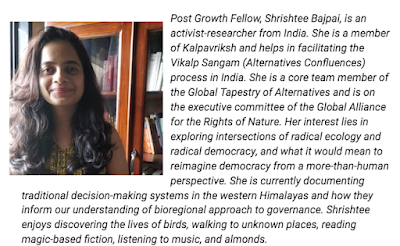
Written by Shrishtee Bajpai and first published at Medium

Our food systems are not just the work of humans. They are the work of the mountains, of Pachamama [Mother Earth], of the sacred, the whole community which is centered on reciprocity, solidarity, and respect for elements of life. This is buen vivir (‘living well’) for us.

That’s according to Quechua residents of Potato Park in the Peruvian Andes, where the community has for the last three decades been involved in an inspiring process of conserving and sustaining their own livelihoods over the vast landscape where the potato originated. They were speaking to us through the dialogue series initiated by the Global Tapestry of Alternatives (GTA) to highlight stories of community resilience and wellbeing in the face of Covid.

The pandemic has shown the deep fractures and baseless promises of wellbeing that the capitalist model made to the whole world. Of course, several other crises pre-exist Covid, from the climate, biodiversity loss, and pollution, to inequality, conflicts, authoritarianism, and right-wing fascism across the globe.

Occurring alongside all this is a long process of colonization or post-colonial hegemony, and the domination of certain cultures and knowledge systems. Combinations of these interconnected challenges have significantly impacted our individual lives, whether it’s alienation from nature and from each other, or a heightened sense of meaninglessness or hopelessness.

It’s in the context of these multiple crises that GTA attempts to foster a dialogical space to show that there are alternative ways of being, knowing, working, dreaming, and of doing things — that the modern capitalist or nation-state dominated system is not the only system around.

Along with processes of resistance, across the world there are tens of thousands of attempts to construct alternative realities, either through sustaining things from the past which are still relevant, equitable, and just, or creating new ones — especially from within industrial systems or the so-called ‘developed’ systems of the world.

The Global Tapestry of Alternatives is a network that was seeded through experiences of networks of alternatives in India, Mexico, and Colombia. After several conversations and endorsements of movements across the world, GTA was officially launched in 2019 as a horizontal process of weaving with non-hierarchical ways of functioning.

With a strong commitment to highlighting the emergence and visibility of an immense variety of radical alternatives to this dominant regime rooted in capitalist, patriarchal, racist, statist, and anthropocentric forces, GTA seeks to create solidarity networks and strategic alliances amongst all networks of alternatives on local, regional, and global levels.

Over the last two years, GTA has organized over 22 sessions ranging from the responses to Covid by indigenous communities in Peru, Mexico, India, and Bolivia, to the responses of women in Rojava to Black Lives Matter and eco-socialist organizing for radical transformations.

Sessions have also included dialogues on techology and alternatives, economies of wellbeing, a commons future, the degrowth movement, alternative models by women farmers, feminist realities and alternatives, artistic resistance in Palestine, the Karen community’s alternatives to state authoritarianism in Myanmar, mining and alternatives by women in Africa, among many others.

Through these dialogues and conversations, the attempt has been to show how communities across the world have responded to contemporary crises with resilience, care, innovation, and adaptability — however desperate the last two years have been. The resurgence of life that we see in innumerable actions of solidarity, cooperation, love, and care in these times are rooted in the aeons-old articulations of indigenous peoples and local communities, both rural and urban.

This spirit circulates among many grassroots expressions of collectives and networks, as dignified rage against systems of oppression as well as the affirmation of their resolve to defend their dignity by articulating a pluriverse of alternatives.

In furtherance to this effort, GTA has also recently launched its first volume of various narratives from around the world weaving solidarity and hope in the times of crises. Together, they provide multifaceted expressions of resistance to dominant forms of oppression — to defend local ways of life, strengthen local autonomy, and reconstruct societies.

The first volume has contributions from Africa, Latin America, South and South-east Asia and Central America. Our two inspiring contributions from Latin America speak to the need of keeping care of Mother Earth at the center of building resilience. The Nasa people of the north of Cauca, Colombia are working towards recovering their territories to grow toxic-free food and in the process heal the earth and themselves.

Another example is from Cauca valley, Colombia, where communities are building water and food sovereignty to supply those in need during the pandemic. From Costa Rica, we learn how the local fishing communities re-launched small-scale fisheries to ensure dignified livelihoods for themselves in times of crises.

From Tharakans in Kenya, we learn how the revival of rituals, ceremonies, and traditional governance helped cope with the crises that the pandemic posed — in turn revealing how traditional knowledge systems act as a counterweight to the hegemonic paradigm of modernity.

From another corner of the world, in Indonesia, the Confederation of Indonesia Peoples Movement (consisting of federations of women, workers, peasants, fisherfolk, indigenous people, and the urban poor) have been building a solidarity economy through various alternative community projects and practises. Their processes helped them respond to the crises by readily organizing community kitchens, engaging with fundraising, and distributing essential amenities within the community.

Not too far from Indonesia, in Bangladesh, the farmers have been leading a New Agriculture Movement that is building innovative farming practises based around ‘seed’, providing an inspiring example of resistance to a globalized food chain by using minimal external inputs, building on local knowledge, facilitating local markets, and practising biodiverse agricultural techniques.

From central India, we learn how communities who were in control of their local means of production could not only counter market forces but also guard themselves against the insecurities of the mainstream economic system. While cities, with their heavily- guarded top-down governance, have been at the epicentre of the pandemic and the economic fallout, empowered grassroots communities fared much better.

These examples show that communities, initiatives, and civil society already have approaches that effectively counter the systemic problems highlighted by the pandemic. They give important insights and pathways for just, equitable, and ecologically resilient futures, and provide hope at a moment when it’s easy to feel hopeless, by showing concrete pathways towards a better future where “many worlds fit,” as the Zapatistas of Mexico put it. It is crucial to tell these stories, to hear them and re-hear them, as they have important lessons for all of us.

The question is: are we truly ready to hear them? Are we ready to constructively challenge each other, offer active solidarity to each other whenever needed, interweave the initiatives in common actions, and support the conditions for the radical systemic changes we need? More than ever, we need to work together and stand in solidarity with each other’s resistances and re-constructions.

As we walk this path, it’s always useful to revisit the famous words of Argentinian film director and theorist, Fernando Birri: “Utopia is on the horizon. I move two steps closer; it moves two steps further away. I walk another ten steps, and utopia runs ten steps further away. As much as I may walk, I never reach it. So what’s the point of utopia? The point is this: it makes us continually advance.”

Three things you can do right now

  1. Take a look at GTA’s webinar seriesresilience documents, and recent periodical on Climate Change and Alternatives, and share them among your friends, family, and colleagues.
  2. Help promote this article by sharing these posts on TwitterFacebook, and LinkedInSign up here for email alerts when articles like this are shared on social media.
  3. Are you involved with a community resilience project or interested in starting or joining one? Get in touch with the GTA to collaborate.

Monday, 6 December 2021

Big Agriculture versus public health

Written by Lois Ross and first published at Rabble

Our current modes of capitalist meat production are dangerous and deadly.

Agribusiness is at war with public health — and public health is losing…”

That quote is taken directly from a new book published by Rob Wallace, a progressive evolutionary epidemiologist from Minnesota who has been studying the onslaught of novel viruses for more than 20 years.

Almost since the inception of this COVID-19 pandemic, the World Health Organization and other organizations have been tracking and investigating, trying to uncover the origins of this zoonotic virus.

In late October, the WHO restructured and reconvened its expert panel after extending its call for experts from around the world to join the committee which will look at emerging pathogens from SARS COV-2 to Ebola. Called the Scientific Advisory Group for the Origins of Novel Pathogens (SAGO), this panel will included some 26 members from around the world. Some of these same members were on the initial panel — criticized for not being serious enough about the theory that the virus was leaked from a lab in Wuhan.

If you do an online search regarding the origins of COVID-19, you will come up with many articles of where the virus may have originated. Check out this line-up from Nature, which includes articles from lab leak theories right through to spillovers from nature. The nature theory is gaining traction. Even prior to the pandemic, an article in Nature published in June 2019 linked increasing human infectious diseases to the expansion of agriculture.

Two recently published books by Rob Wallace track the origins of these and other zoonotic diseases (diseases transmitted from animals to humans), providing compelling information that points to the global agro-industrial food system as the culprit.

In these publications, Wallace tracks how we are producing food — primarily meat — and the impact of our model of agriculture on public health.

It was only a few months ago that I came across a book with a fascinating title and had to buy it. Big Farms Make Big Flu by Rob Wallace was published in 2016 by Monthly Review Press in New York. This collection of essays by Wallace tracks the ways influenza, and other deadly pathogens are emerging out of an agriculture controlled by multinational corporations. The book urges readers to reflect on the connections between industrial farming practices, ecological degradation and viral epidemiology.

Along with many others who study epidemics, Wallace predicted the current pandemic. But what he has also done through these essays is trace the links of dangerous viral outbreaks to the way in which transnationals are destroying forests, grabbing land, overtaking community agriculture, and creating a model of industrial agriculture severely at odds with public health — all in the name of profit.

Wallace is a researcher with the Agroecology and Rural Economics Research Corps and has consulted with the Food and Agriculture Organization and the Centers for Disease Control and Prevention in the United States. For more than two decades he has been mapping the global locations of viral outbreaks, studying the expansion and industrialization of meat production, transportation systems and policies of structural adjustment that have forced countries to adopt methods they might have otherwise foregone.

Raj Patel, author of Stuffed and Starved: The Hidden Battle for the World Food System had this to say about Big Farms Make Big Flu when it was published in 2016: “This collection is a bracing inoculant against the misinformation that will be spewed in the next epidemic by the private sector, government agencies, and philanthropists.”

In March 2020, Wallace began writing about COVID-19. The results of those writings are his second book titled Dead Epidemiologists: On the Origins of Covid 19 – which Raluca Bejan reviewed for rabble earlier this year. In this book, Wallace is straightforward, both about the roots of COVID-19, but also about what the planet must do to try to ensure public health going forward. Throughout the book he also emphasizes the lack of adequate public health infrastructure of many countries, including in the United States.

Wallace writes:

“This century we’ve already trainspotted novel strains of African swine fever, Campylobacter, Cryptosporidium, Cyclospora, Ebola, E. coli O157:H7, foot-and-mouth disease, hepatitis E, Listeria, Nipah virus, Q fever, Salmonella, Vibrio, Yersinia, Zika, and a variety of novel influenza A variants, including H1N1 (2009), H1N2v, H3N2v, H5N1, H5N2, H5Nx, H6N1, H7N1, H7N3, H7N7, H7N9, and H9N2.25. And near-nothing real was done about any of them. Authorities spent a sigh of relief upon each reversal and immediately took the next roll of the epidemiological dice, risking a snake eyes of maximum virulence and transmissibility.”

Dead Epidemiologists is dedicated to three migrant meat-packing workers who died from COVID-19. In paying tribute, the book describes their circumstances (one a 64-year old worker at Cargill’s plant in Hazelton, Pennsylvania; another a 59-year-old poultry farm worker in Forest, Mississippi). This tribute is a poignant reminder of those who toil on the front lines of the agro-industrial complex that Wallace states is creating a global public health crisis. In the next few days, Cargill meat-packing workers in High River, Alberta, belonging to the United Food and Commercial Workers Local 401, are set to strike over festering occupational health and safety issues. Two workers at the plant died and 950 others contracted COVID-19 last year — as documented in a column I wrote in June 2020.

It is no secret that global meat production has increased dramatically in the last 60 years. Each year we consume around 350 million tonnes of meat globally. Meat production has increased four-fold since the mid-1960s and production is expected to grow to more than 500 million tonnes by 2050 — close to twice as much as in 2009.

Meat production is inefficient and requires more energy, water and land to produce than any other food source. In the United States, on average an individual consumes 124 kilos of meat, compared to 20 kilos in most African countries. In Canada, average consumption of meat in 2020 was 67 kilos.

Not only does Wallace challenge the model of meat production, he is also very clear on how dangerous and deadly our current modes of capitalist meat production are. A magazine interview with Wallace published in Germany titled Agribusiness would risk millions of deaths is included as a first chapter to the book. In it, Wallace states:

“Capital is spearheading land grabs into the last of primary forest and smallholder farmland worldwide. These investments drive the deforestation and development leading to disease emergence. The functional diversity and complexity these huge tracts of land represent are being streamlined in such a way that previously boxed-in pathogens are spilling over into local livestock and human communities.”

In that same interview, Wallace continues:

“The real danger of each new outbreak is the failure, or better put, the expedient refusal to grasp that each new COVID-19 is no isolated incident. The increased occurrence of novel viruses is closely linked to food production and the profitability of multinational corporations. Anyone who aims to understand why viruses are becoming more dangerous must investigate the industrial model of agriculture and, more specifically, livestock production. At present, few governments, and few scientists, are prepared to do so.”

Both of Wallace’s books Big Farms Make Big Flu and Dead Epidemiologists: On the Origins of COVID-19 are grounded and logical. And as we well know by now, reality can be stranger than fiction.

These books are not an easy read, but they are an important one — and much of what Wallace details related to viral epidemiology also rings true with those of us reflecting on how agriculture contributes to climate change.

In Dead Epidemiologists, Wallace calls on us to do more:

“If we must partake in the Great Game, let’s choose an eco-socialism that mends the metabolic rift between ecology and economy, and between the urban and the rural and wilderness, keeping the worst of these pathogens from emerging in the first place. Let’s choose international solidarity with everyday people the world over… Let’s braid together a new world system, indigenous liberation, farmer autonomy, strategic rewilding, and place-specific agro-ecologies… Consider the options otherwise.”

Lois L. Ross has spent the past 30 years working in Communications for a variety of non-profit organizations in Canada, including the North-South Institute. Born into a farm family in southern Saskatchewan, trained as a journalist and photographer, she is the author of both fiction and non-fiction books. Two of these books are based on the lives of Prairie farm people. Lois has also worked internationally in Latin America and the Caribbean, reporting and writing about life in Mexico, Nicaragua, and Cuba. The topics she is passionate about include agriculture, rural and international development, and health. 

Thursday, 28 October 2021

Challenge Capitalist Use of Agriculture as a Weapon of Domination


 Written by Don Fitz

It is time to take action against corporate methods of agriculture which poison the food our families eat, threaten the survival of soil ecosystems, destroy the livelihood of farmers, crush farmworker organizing efforts and subjugate entire countries.  Here are a few of the many ways that people are challenging capitalist agriculture, from the very theoretical to the very concrete. 

The core problem of agriculture is 10,000 years old.  Cultivation of annual grain crops inevitably degrades the soil ecosystem and depletes soil organic matter. Perennial grain crops and cropping systems now being developed can resolve this, making food-producing ecosystems as resilient as natural ecosystems.

In India, the small and marginal farmers who comprise 83% of farm households suffer brazen commercialization of the countryside.  The steady withdrawal of state support causes a decline in incomes. Yet, a growing network of people's collectives and agro-ecological approaches are reinvigorating Indian farming and augmenting incomes.

South Africa exemplifies a theme that runs rampant.  Colonialism wrecks the economy of the colonized.  This is especially true with regards to food deserts imposed by settler “farmers” on Black people within South Africa.

In the US, conditions for farmworkers go from daily abuse through wage theft to modern day slavery.  A small, driven group of farm workers joined with the Fair Food Program to completely change these conditions.  Allies across the US can support the expansion of farm worker rights through the Boycott of Wendy's.

On Wednesday, November 3, 2021 (at 7 pm CT USA) four speakers will address these problems during the webinar, “Agriculture as a Weapon of Domination.”  (If you join live from India, 5:30 am, Thursday Nov 4, 2021.)  It will include: 

Wes Jackson, co-founder of The Land Institute, has a doctorate in genetics from North Carolina State University and has written Altars of Unhewn Stone, Becoming Native to this Place, Nature as Measure, and Hogs Are Up, Stories from the Land with Digressions. 

Jaideep Hardikar is a journalist, writer and researcher in Nagpur, India. He is a Roving Reporter with the People's Archive of Rural India, a fellow of the New India Foundation, and the author of Ramrao and A Village Awaits Doomsday. 

Asa Anpu is an African from Occupied Azania (South Africa), who was born in 1992, became a revolutionary in 2013, and joined with the Uhuru Movement to spread the message that colonized people must overturn colonialism in every possible way. 

Nely Rodriguez is a leader of the Coalition of Immokalee Workers (CIW).  She conducts workers’ rights education in the fields of farms participating in the Fair Food Program, hosts daily radio shows on the CIW’s community radio station, receives abuse complaints, manages wage theft claims, and investigates cases of modern-day slavery. 

Delilah Barrios will moderate the program.  She hosts "As All Get Out" on The Populist Voice channel and is the Green Party candidate for Texas Governor as well as being active in its Latinx caucus and Indigenous caucus. 

People with internet connections can join the program via Zoom from anywhere in the world.  The webinar is NO COST, but you need to REGISTER to attend. 

Click HERE to register for the webinar or copy this link into your browser:  https://us06web.zoom.us/meeting/register/tZIsduitpjMsGNU0a8Wqpyj4VEVM1FsFg8Md

After registering, you will receive a confirmation email containing information on joining the meeting. 

Following presentation there will be time for questions, comments and discussion of up to two minutes from those in the audience. 

Don Fitz (fitzdon@aol.com) is on the Editorial Board of Green Social Thought where a version of this article was first published.  He was the 2016 candidate of the Missouri Green Party for Governor.  His book on Cuban Health Care: The Ongoing Revolution has been available since June 2020.

Tuesday, 2 February 2021

Environment and the Irish National Question


Written by Diarmuid Breatnach and first published at rebelbreeze under the title Rupture and Revolution Part 1.

A new periodical has emerged from the Irish Left. At the time of writing two issues of Rupture have been produced and Parts I and II of this article consist of a political overview (but of course from my individual viewpoint) of a number of issues discussed in the magazine. While the assessment of some is highly critical, overall my opinion is that Rupture is a welcome introduction to socialist analysis of conditions in Ireland.

Rupture is a quarterly magazine format produced by RISE, a group of socialists whose most publicly-prominent individual is Paul Murphy (see Appendix) who is also a TD, i.e a member of the Parliament of the 26 Counties. The formation of the party RISE was announced in September 2019 when Murphy announced his departure from the Socialist Party and his joining this new organisation, of which he is a founding member.

Rupture espouses “eco-socialism”, a drive to organise the production of food and fuel under socialist control while dramatically reducing its harmful impact on the environment. Most of its contributors address issues from a Marxist perspective but interviews with activists from some other perspectives are included.

The magazine’s two issues to date included features on public health and private services, the environment and food production. In addition there have been a number of articles on developing a broad socialist front, combating racism and fascism, multi-national companies and neo-liberal capitalism, Big Pharm and trade union struggle. For the first time, the latest issue (November 2020) addressed the issue of the national question (and struggle) in Ireland.

PART I of this article deals mostly with the magazine’s discussion of a) the Environment and b) the National Question, while PART II focuses on its coverage of c) the Health Service and d) the Broad Front and Anti-Fascism. As a consequence each Part contains both positive and negative evaluation.

For another aspect, the layout is generally attractive and mostly easy to read with photography and artwork which is interesting (if its relevance is not always clear). Some articles are perhaps on the longer side for some tastes but then these are big issues being discussed, in many cases literally of life-and/or-death dimensions.

 An annual subscription costs €40 all Ireland or €60 international and I would recommend taking out one for 2021).

Environment

As with most serious commentators on the environment, the articles in Rupture point to an accelerating crisis and the need for urgent action right now. At the same time they point to the unwillingness or inability of the capitalist system – which means the governments of most states today — to take the necessary steps. In fact, unwillingness and inability are almost the same thing with the capitalist system because if one capitalist does not maximise his profit he will be undercut and crushed – or taken over – by another who will do “what is necessary” according to the rules and logic of the system.

Even if in the longer term (or the medium term, in this case) the scramble for profit maximisation destroys the very resource — cod and herring, for example or rainforest. In this case, without the slightest exaggeration, it is the whole civilisation-sustaining environment that is at stake.

Not Fun Facts

“In 2017 a habitat area the size of a football field was lost every second.” “Eirgrid has projected that 2027 as much as 31% of Ireland’s electricty could by consumed by data centres” (most of it for cooling the servers to prevent them overheating). “In Ireland a fairly normal herd of pigs consists of 3,000 animals — only 2% of pigs are living in small herds of 5 or less. ….. a flock of chickens can normally be around 3,000.” Diseases due to overcrowding of animals enter the food chain for humans, causing infections of “bird ‘flu” and “swine ‘flu” through ‘zoonotic spillover’ (remember that term — you’ll be hearing more of it in future).

The prediction a fairly long time ago that the choice, rather than being between socialism or capitalism is in reality socialism or barbarism, is facing us now as an urgent practical question. Because when civilisation crashes the remaining groups of humanity around the world, assuming their survival, will indeed be thrust back into barbarism.

The contributors to Rupture quote writings of Karl Marx and Engels which one never hears from non-Marxist environmentalists and rarely either from Marxists themselves. These early developers of Marxist thought studied not only economics, class struggle and philosophy but also (and dare I say it, necessarily), history, science and culture too.

Mental health is an issue discussed in the magazine not only in respect to the appalling lack of health services in that area or the stresses and strains of work under capitalism but also in the divorcing of most humans in cities from nature. The agricultural landscape, having been moulded by humanity is far from natural and yet retains much of nature, the environment in which humanity first came to exist and in which it developed …. but most people in the West are not employed in agriculture. In these times of fear of infection along with isolation from our regular social contacts, even a walk in a park, in woods, on hills or botanic gardens can be rewarding and a reminder of what we have lost and are losing.

It is a challenge to radically change the way we produce food and generate power in a long-term sustainable way but only a socialist system, with overall benefit replacing profit as the ruling motivation has the possibility of bringing an end to the ruthless exploitation of not only labour but the very environment.

 The National Struggle

This is a question rarely dealt with by the socialist parties in Ireland, a situation which surprises revolutionary socialists across Latin America and much of Europe in particular. Some might ascribe that to the British origin of a number of those parties, particularly the main Trotskyist ones which in that respect established a tradition very far from the theory and personal practice of Karl Marx. So although I have much to disagree with in this article, the fact that it is being discussed at all should be encouraged.

I hope it will serve to encourage further discussion rather than its opposite when I summarise the piece as containing partial history and poor analysis with however one important recommendation. This critique really deserves a treatment all of its own but since this evaluation of the magazine has already got appreciably longer than was my original intent, I will have to be brief and therefore blunt.

The brief overview of history does not even mention that the United Irishmen (and therefore the uprisings of 1798 and 1803) was led almost exclusively by a section of the colonist-descended bourgeoisie, which is why the leadership was virtually all of various Protestant religious backgrounds. This is important because this is not the same bourgeoisie that rules the Irish state today.

The article also omits any mention whatsoever of the linguistic genocidal legislation and practice of the conquerors of Ireland and for any treatment of “the national question” one would have to wonder how or why one would omit that. In dealing with the occupied Six Counties, the treatment of the civil rights movement is poor, even for a very brief overview – it was not only “anti-Unionist unity” that drove or characterised it but opposition to the violent response of the Unionist statelet, Loyalist mobs and paramilitaries and their resolute backing by the armed force of the British State.

 The article remarks on the “weak capitalist class” in Ireland. But what is the nature of the weakness of this class? In other words, towards which forces are they weak? Not towards the working class, with programs of austerity funding bank bailouts, decades of emigration, slow adoption of equal social rights, high homelessness. Not towards the working class, with the Army used to undermine the Dublin Bus strikers in 1963 and 1979 or the restrictions on the right to strike and solidarity action. Not towards the Irish Republican movement with its Civil War, special non-jury courts, its repressive legislation and armed police.

No, it is not those towards which the Irish capitalist class is weak. But it is weak in developing its own industry and developing an independent political line. Its weakness economically is marked by the takeover by big foreign capitalists of nearly all of its industry and telecommunications network, along with chunks of its transport infrastructure and services, its health services (private religious and foreign companies) and its national airline and large pieces of its agriculture. Its weakness is demonstrated in failure to develop its own natural resources and selling them off or giving them away.

The weakness of the Irish capitalist class is demonstrated in its firstly accepting the partition if its national territory and going to war with the independence movement rather than join it gaining total independence. Subsequent, the same weakness manifested itself in its inability to unite its territory and subsequently abandoning any claim to do so.

The weakness of the Irish capitalist class is demonstrated in its permitting atrocities committed against its citizens at home and abroad by the occupying power, only once taking a case against it to the European Courts of Human Rights and never to the European Court of Justice or the United Nations. And it permitted without protest the intelligence services of that occupying power to bomb its capital city many times, including in 1974, with the murder of 26 people (and another eight in Monaghan). And there are many other examples too.

The article admits that the Irish capitalist class has been “acting to facilitate the exploitation of people and resources by foreign capital”. What would we call a capitalist class that behaved like that in Latin America, Asia or Africa? Yes, neo-colonial. Or in Latin America, possibly “comprador”. The difference is not just in location but in the minds of the Irish electoral Left – but none of significance in the reality on the ground. As the contributor from Talamh Beo points out, “even though we’re geographically in Europe, our land history is radically different.” Of course defining the Irish capitalist class as neo-colonial might give one a very different outlook on the national struggle, right?

And also on socialist revolution, which we would understand to be opposed in Ireland not only by the majority native and the minority colonial capitalist classes and their apparatus, not only against our powerful imperialist neighbour, but also against economic interests in the imperialist USA and EU.

In addition, despite the officially neutral status of the Irish State, its armed forces are being integrated into the European imperialist military alliance. Ireland has not (yet) joined NATO but has the EU Battlegroups, as part of the Common Security and Defence Policy (CSDP) of the European Union (EU).

Fianna Fáil, although a split from Sinn Féin in the 1930s and therefore the losing side in the Civil War, it has become the first party of choice of the Irish national bourgeoisie, the “Gombeen” class, a neo-colonial capitalist class. In the historically two-party state, it is currently in power in coalition with its main rival, Fine Gael (and the Greens).

Fine Gael, although formed from the victorious side in the Civil War, it has become only the second party of choice of the Irish national bourgeoisie, the “Gombeen” class, a neo-colonial capitalist class. In the historically two-party state, it is currently in power in coalition with its main rival, Fianna Fáil (and the Greens).

The truth is that in the above respects, Irish Republicans in general have a much better understanding of the Irish State, the representative of that neo-colonial capitalist class, than do the electoral left parties in Ireland. The Republicans have traditions and history and recurring practical experience that teaches them.

Ireland’s main social-democratic party, whenever in Government it has always been as a minor partner in coalition. It always supports the Irish national bourgeoisie, the “Gombeen” neo-colonial capitalist class. It is currently sits on the Opposition bench.

The Green Party of Ireland, whenever in Government it has always been as a minor partner in coalition. It always supports the Irish national bourgeoisie, the “Gombeen” neo-colonial capitalist class. In the historically two-party state, it is currently in power in coalition with Fine Gael and Fianna Fáil.

The electoral socialist Left, far from joining with the Republicans, chooses instead to snipe at them on occasion and to ignore them the rest of the time. And to permit their civil liberties and human rights to be attacked for the most part without protest.

Positive Recommendation

The positive recommendation in the article regards the projected Border Poll. While not wishing for any kind of capitalist Ireland, whether partitioned or united, the article recommends voting YES in any such referendum. I myself must agree with that and along with them find it difficult to imagine how any socialists could advocate any other position.

Recommending a NO vote even if for the best of reasons would isolate any party from the majority of the Irish people, while recommending abstention would leave the party on the sidelines not only regarding the poll but in important debates about what kind of Ireland we should have. Even the British & Irish Communist Organisation deviation of the 1960s and 1970s with their two-nation theory, although it generated much discussion, never looked likely to grow to any size, much less become a mass party of the Left.

I am far from convinced however that a genuine poll on the reunification of Ireland will ever be agreed by the ruling classes of the UK and of Ireland or, should it be held and have a majority for reunification, that the ruling classes will implement the verdict.

 APPENDIX

A Brief Introduction to Paul Murphy (RISE)

Formerly an activist and TD of the Irish Socialist Party, an Irish child of the British Trotskyist organisation the Socialist Party (and formerly, Militant, the largest among a number of entrist groups into the British Labour Party), Murphy left them gently in September 2019 to form the RISE group. It may be remembered that Clare Daly, also a TD, left the SP in August 2012 in a somewhat more acrimonious dispute and became part of Independent Left with some other socialist TDs and municipal councillors, since when she and her partner Mick Wallace were elected Members of the European Parliament and virtually disappeared from the Irish political scene (to be missed by many without allegiance to either group). 

Paul Murphy has also been an MEP in the past, from 2011-2014. Although now a member of a different political party, he has remained in the Solidarity-People Before Profit coalition of SP and PBP which retains another five TDs (four essentially of the Socialist Workers’ Party but no longer any of the SP). 

Murphy has a long record of activism and has been violently handled by the Gardaí (Irish state police force) on a number of occasions and also arrested as part of the celebrated Jobstown case defendants in 2015 (all acquitted two years later). His international activism includes participation in the Gaza blockade flotilla in 2011 and high seas capture by the Israeli Zionist state, detention and deportation. 

His production of regular video broadcasts to date during the Covid19 crisis, both from home and of his interventions in the Dáil have included lashing the Government on placing accommodation of capitalism above the lives or ordinary people, denouncing its “yo-yo policy” of precautionary restrictions followed by much-too-early relaxation and also demanding the nationalisation of private health facilities.