Showing posts with label Fred Magdoff. Show all posts

Tuesday, 28 April 2020

The Natural World and Covid-19


Written by Allan Todd

“The past is a foreign country: they do things differently there.”

L. P. Hartley, The Go-Between, (Harmondsworth, Penguin Books, 1975), p.7

In the midst of this global Covid-19 pandemic, Wednesday 22 April marked the 50th. Anniversary of Earth Day. Fifty years ago, on 22 April 1970, 20m people in the US (around10% of the total population) took to the streets and university campuses to protest against environmental degradation: such as oil spills, smog and rivers that, quite literally, caught fire. The protesters demanded a new way forward for Planet Earth - and, initially, in the early 1970s, some important environmental gains were made: such as the setting up of the Environmental Protection Agency, and the establishment of the principle that "the polluter pays".

But the fifty years since 1970 has shown that the past is indeed “a foreign country” - certainly as regards the environment. From the late 1970s, rampant neoliberal capitalism has not only wiped out most of those gains - it has even made things much worse. In particular, its rapid and on-going destruction of the natural world has resulted in an ever-worsening Climate Crisis - and in dangerous zoonotic pathogens and viruses increasingly crossing from the dwindling number of wild animal species to humans.

As well as the Covid-19 coronavirus, this century has also experienced three other coronavirus epidemics: SARS, in 2002 and 2004; and MERS in 2012. Most recently, from 2013-16, there was the Ebola epidemic, caused by a filovirus. The combined evidence of dangerous global warming and ecological crisis shows that the world is experiencing nothing short of capitalist ecocide.


As Michael Löwy, (Ecosocialism: A Radical Alternative to Capitalist Catastrophe) one of the leading ecosocialist thinkers, has said, “…preserving the ecological equilibrium of the planet and therefore an environment favourable to living species, including ours, is incompatible with the expansive and destructive logic of the capitalist system.”

In the 21st. C., the planet - and all life on it - is now facing an unprecedented combination of threats, all as a result of the expansion of the global capitalist system: catastrophic climate breakdown as a result of global warming; a huge loss of ecosystems and biodiversity via a Sixth Mass Extinction; and, as a result of both these dangers, an increase in the frequency of dangerous pathogens crossing from wild animal species to humans.

Twenty-first century ecosocialists are not alone in having recognised the negative impacts of capitalism on the natural world. As well as William Blake - whose poem Jerusalem was one of the earliest literary attacks on the “dark Satanic Mills” of early industrial capitalism - William Wordsworth also pointed out, in a critical way, both the growing encroachments of industrial capitalism on nature (at what has since come to be seen as the start of the Anthropocene), and emerging consumerism:

“The world is too much with us: late and soon, 

Getting and spending, we lay waste our powers; 

Little we see in Nature that is ours; 

We have given our hearts away, a sordid boon!

...For this, for everything, we are out of tune; ”

William Wordsworth, The World Is Too Much With Us in William Wordsworth, S. Gill (ed.), (Oxford, OUP, 1990), p.270

Much more recently, in 1979, James Lovelock’s Gaia: A New Look at Life on Earth, summarised the main points of the ‘Gaia Hypothesis’, that he had developed earlier with Lynn Margulis. In fact, it was the novelist William Golding who suggested the name ‘Gaia’ - as Gaia was the Ancient Greek goddess of Earth. 

And that theory - as briefly summarised by Bryan Appleyard - is that: “Life and the Earth are an interacting whole and the planet can be seen as a single organism:…”  Since then, we have become increasingly aware of just how dangerous it can be to radically alter/interfere with the complex ways in which this organism functions.

However, one of the clearest summaries of the negative impacts of capitalism was drawn up by Michael Löwy in 2005:

“The reigning capitalist system is bringing the planet’s inhabitants a long list of irreparable calamities….All the warning signs are red: it is clear that the insatiable quest for profits, the productivist and mercantile logic of capitalist/industrial civilization is leading us into an ecological disaster of incalculable proportions. This is not to give in to ‘catastrophism’ but to verify that the dynamic of infinite ‘growth’ brought about by capitalist expansion is threatening the natural foundations of human life on the planet.”

If nothing else, this pandemic crisis is making it painfully clear that ‘system change’ is now needed, as quickly as possible, in order to create an economic system that allows for a habitable and sustainable planet. The past 50 years has shown that the ‘System’s’ – i.e. capitalism’s - imperative to push for ever-continued and - increased productivity and consumption, in order to expand short-term profitability, is increasingly exposing the planet’s ecosystems, natural habitats and species to serious threats that are already significantly undermining the planet’s ecological balance.

Furthermore, the unsuccessful global attempts to significantly reduce the emission of greenhouse gases - primarily, but not solely, CO2 - show that the ‘System’ cannot even regulate its destructive actions, let alone overcome the planetary and ecological crises it has already triggered. Faced with the choice of ‘Grow - or die!’, it is clear that, as regards the natural world, neoliberal capitalism continues to favour the latter.

Thus, if capitalism remains - at the very least - unchecked, it will have increasingly devastating impacts on human, animal and plant life. It is now abundantly clear that one of those impacts - especially, but not exclusively, on the poorest and most vulnerable members of all societies - will be ”Epidemics of malaria, cholera, and even deadlier diseases…”

Zoonotic pathogens

As the global impact of the Covid-19 pandemic continues to disrupt lives - and ‘business as usual’ - many are looking for explanations. In part, this is because this is the fourth time this century that humans have been hit by a zoonotic pandemic or epidemic: in 2002, and again in 2004, there was SARS; in 2012, there was MERS; and, from 2013-16, there was the Ebola epidemic.

One aspect that all four infections have in common is that they were all viruses - zoonotic pathogens - that crossed over from wildlife species to humans. The first two - SARS and MERS - like Covid-19, were both coronaviruses; Ebola was a filovirus.

A second feature of these recent infections is that they can all be linked to the climate and ecological crises which have all got worse since the start of this century. Jem Bendell is one researcher and writer who has made the point that climate change has made humans more vulnerable to such viruses. For instance, he explains how declining food sources force wild species - such as bats - to range into new areas:

https://jembendell.com/2020/03/23/the-climate-for-corona-our-warming-world-is-more-vulnerable-to-pandemic/

In addition, lack of sufficient food sources renders such species weaker and therefore more susceptible to infections.


Another factor he highlights is how climate change is increasing our risk of catching diseases like Covid19 by its impact in destroying and degrading natural habitats, and by the resultant biodiversity loss. As he explains:

“The reduction of the total number of wild animals like birds and bats has implications for our exposure to disease. Why?  Because these are ‘reservoir host populations’ for pathogens, and the fewer birds and bats there are, then pathogen concentration and mixing tends to be higher (for reasons of lowered genetic diversity and easier spread). This increases ‘spillover risk’ for zoonotic infections to humans.”

Another to have warned recently about the likelihood of this increased risk of new infections and pandemics because of the growing convergence of ecological crises is Ian Angus:

“Global warming…Species extinction…Deforestation…New diseases and plagues. The list goes on. We face a planetary emergency,…”

However, it is not just global warming and climate change that is causing the loss of natural habitats and biodiversity. As has been seen, one of the biggest drivers of the destruction of natural habitats - and of the resulting ‘Sixth Mass Extinction’ of species - is the global capitalist agricultural system. 

This is especially true of the industrialised meat and dairy industries, which, firstly, destroy ever-larger sections of the natural world; and, secondly, also create unhealthy conditions for factory-farmed animals, which make it much easier for animal viruses to cross-over to humans. In addition, there is the use and abuse of wild animals - such as the capturing, breeding and eating of various species.

Even during this pandemic, Brazilian president Bolsonaro has stepped up the destruction of the tropical rainforest in Brazil - from August 2019 to March 2020, satellite photographs show that an area the size of Germany has been cleared. 

Yet scientists and researchers have known for some time that disturbance and destruction of such natural habitats is one of the principal drivers of the transfer of animal-borne infectious diseases from wild animals to humans. Kate Jones, Chair of Ecology and Biodiversity at University College London, has said that such developments are resulting in an “increasing and very significant threat to global health, security and economies.”


In 2008, she was part of a research team that determined that at least 60% of the 335 new diseases that emerged between 1960 and 2004 originated with non-human animals.

To deal with the wider ecological dimensions of this pandemic, as Alan Thornett explains in a very timely article:


will involve “…a revolution in the infrastructure, [in] how we live; the size of cities, how we travel, and what we eat. The task is gigantic but there is no alternative if we are to forge a sustainable future for the planet which resolves the contradiction between ourselves as modern humans and [the] myriad of other non-human species we live alongside.” 

In a way, pathogens like Covid-19 could be seen as Nature’s equivalent of Walt Kowalski in the film Gran Torino (2008), taking its revenge on humans for the damage we are doing to it:

“Ever noticed how you come across somebody once in a while that you shouldn’t have f**ked with? That’s me.”


Half-Earth

One very radical way to overcome these problems is proposed by world-renowned biologist Edward Wilson, who has argued for what has been described as “a visionary blueprint for saving the planet”. This blueprint calls for half of the surface of the Earth to be dedicated to nature. He sees such a scheme as essential if we are to stave off the mass extinction of species - including of humans. Essentially, he sees the current situation as too large to be solved by piecemeal measures, because:

“For the first time in history, a conviction has developed among those who can actually think more than a decade ahead that we are facing a global endgame. Humanity’s grasp on the planet is not strong. It is growing weaker.”

He goes on to argue that anything less than half would not be enough to deal with the threats currently being faced by the natural world:

“Unless humanity learns a great deal more about global diversity and moves quickly to protect it, we will soon lose most of the species composing life on Earth. The Half-Earth proposal offers a first, emergency solution commensurate with the magnitude of the problem: I am convinced that only by setting aside half the planet in reserve, or more, can we save the living part of the environment and achieve the stabilization required for our own survival.”

As has already been seen, one aspect of human activity which has already destroyed large amounts of natural habitats and biodiversity is the ever-expanding meat and dairy components of capitalist agriculture. This ‘conventional’ agricultural system needs to be changed in order to save what remains of biodiversity - and one of the quickest ways to do so would be, at very least, to drastically reduce meat and dairy consumption.

This would allow some already-existing agricultural land to be used, instead, to provide humans with plant-based sources of proteins and other nutrients. In addition, other areas of land could be returned to the natural world. Such a move would also help reduce greenhouse gas emissions - and thus contribute to the slowing of global warming which is another factor destroying so much of the natural habitat required by so many species. 


In addition, a shift to a more plant-based diet for humans would play a big part in reducing humanity’s overall ecological footprint, which is necessary to allow the development of a genuinely-sustainable economic system. This doesn’t mean less food for humans - on the contrary, it actually means more food; and food which is not full of the antibiotics and hormones that are often present in meat and dairy products. Such a shift would also form an essential element in creating a world where wealth would be based on quality of life rather than on the quantity of material goods. 

This is a view expressed by the UK’s Royal Society, in their 2012 Report, People and the Planet - which was subsequently endorsed by a global network of scientists and ecologists. In particular, it referred to the need for “systematically decoupling economic activity from environmental impact” and pointed out the urgent need to reduce “…deforestation, and land use…” Instead, the Report saw greater valuing of “natural capital” as the way to improve human welfare so that people can flourish rather than just survive;


Currently, it can be argued that the destruction of so many ecosystems - and the Sixth Mass Extinction of species such destruction is causing - is a threat as big as that posed by the worsening Climate Crisis. As Covid-19 is currently showing, both of these linked and deadly Anthropocene developments are linked to the increased frequency of pandemics.

The Half-Earth proposal also makes sense as an insurance policy: because, in addition to global warming and the destruction of so much of the natural world, there will always be natural disasters to contend with. Our Anthropocene epoch has seen many earthquakes and volcanic eruptions that have impacted on human life - and earlier epochs have also experienced significant climate damage as a result of asteroid strikes. By ensuring sufficient biodiversity remains on Earth, the chances of coping with such additional natural crises are significantly increased.

An important point to grasp as regards the destruction of the natural world is that it’s not, per se, a problem of ‘excessive consumption’ by humans, all of which thus needs to be limited. Rather, it is a problem of the types of consumption - of many products, including food - associated with capitalism. In a more rational society, as Ernest Mandel commented, instead of:

“The continual accumulation of more and more goods (with declining ‘marginal utility’)…” other priorities, such as “…the protection of health and life” would “become major motivations once basic material needs have been satisfied.”

Allan Todd is a member of Left Unity, an environmental and anti-fascist activist, and author of Revolutions 1789-1917. 

Sunday, 18 February 2018

Book Review - Creating an Ecological Society: Towards a Revolutionary Transformation


Written by Sean Ledwith and first published at Counterfire

Magdoff and Williams provide a powerful case that ecological disaster can be overcome by a revolutionary transformation of social relations.

In November 2017, UN climate observers reported that the past three years have all been in the top three years in terms of temperature records. They also reported temperatures topping 50C in Asia, record-breaking hurricanes in rapid succession in the Caribbean and Atlantic, devastating monsoon flooding affecting millions, and a relentless drought in East Africa. The World Meteorological Organisation has stated that indicators up to this point suggest that 2017 will actually be the hottest year since records began. The concentration of CO2 in the atmosphere is now estimated to be higher than at any time in at least 800,000 years. Bearing in mind our species has been on the planet for only about a quarter of that time, this is clearly a crisis of unprecedented magnitude for humanity.

Although the existential threat to life on Earth by climate change becomes increasingly apparent year by year, the capacity of capitalist politicians to respond appropriately remains pitifully inadequate. Trump’s stated goal to take the US out of the 2015 Paris climate deal is only the most egregious example. Supporters of renewable energy estimated earlier this year that UK government funding of wind, solar, biomass power and waste-to-energy projects is set to fall by 95% over the next three years.

The incompatibility of sustainable development with the logic of capital has long been recognised on the left and there have been a number of insightful attempts recently by writers such as John Bellamy Foster and Ian Angus to systematise a coherent ‘red-green’ perspective on the unfolding crisis. Fred Magdoff and Chris Williams, in Creating an Ecological Society, have produced a left-wing analysis that is a worthy addition to this collection. They explicitly make the case that only a revolutionary transformation on socialist principles will generate a political framework to save the planet: 

‘if we can’t even imagine a different way of interacting with one another, the economy and the resources we use and depend on, then the struggle for a just and ecologically sound world recedes into the realm of utopian fantasy’ (p.18).

What makes their account particularly powerful is an awareness that only a Marxist perspective on climate change can comprehend that the environmental crisis is intrinsically linked to other manifestations of a declining and dysfunctional social and political system. The book includes incisive analyses of how racism, sexism, class inequality and other forms of oppression are rooted in the dynamics of capitalism and that, consequently, the struggle to avert ecological collapse cannot be separated from campaigns against these and related injustices.

A holistic and all-encompassing vision of both the global situation, and the type of activism required in response, makes this an informative and uplifting account of ecosocialism that is as good as any other available:

‘Whether the issue is police brutality, the building of new oil or gas pipelines, the erosion of voting rights or workers’ rights, the vilification of Muslims or immigrants, sexism in the workplace or elsewhere, or some other battle for social and economic justice and a healthy environment, we must take it on’ (p.328).

The book is coherently structured into sections that address different aspects of the debate on the politics of the environment.  As the co-authors have both a scientific background and a commitment to left-wing politics, their exploration of the issues provides a wealth of professional expertise and political acumen.

The scale of the crisis

The first section is a searing explication of the enormity of the crisis confronting the planet. Climate-change denial is hopefully a shrinking point of view (with the disastrous exception of the Trump administration) but it is always worth being reminded of the scale of ecological degradation that is underway in the natural world. Magdoff and Williams collate a valuable synthesis of data from numerous fields that collectively make an irrefutable case for the evidence of human impact on the planet. Their grim but thought-provoking starting point is an imaginary scenario set centuries ahead in which the crisis of our times has not been tackled effectively:

‘At some time in the future archaeologists may look at the rubble of a large twenty-first century city or other physical remnant of today’s world and wonder, as Shelley’s traveller surely would, what cataclysm struck that civilisation?’ (p.17).

Based on that premise, they provide some staggering evidence that such a scenario is not far-fetched (chapter 1). Even the Paris deal on which Trump has reneged, the authors calculate, is hopelessly insufficient. The guidelines contained in the agreement on acceptable warming would still result in a global temperature rise of 4C, making a mockery of the deal’s stated purpose to limit it to 2C.

They estimate the amount of energy being pumped into the atmosphere since the start of this century is the equivalent of four atom bombs every second. Last year, the extent of sea ice of the Arctic hit an all-time low. An area the size of Alaska has been lost from the ice pack there in just the last fifty years. The fastest melting point of Antarctica contains enough water to raise global sea levels by four feet. In thirty-five years, there will be more plastic in the oceans than fish. Ninety percent of all sea birds have ingested some type of plastic. 

Giant tortoises existed on the Earth for ten million years and yet one sub-species has now been exterminated by human beings in the space of less than one century. Four thousand people die every day in China due to breathing polluted air; 6.5 million die every year around the world for the same reason. Half of the forests cut down by human beings since the last ice age have been since World War II. Last year, London exceeded its annual limit for nitrogen-dioxide levels within the first week of January.

The role of class and imperialism

Unlike more mainstream accounts of the crisis, however, Magdoff and Williams link these types of problems to the class nature of the system that is presiding over them. They identify that 10% of the global population (the richer countries that is) are responsible for consuming 60% of the Earth’s resources and releasing the same proportion of pollutants into the atmosphere (p.108). Of course, within that 10% is the even smaller percentage who actually control the economies of the major capitalist states. In the US, nearly 40% of all consumption is by the richest 5% (p.50). The authors highlight the jaw-dropping disparity recently highlighted by Oxfam that eight super-rich individuals have accumulated as much wealth as the poorest half of humanity, that is 3.2 billion people (p.41). The same report noted the wealth stashed away by the global elite in offshore tax havens amounts to nearly $7 trillion.

The necessity of integrating the campaigns against climate change and inequality is underlined by research that shows that nearly two-thirds of carbon emissions originate from just ninety companies around the world and, of those ninety, eight are responsible for 20% of the emissions from fossil fuels and cement production over the past couple of centuries (p.120). The authors regard a combined struggle against the elite and the destruction of nature they have wrought as a pre-requisite for safeguarding the future of humanity. They creatively deploy a concept deployed by the nineteenth-century thinker, John Ruskin, that capitalism generates not wealth but ‘illth’:

‘Illth comes in many forms. One is conspicuous consumption by the very rich - the luxury cars, yachts, private jets, huge houses, and other forms of conspicuous living. If this richest 10 per cent reduced their consumption to the average consumption of the rest of humanity, total global resource use would be cut in half (p.108).

As well as underlining the crucial link between capitalism and the environmental crisis, Magdoff and Williams highlight the often hidden role imperialism plays in exacerbating the threat to the biosphere by diverting vast funds into wasteful projects. In the eyes of some, Obama now looks like a model of ozone-friendly politics compared to his toxic successor, but the authors are scathing about the reality behind the rhetoric. They remind us that Obama ploughed $1 trillion into an upgrade of the US’s stockpile of nuclear weapons and the development of the F35 fighter, the most expensive military vehicle in history. The Pentagon is planning to construct over two thousand of these by the end of the 2030s; the helmet for one pilot alone costs $400,000! Magdoff and Williams calculate the cost of one plane would be enough to subsidise over three thousand years of college money! (p.111):

‘The military also wastes incredible quantities of fuel. It is exempt from all international climate agreements and local environmental regulations at its hundreds of bases worldwide, allowing the US military to be the single largest user of fossil fuels and by far the world's biggest polluter’ (p.112).

This recognition of the threads connecting the crisis in the natural world to a crazy economic system with its militarised obsessions makes this analysis superior to anything coming from the orthodox green movement.

Oppression and ecological crisis

As part of their crucial perspective that the environmental crisis is one aspect of the systemic failure of capitalism, Magdoff and Williams also provide valuable analyses of the sexism, racism and poverty afflicting Western societies and explain why these forms of oppression cannot be siloed away from the impact of the rich on the biosphere. Again, their utilisation of official statistics provides powerful ammunition for activists. They note data from the UN that women’s unpaid contribution to the global economy amounts to $11 trillion (p.144) and from the World Health Organisation that one third of women around the world have experienced some form of physical or sexual violence, usually from a partner (p.147). The Weinstein scandal this year has obviously put this issue in the spotlight, but this shocking fact suggests no one should really be surprised by the extent of the problem.

They also draw attention to the epidemic of police violence plaguing US society in particular, and see it as another symptom of a rotten system; 67% of the US prison population is black, whereas only 37% of the general population is classified as such (p.134). This is part of a wider increase in the size of the prison population of 500% over the last forty years (p.133)

The link between racism and the environmental crisis is spelled out even more in a discussion on how the living conditions of working-class black Americans puts them at greater health risk than more affluent sections of society:

‘Compared to the rest of the population, people of colour are more likely to be living near toxic waste sites (56 percent of those living nearby are people of colour); twice as likely to live without clean water and modern sanitation facilities; they are thirty-eight times more likely to be exposed to nitrogen dioxide, which causes respiratory problems’ (p.139).

As Marxists, the authors integrate their account of these forms of oppression within the concept of alienation as developed by Marx in the nineteenth century, and explain how part of its deleterious effect of the human personality is to set us subjectively against those who are objectively our comrades in struggle:

‘These social divisions are not accidents. They act to prevent people from uniting, to keep them fighting to stay one rung higher up the ladder by stepping on those below. That is why racism and the systematic oppression of women are endemic to capitalist societies, varying only by degree’ (p.132).

It would be understandable if a reader of this volume was to feel despondent due to the overwhelming evidence presented that twenty-first-century capitalist society is taking us at an accelerating rate towards a precipice. However, the authors are refreshingly optimistic about chances of a revolutionary transformation taking place at some point in the next few decades and argue the Arab Spring, the Occupy movement and the electoral revival of the left in the West are all portents of impending class struggle on a massive scale:

‘To be successful any revolutionary upheaval will have to dwarf the mobilisations we have seen recently around the world and take place on a qualitively different basis. It will have to be organised to reflect the principles of the future society and take control of the centres of production to bring capitalism to a halt’ (p.301).

They helpfully remind us that ‘capitalism has been prevalent for less than 0.3 percent of the entire period that modern humans have walked the earth’ (p.184), so it is irrational to believe future generations are condemned to endure the madness of a system that prioritises mass destruction above mass education. They forcefully argue that for the majority of our history as a species, altruistic and other-centred behaviour has been the norm in most societies and it is probable these traits will predominate in a postcapitalist system. Even in today’s cutthroat neoliberal culture, the indicators of a re-energised human nature are visible:

‘Prosocial behaviour and traits are often suppressed by the need to express those contrary behaviours required to survive and flourish within the system of capital. However, even when antisocial capitalist social relations are prevalent, there are expressions of the deep human values of empathy, solidarity and cooperation’ (p.193).


Sean Ledwith is Lecturer in History and Politics at York College, where he is also UCU branch chair. He is a member of Counterfire and York People's Assembly. Sean is also a regular contributor to Marx and Philosophy Review of Books and Reviews in History.

Sunday, 7 May 2017

Democratic Eco-Socialism as an Alternative World System


Written by Dr. Hans Baer adapted from a presentation to the Isocracy Network 2016 Annual General Meeting, November 19, 2016 and first published at The Isocracy Network

Capitalism and the Environment

In the drive for profits, global capitalism sacrfices the basic human needs of the majority. Some, a very small percentage, get much more than they need and others do not even get enough to satisfy their minimum needs. There is an enormous disparity is wealth; Oxfam reports that the 62 richest people in the world have as much as the poorest half of the world's population [1]. The existence of poverty and patriarchy stimulates further population growth which entrenches these problems. Global capitalism's requirement for on-going accumulation and growth is environmentally unsustainable, fostering a treadmill of production and consumption that is heavily reliant on fossil fuels, contributing to climate change and resource wars.

Climate change is real. According to NASA [2] and instrument records global surface temperature has rose over a degree since 1880, and fifteen of the sixteen warmest years have occured since 2001 (the exception being 1998), with 2015 the warmest year on record - and 2016 projected to surpass it. Many climate scientists project 4+ degree world by 2100 if greenhouse gas emissions are not quickly diminished. The prevalence of CO2 has increased from 280 ppm at time of Industrial Revolution to 404 ppm in 2016, leading to the a level at the highest point of the last 800,000 years and a rise in other greenhouse gas emissions such as methan, nitrous oxide etc. Recent decades have witnessed retreats of glaciers, a reduction in permanent polar ice cover, and a rise in global sea levels. The result is significant impacts on biodiversity.

A Future System

As a critical anthropologist, I argue that social systems do not last forever, whether on a local, regional, or global scale. As a system capitalism has been around for approximately 500 years and has become the global system. It contains many inherent contradictions, and must be transcended to ensure survival of humanity and animal and plant life. Whilst it is however a well-entrenched system with a great deal of money and power backing it, there is a need for an alternative global system, one that is committed to meeting people's basic needs, providing equity and justice, democracy and sustainability - that is democratic eco-socialism.

Over the past forty years Immanuel Wallerstein has been a significant contributor to the research project of world-systems theory, which emphasizes the world-system of global capitalism as the primary focus of study. Capitalism has global market economy. It pays attention to an international division of labour where some 'core' regions of wealth and power (North America, Western Europe, Australia and Japan) differ in their characteristics and capital concentration to the 'semi-periphery' and 'periphery' regions.

The current system cannot survive forever [3]. One possible alternative is global fascism or eco-authoritarianism. In many ways it reflects more of the same but with increasing authoritarian control. It is a fortress world mentality, which assumes continued and expanded private ownership and control of environmental resources with meagre resources metered out to the many. The other alternative is global democracy or an eco-socialist world system. According to Wallerstein the end crisis of the present world capitalist system will occur in the next thirty to forty years, but what will replace it remains unclear.

Socialism and Democracy

Rosa Luxemburg once remarked: "Kein Sozialismus ohne Demokratie, keine Demokratie ohne Sozialismus" ("No socialism without democracy, no democracy without socialism"), which serves as a complement to another of her famous quotes "Bourgeois society stands at the crossroads, either transition to Socialism or regression into Barbarism." With this is mind it is worth considering the two alternatives of capitalist democracy and ‘actually existing socialism’.

Capitalist democracy, even in its most advanced liberal form, is a very limited democracy, on that offers the formal choice of representatives every few years. It does not provide economic democracy, and it limits participatory democracy. Noam Chomsky, for example, has described capitalist democracy in the United States as a democracy for the one percent [4]. It is effectively a one party system where different factions of the capitalist class determine their representatives; multinational companies have the global capacity to make or break governments and politicians around the world.

With regard to "actually existing socialism", it is clear that the forces of production not fully developed, placing them between a economic transition between capitalism and socialism and often not even as politically advanced. Various political theorists have different interpretations of what these societies constituted. Leon Trotsky referred to the USSR as a "degenerated workers state." Paul Sweezy referred to the USSR as a "post-revolutionary society", and Wallerstein references the "socialist world government" (that is, the government of 'the socialist world'). Others such as Tony Cliff and Charles Bettelheim referred them as "state capitalist". Others, like Milovan Djilas, referred to the collective bureaucracy as a new class society.

The alternative to capitalist democracy and state socialism is socialist democracy [5]. It means a political economy orientated towards meeting social needs which is decided democratically. It means public ownership of the means of production, with high levels of social equality. It means adherence to democratic processes, both representative and participatory. And it means environmental sustainability. As Magdoff and Foster observe,
"An economic system that is democratic, reasonably egalitarian, and able to set limits on consumption will undoubtedly mean that people will live at a significantly lower level of consumption than what is sometimes referred to in a wealthy country as a 'middle class' lifestyle (which has never been universalized even in those societies. A simpler way of life, although 'poorer' in gadgets and ultra-large luxury homes, can be richer culturally and in reconnecting with other people and nature, with people working the shorter hours need to provide life’s essentials. A large number of jobs in the wealthy capitalist countries are non-productive and can be eliminated, indicating that the workweek can be considerably shorter in a more rationally organized economy" (6).
A Transitional Programme

Socialism has become a subject of interest again in the world, especially in Latin America with various implementations of the "Boliviarian Revolution", such as Venezuela, Bolivia, Ecuador, and with support from Cuba. In 2008 a Gallup poll in Peru found that nearly 50% favoured socialism over capitalism and only 16% favoured capitalism [7]. In the UK, A New Statesman article states:
"At the beginning of the century, the chances of socialism making a return looked close to zero. Yet now, all around Europe, the red flag is flying again. Make no mistake, socialism – pure, unadulterated socialism, an ideology that was taken for dead by liberal capitalists – is making a strong comeback. Across the continent, there is a definite trend in which long-established parties of the centre left that bought in to globalisation and neoliberalism are seeing their electoral dominance challenged by unequivocally socialist parties which have not." [8]
Countries with parties in places that are engaging in this challenge include Greece (SYRIZA), France (Nouveau Parti anticapitaliste), Germany (Die Linke) and Holland (Socialist Party) "challenge an economic system in which the interests of ordinary working people are subordinated to those of capital". In the English-speaking world there has been the phenomenon of Jeremy Corbyn and Bernie Sanders phenomenon in UK and US, although we are yet to see such an example in Australia.

Transitional reforms for democratic eco-socialism require left parties to capture the State, with support from various anti-systemic movements. In power, corporate carbon and other emissions would be taxed at point of production, and there would be an increasing ownership or socialisation of means of production. A movement toward greater social equality nationally and internationally would occur parallel to building workers' democracy and implementating reforms such as creating meaningful work in a shorter working week, eventually moving towards a net-zero-growth or steady-state economy.

As much as possible would be produced locally, avoiding the environmentally destructive effective of fossil fuel-based shipping. Energy itself would be based on renewals, such as solar, wind, thermal, and wave energies, and these would in preference to nuclear, hydroelectric, and biofuels of of which have their own environmental problems. There would be an emphasis on public transportation, and as a result a massively diminishing reliance on private motor vehicles and special licensing required for four-wheeled drives. Cities would need to be redesigned to provide smaller and more energy efficient buildings and dwelling units.

Finally, a transitional program would require shifts in food production. With full environmental costs included in the price of foodstuffs there would be a shift towards more consumption of vegetables and grains over meats. Industrial agriculture would be gradually replaced by permaculture and agro-ecology - essentially producing what is sustainable for the land and what is sustainable for the environment to be consumed.

These are, of course, very significant changes to the way that we are doing things at the moment. But the way that we are doing things is part of the capitalist world economic system. It is not a sustainable system, and it is a system that is destructive to the health and well-being of members of our own species, of other species, and of the planet itself. Because of this we must change to a world system of democratic eco-socialism. These ideas are further explored in greater detail at The Next System website [9], and those who wish to engage in the ideas are encouraged to review the documents there.

Dr. Hans Baer of the Development Studies Program, School of Social and Political Sciences, at the University of Melbourne, Australia.

References

[1] Oxfam, 62 people own same as half the world, 18 January 2016. https://www.oxfam.org.au/media/2016/01/62-people-own-same-as-half-the-wo...
[2] Data source: NASA's Goddard Institute for Space Studies (GISS).
http://climate.nasa.gov/system/internal_resources/details/original/647_G...
[3] Discussion of some alternatives can be found at: Wolgang Streck How Will Capitalism End?: Essays on a Failing System, Verso Books, 2016 and Immanuel Wallerstein (ed) et al., Does Capitalism Have a Future?, Oxford University Press, 2016
[4] Alexandra Rosenmann, Noam Chomsky: America is only a democracy for the 1 percent, Alternet, June 22, 2016. See also 'On Democracy: Noam Chomsky interviewed by Tom Morello", 1996 https://chomsky.info/1996summer/
[5] Hans A. Baer, Global Capitalism and Climate Change: The Need for An Alternative World System, AltaMira Press, 2012
[6] Fred Magdoff, John Bellamy, "What every environmentalist needs to know about capitalism", Monthly Review, May 2010
[7] Steve Crabtree, More Peruvians Favor Socialism Than Capitalism, Gallup, August 6, 2008
[8] Socialism's comeback, New Stateman, December 4, 2008
http://www.newstatesman.com/europe/2008/12/socialist-party-socialism
[9] http://thenextsystem.org/toward-democratic-eco-socialism-as-the-next-wor...

Sunday, 18 September 2016

An Ecologically Sound and Socially Just Economy


Written by  and first published at Monthly Review

Two weeks ago I returned from my fiftieth class reunion at Oberlin College in Ohio. The brief discussions I had there with environmental faculty and students left me feeling a bit dazed. So many good and intelligent people, so concerned, and doing what they think and hope will help heal the environment—this college has one of the best environmental education programs in the country.

However, I was left disappointed and profoundly discouraged by the lack of discussion—or even interest in having a real continuing discussion and debate—regarding the root causes of our environmental disasters. Not just climate change, but also pollution of the air, water, soil, and living organisms, the loss of biodiversity both aboveground and in the soil, the extinction of species, and the overuse and misuse of both renewable and nonrenewable natural resources.

It is as though there is a flat tire with perhaps a thousand holes and people are working on the best way to patch this hole or that one. No one there seems to consider that the problem might be the tire itself—that the design and materials utilized are not appropriate to the way it is being used. And, if that is the case, then no amount of patching can solve the flat tire problem. It is of the utmost importance to be able to distinguish between symptoms (that most people call “problems” or “crises”) and underlying causes.

I ran into this confusion between symptoms and underlying causes time and time again in agricultural science and farming practices. Soils may be prone to erosion, store little water, grow crops that are susceptible to diseases and insect attack, become compacted, or have low fertility. Farmers (and extension specialists), usually think of and deal with these as individual problems—using pesticide applications, lots of commercial fertilizers, irrigating more frequently, using heavier equipment, and so on. In fact, I spent a significant portion of my career as a soil scientist helping to deal with the negative side effects of one of these responses—excess fertilizer use, especially nitrogen and phosphorus.

(As an aside, as I was preparing this talk, an unbelievable thirty-five tons of nitrogen in the nitrate form, worth approximately $35,000, flowed down the Raccoon River past Des Moines, Iowa, on the way to the Mississippi and the “dead zone” in the Gulf of Mexico. This flushing of nitrate out of the soil by prolonged spring rains, partially the result of nitrate left over after last year’s drought [2012], was mainly a consequence of an ecologically damaging, but profitable, emphasis on growing corn and soybeans without an ecologically sound crop rotation.)

However, what I learned over time was that in reality these are symptoms of an unhealthy soil and a simplified approach to soil and crop management. The same is true of never-ending unemployment, inequality and poverty, the systemic necessity of perpetual growth, and pollution of air, water, soil, and organisms. As harmful as each of these is, they are all only symptoms—of an economic system that is essentially unmanaged. Of course large corporations and politicians that represent them try to manage national and international laws, regulations, and markets in such ways that it becomes easier for them to make more money. But with individual corporations and other private capital making decisions which consider only their own interests, the system as a whole alternates between periods of growth (that nowadays are pretty lackluster) and periods of recession. Addressing individual symptoms alone is not sufficient for the tasks we need to undertake—either to create healthy soils or to create an ecologically based and humane society.

One of the neglected issues regarding thinking and acting about the environment—perhaps the most critical of all—is, to borrow a phrase from the first President Bush, the vision thing. The environmental movement is lacking any kind of meaningful vision as to what a truly ecologically sound and socially just society would look like and how it might operate. I am not talking about a blueprint with all sorts of details, but rather an agreement on essential characteristics of such a system. Without a vision—including some conception of the essential parts of such a system, the chances of actually getting to such a society are essentially zero. Or, as James Baldwin put it in a commonly cited but still very appropriate passage, “Not everything that is faced can be changed; but nothing can be changed until it is faced.” It is my contention that we are not facing the root cause of our problems, and until we do, there is no hope of solving the social and ecological problems confronting the world.

Before going into some suggested characteristics of such a system—one that is ecologically sound and socially just—it seems as if most environmentalists think that the answer is to change capitalism. However, none of the suggested tinkering—with banks, international institutions such as the IMF or the World Bank, environmental regulations, worker cooperatives, trying to use markets to reduce pollution, etc.—gets to the heart of the matter. This, of course, does not mean that we should abandon all attempts to buy more time and help educate others through involvement in here-and-now activism.

However, the primary problem is the inner moving force of capitalism—its Achilles heel regarding the environment—the unending accumulation of capital, which means perpetual “creative destruction.” Produce and sell more stuff next year and more than that in the following yearfor all of eternity.1 In such an economy there can be no concept of “enough.” There cannot be an endpoint to the production and consumption of ever-greater amounts of stuff. No-growth capitalism is an oxymoron.

There are severe repercussions for many people when economic expansion falters—because it is only through growth that capitalism creates jobs for new workers and for those displaced by automation (nowadays by robots and software programs). In the period from 1949 to 2012, unemployment increased in twenty-one years, about one-third of the time. During those twenty-one years the average annual real GDP growth rate was only 0.8 percent. Although the business cycle does not neatly correspond to calendar years, it is apparent that significant real GDP growth, around 2 percent or greater, is needed to hold down the unemployment rate. The U.S. GDP is currently growing at about a 2 percent rate, with relatively sluggish job growth. As of May 2013, there are still 2.3 million fewer people working than before the start of the Great Recession five-and-a-half years ago. And there are approximately 5.6 million fewer people working in full-time jobs.

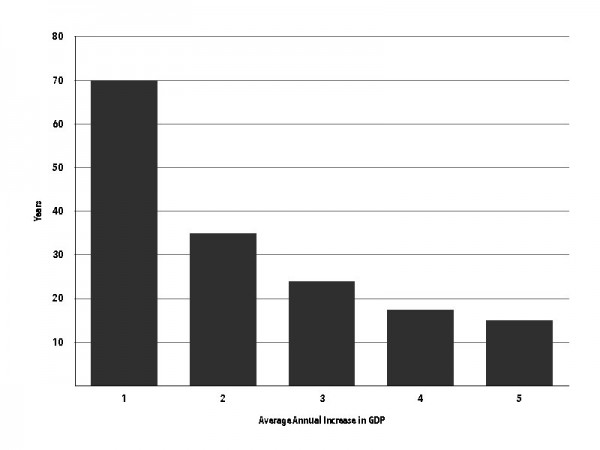
What is the implication for the environment of this growth imperative of capitalism and the need to have growth in order to create jobs? Almost all environmentalists understand that we need to have an economy that does not grow and is still able to function. But if the economy continues growing at its current anemic rate, the GDP will double in 35 years (see Chart 1). If it were to grow at a more healthy rate, the GDP would double in less than twenty-five years. Although a doubling of the GDP will certainly mean more stuff produced, more resources used and more pollution, it does not mean that they will necessarily double.

Chart 1. Years to Doubling of GDP at Different GDP Growth Rates

Chart 1. Years to Doubling of GDP at Different GDP Growth Rates

Source: Calculated by author.

Just to give a small and somewhat humorous example of the problem, here is a passage from a 2013 New York Times Magazine section (in an issue devoted to inventions):

Booty Pop, padded underwear that makes a person’s backside look bigger and shapelier, an idea so simple its incredible that it took until 2008 for someone to perfect it. Two friendswere struck by the popularity of bun-lift surgery and thought there had to be a safer, cheaper way for women to achieve the same effect. So [one of them] glued the padding from her bra into a pair of underpants, found a manufacturer in Asia to produce a version of it that met her specifications; and then introduced it to the world on a cable-television show. They have since sold almost two million Booty Pops.2

A society that allows (not to mention encourages) such a waste of capital, and both human and natural resources, will never be ecologically sound and will never be socially just. It is not an issue, as some have said, of simply changing from a “growth philosophy,” “growth model,” “growth paradigm,” “domination ethic,” or the focus on GDP growth by economists and the media.

Capitalism’s growth imperative has nothing to do with philosophies, models, paradigms, ethics, or which numbers pundits and economists focus on. Neither can it be “reinvented,” as some think, to be ecologically sound and socially just. Rather, it is an economic system that has basic internal forces—especially the profit motive and competition among firms—that operate in such a way as to promote exponential growth while simultaneously causing massive negative social and ecological effects. And when growth in this system fails, what Herman Daly refers to as “a failed growth economy,” the cruelest forms of austerity prevail—giving rise to more and more unequal conditions and more ruthless forms of exploitation of both human beings and the earth.

Occasionally even a major capitalist sees the weaknesses of the system. After mentioning what he thinks are the strong points of capitalism (some of which I would take issue with), Jeremy Grantham, the environmental philanthropist and legendary fund manager, goes on the explain the following: “However, it [capitalism] is totally ill-equipped to deal with a small handful of issues. Unfortunately, today, they are the issues that are absolutely central to our long-term wellbeing and even survival.”3

There are some who think that capitalism should be saved because they are under the mistaken notion that capitalism equals democracy. There are, of course, plenty of examples of dictatorships that were capitalist (in many countries of the South, as well as Spain, Greece, Germany, and Italy). For those under the illusion the United States is a democracy because you can vote every four years for a president (or for members of the House of Representatives every two years and the Senate every six)—choosing between candidates of two parties that are both owned lock, stock, and barrel by corporate interest—I urge you to read a short article by Joseph Stiglitz, “Of the 1%, by the 1%, and for the 1%,” as well as many other sources on the U.S. plutocracy.4

The nationally coordinated shutting down of one of the most promising modern exercises of democratic rights in the United States—the Occupy movement—by simultaneous police raids on the Occupy sites, indicates how little tolerance there is for mass expressions of dissenting views. And now with the scandal accompanying Edward Snowden’s release of National Security Agency documents we can see the extent of U.S. government spying on citizens as well as many abroad—in clear violation of the Fourth Amendment to the Constitution: “The right of the people to be secure in their persons, houses, papers, and effects, against unreasonable searches and seizures, shall not be violated, and no warrants shall issue, but upon probable cause, supported by oath or affirmation, and particularly describing the place to be searched, and the persons or things to be seized.”5

I have not heard another argument regarding just what it is about the capitalist system that is so good that it should be preserved. It is true that as part of its growth imperative there is constant innovation to find new products to sell or new processes of production. But there is no reason why there can’t be innovation in a non-capitalist system—if not the churning, continual, “creative destruction” type.

Why won’t there be people in an ecologically sound and socially just society who think of better—more environmentally sound ways—of doing something or those engaged in scientific research not for profit but for the love of science, the profound need of some to understand at a deeper level, or just for the benefit of humanity (for example, in the health sciences)? Even today, many people are engaged in innovation for reasons other than the potential monetary payoff.

An ecologically sound and socially just economy can be defined as one that encourages all people to develop their full human potential in such ways that the environment—with all its complexity, essential cycles, and relationships—remains intact, functioning, and healthy. In other words, an economy designed to be at the service of humanity, which includes the environment on which we and other species depend. This is an economy that can stop growing and can function well during a steady state, while meeting the needs of people and the rest of the natural world.

The ideas and suggested characteristics, principles, and procedures below are not a grab bag of possibilities from which one can choose. Rather, the various parts need each other in order for the economy and social system to function in an ecologically sound and socially just way. Each fits into one or more of the five attributes or pillars of strong natural systems: self-regulation; self-sufficiency; diversity and interdependence; efficiency (of cycling of energy and nutrients by closely linked metabolic relations); and resilience through self-renewal.

Social, Economic, and Ecological Principles

  1. Economic decisions—what to invest in, and what, how, and where to build/produce—are made democratically and for the purpose of fulfilling the basic needs of people. One of the basic needs, of course, is a healthy local, regional, and global environment. Such a society will be oriented to encourage everyone to strive to reach their full human potential. All people can live a culturally and socially rich life, though with a modest amount of stuff—below what is considered necessary for a “middle-class western standard of living.” Note the contrast—production to fulfill human needs versus capitalist production for the purpose of sale in a market in order to generate a profit.
  2. Workplaces (including farms) will be controlled and managed by the workers and communities in which they are based. There will be no economic exploitation by one person of another and community members will have input into production in their own backyards.
  3. Once socially determined basic human needs (material and non-material) are met—and after defining how much is enough—the economy stops growing with only neutral or positive side effects for society.
  4. All people who can work will have a role in the economy. It is important for individuals to feel a part of the community and society and work provides one of those links. If everything is provided for a decent and full existence there is a responsibility for all who are able to participate in providing goods and services.
  5. Leadership positions (in the economy, community, region, etc.) rotate among the people and there is a system for easy recall of elected officials/leaders.
  6. Substantive equality among people. This is essential because all will be living at a modest standard in terms of goods and services. In that situation people living at a much higher standard becomes socially unacceptable and unsustainable. People will have richer lives with less stuff because they will have time, assistance, and encouragement to develop and follow their passions—in sports, science, music, dance, writing, painting, handicrafts, or growing flowers—and to more fully engage with family, friends, and community. In a no-growth economy sharing and equality become means to eliminate the remnants of poverty and make sure it does not reappear.
  7. Interactions between and among communities, regions, and nations will be based on principles of reciprocity, solidarity, and mutual assistance.
  8. An economy that has a social purpose must involve considerable active management. Planning for short- and longer-term needs begins at the community level (as with the over 30,000 Community Councils of Venezuela) and is intertwined and coordinated with other communities in a regional plan.Once there is social purpose for an economy—as opposed to individuals making decisions that are aimed almost exclusively at obtaining the largest profits possible—there is no way to rationally operate without planning. For example, the production needs for both the First and Second World Wars were accomplished only through planning—and the use of rationing for the public. These plans were essential. After all, given the competition among the military services and with civilian needs as well, how else could you ensure that a particular part, say, a set of ball bearings, got to the right factory at the right time in order to produce an airplane needed for the war effort? It is not possible for markets to do this. In the absence of a planning system for production and distribution, how can we ensure that all people have adequate housing, clean water, sanitation, health services, clothing, and enough food?There may be markets in a post-capitalist society (as there have been since long before the existence of capitalism); in an economy of substantive equality, where basic needs are met, markets may provide some information to planners. When items are scarce, for whatever reason, rationing will ensure that everyone has a fair share—as was done in the United States during the Second World War.(Mostly unacknowledged by economists and pundits, “the market” in capitalist economies is actually a powerful rationing system—rationing according to individual/family resources. Commodities are theoretically available for anyone to purchase—for example, a good new car—but these are out of the reach of people with modest means. And sometimes even basic needs such as food are also beyond the reach of the poor, even in wealthy countries. Close to 50 million people in the United States are considered “food insecure.” This is clearly the result of food rationing occurring in a country that produces bountiful amounts of food.)

    Procedures: Ecologically Sound Metabolic Interactions with Nature/Resources

  9. Each community and region should strive, within reason, to be as self sufficient as possible with respect to basic needs such as water, energy, food, and housing. This is not a call for absolute self-sufficiency but rather for an attempt to build resilient communities and lessen the need for long-distance transport. Clearly not everything is going to be produced in every community, or even every city. But trying to be as self-sufficient as reasonably possible can still be a goal. Redundancy is an important part of both self-sufficiency and resilience. People with similar skills are needed in a community (there cannot just be one electrician) and redundancy in production facilities means that if something happens to one (say a fire), that others can pick up the slack.
  10. Energy used comes from current (or very recently past) renewable energy sources and used near where it is produced.
  11. Methods and aims of industrial production and building construction are such that goods have a long life and are easily repaired, repurposed, and/or recycled.
  12. Non-renewable resources will be conserved and used sparingly and in such ways that they can be recycled efficiently as efforts continue to replace them with renewable ones. Let me give just two examples: one is very well known, and one very new. The first is that legumes can be grown in rotation to supply nitrogen to grain crops (instead of using nitrogen fertilizer produced by using natural gas). The second is a relatively new process in which fungal hyphae replaces Styrofoam as packing or insulating material.6
  13. Agricultural production will be carried out based on soil and above-ground habitat management that produces healthy plants better able to defend themselves from diseases and insects and to enhance habitat for beneficial organisms. Integrated animal-crop farms will be encouraged—providing a mosaic of habitats—including relatively undisturbed ones. Farm animals will be treated humanely and allowed to do what they would normally want to do and eat what they would normally eat—instead of being confined under cruel conditions and fed corn and soybeans laced with hormones and antibiotics. Farms will rely on legumes for nitrogen for non-legume crops, as well as efficient nutrient cycling for most nutrient needs. Integrated animal-crop farms make this easier to accomplish.7
  14. Nutrients from human waste (and farm animal waste, as mentioned above), including bodily waste and unused or spoiled food waste, will be cycled back to farmland as efficiently and safely as possible.
  15. Renewable resources will be used in ways that preserve the resource base and do not create problems for other species/resources. Local communities will cooperatively manage natural resources such as nearby forests and fisheries to perpetuate them for future generations.
  16. Labor efficiency will not be an important goal (as it is in an economy in which using less labor is a way to enhance profits). For example, ecologically sound and productive agriculture—which will become essential when oil and phosphorus fertilizer run out or become unaffordable to use for agricultural purposes—will take more people working smaller farms with more human and animal labor. These farmers should be able to produce high yields per hectare and per input of energy, but will have lower yields per hour of labor.
  17. People will be encouraged to live near where they work and use multifaceted and efficient public transportation when needed. Bicycling will be encouraged and private automobiles will play a very small role, if any, in transportation.
  18. The precautionary principle will be used to evaluate and make decisions on new procedures, production systems, and materials as well as to evaluate any chemicals used by society—to prove safety for humans and the rest of the environment before introduction.

    Living in an Ecologically Sound and Socially Just Society

  19. Communities and regions will develop open and democratic processes to make decisions for infrastructure needs as well other investments. Ways need to be developed for communities and regions to work together in solving problems and sharing resources.
  20. Education and interactions among people within communities and between communities will strive to encourage those human characteristics and ethics that best fit an ecological and just society.
  21. People will have sufficient time to develop their various interests. People will work for significantly less than the “eight hour” working day, because so much of what is done now is not socially useful for society at large and would be considered waste in a more rational system. These include luxury cars or yachts, most of the financial system, the intelligence­-military-industrial complex (the U.S. military is one of the great destroyers of the environment), the prison-industrial complex, the constant efforts to change fashions and products to induce buying, the sales effort in all its ramifications, and so on. Socially useless, even harmful, products and programs constitute a very large portion of the U.S. economy and utilize as large a share of workers—perhaps as great as half of the labor force and at least as much of the raw materials used.We are all capable of exhibiting a large range of characteristics, from the most brutal to the most altruistic. There is no such thing as an abstract “human nature” divorced from the society in which people are living. It is the society at large, the way the economy works, and one’s family that encourages or even requires (to be successful) some of these characteristics/behaviors while discouraging others. In capitalism, some of the basest characteristics—such as competitiveness, individualism, greed—are encouraged and rewarded. This leads to putting the individual’s (and a corporation’s) best interests ahead of those of society.
  22. In order for a socially just and ecological society to function, educational efforts need to be taken to encourage compassion (instead of naked individualism), cooperation (instead of competitiveness), reciprocity and sharing (instead of greed and consumerism), an awe of nature in all its complexity and beauty (instead of thinking of nature mainly for its potential usefulness in producing commodities), and egalitarianism (instead of striving to get ahead of others). This means actively working to create a new ethic towards the land, the environment in general, toward our fellow human beings, our communities, and the other species with which we share this planet. The significantly greater time that people will have for purposes other than work will allow for more community activities, interactions with others outside the family and work, and to appreciate the natural world in all its complexity.

Closing Thoughts


I have outlined some of the main characteristics that I think are essential for an ecologically and socially humane and just economy and society. These are incompatible—in almost every way—with a capitalist economy. Doing away step by step with capitalism in a necessary long revolution will not automatically bring positive social or ecological change. That change will happen only if a large portion of the population believe in, and fight for, an environmentally sound and socially just society.

And it will take a huge shift in almost all of human activities, ways of thinking and behaving, including how we relate to each other and interact with the environment. New ethics will be needed for this new society to function. This is not an easy task, but what is the alternative? A system that, as it functions normally, destroys the very foundations of life through exploitation, waste, and greed is by definition an antiquated system. This is not an argument in favor of doing nothing in the here-and-now. We should be helping to stop the Keystone XL pipeline and encourage universities and other organizations to divest of holdings in fossil-fuel companies and fight for the environmental rights of poor communities. We can use these struggles in order to help educate others that, to solve the overall ecological crisis in all its ramifications, another system is necessary.

Is this an unattainable “utopia”? I think that, if it ever comes into being, an economy and society that is ecologically sound and socially just will have to embody most of the characteristics I have described above. There is no doubt that it will not happen in the near future. But I contend that it is no more utopian than to think that the financial and other strong business powers and their governmental representatives will allow you to make major changes to the financial system or the way international trade operates. What are the chances of, as some ecological economists have suggested, forcing banks to have very high (some have said 100 percent) reserves so they cannot create significant amount of debt or making major modifications in the workings of the World Bank and rules of the World Trade Organization so that they encourage equality and environmental justice? I think that those ideas are perhaps even more utopian than the possible creation of a new society. As the economist Joan Robinson once explained, “Any government which had both the power and the will to remedy the major defects of the capitalist system would have the will and the power to abolish it altogether.”8

It has been said, accurately in my opinion, that most people in this society can more easily imagine the end of the world than the end of capitalism. I fear that barbarism may be the fate that awaits our grandchildren and their children unless we can change that way of thinking and start to envision, and begin to work towards, an economy and society under truly democratic social control with the very purpose being to satisfy basic human needs, which as I have stressed many times, includes a healthy and thriving environment.


Notes

  1. On the growth imperative of capitalism see Chapter Three in Fred Magdoff and John Bellamy Foster,What Every Environmentalist Needs to Know About Capitalism (New York: Monthly Review Press, 2011).
  2. Hugo Lindgren, “If you were trying to name the greatest invention in human history it would be,”New York Times Magazine, June 7, 2013, http://nytimes.com.
  3. Leo Hickman, “Jeremy Grantham On How to Feed the World and Why He Invests in Oil,”GuardianEnvironment Blog, April 16, 2013, http://guardian.co.uk.
  4. Joseph E. Stiglitz, “Of the 1%, by the 1%, for the 1%,”Vanity Fair, May 2011, http://vanityfair.com.
  5. “Fourth Amendment,” http://law.cornell.edu.
  6. Laura Shin, “Using Fungi to Replace Styrofoam,”New York Times “Green” blog, April 13, 2009, http://green.blogs.nytimes.com.
  7. For information about ecological soil and crop management practices, see Fred Magdoff and Harold van Es,Building Soils for Better Crops, 3rd edition (Waldorf, MD: Sustainable Agriculture Research and Education Program, 2010). This book and others from the SARE program are free at http://sare.org/learning-center/books.
  8. Joan Robinson, “Review of R.F. Harrod,The Trade Cycle,”Economic Journal46, no. 184 (December 1936): 691–93.