Written by Alan Thornett
What happened in Glasgow – and where do we go from here?
Many on the radical left have concluded that Glasgow was an unmitigated disaster. That COP is dead. That the 1.5°C maximum temperature target is dead. That any gains made in Glasgow are greenwash. That it is time to stop focussing on the COP process and chart our own independent course. It is even argued that putting demands on the COP process (or indeed other capitalist institutions) is wrong in principle because it makes us complicit with their crimes and failures.
I don’t agree with any of this. It’s certainly true that Glasgow failed to stop catastrophic climate change – and by a huge margin. It is also true the pace of the crisis is still increasing with fires, floods, droughts and hurricanes becoming ever more destructive, and that the Nationally Determined Contributions (NCDs), pledged in Glasgow, would produce a temperature rise of not 1.5°C but of 2.4°C – which would trigger feedback processes that would take the climate crisis out of control.
To withdraw from the COP process, however, would be a big mistake. Although we all have a responsibility for our own ecological impact, only governments have the ability to make the major structural changes necessary to get rid of fossil energy in the timescale available. Nor can we build the mass movement necessary to force them to do so if we ignore the main global forum in which they can be engaged – and which is the main driver of global public consciousness on the issue.
A process of struggle
We are in a process of struggle and not a single event – important as such events are. Glasgow was never going to end capitalism, or indeed stop global warming at a stroke. The question was always how much progress could be made and how it could be used to build the movement to the next stage.
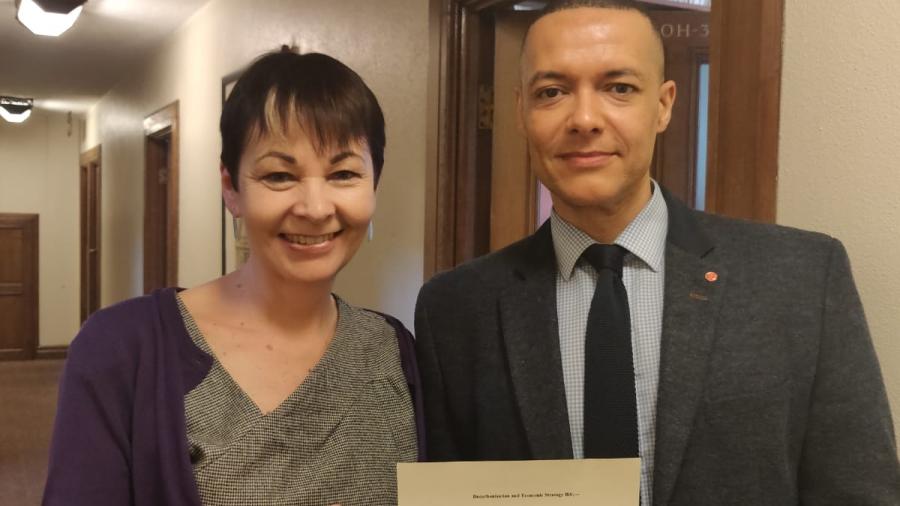
Clive Lewis, Labour MP, climate campaigner and former member of Jeremy Corbyn’s shadow cabinet, speaking on the London Economic’s podcast Unbreak the Planet also argues that there were positives in Glasgow but that it could be a turning point in the struggle. The Glasgow COP, he said, was “dire” and a “failure” when looked at “through a conventional lens”. But he added, “in terms of the climate movement, of understanding where the Global South are in this fight, the need for solidarity between different groups – not just those fighting climate issues – I think it was potentially a turning point.
In 2009 the Copenhagen COP was deeply split over the fundamental issue of whether global warming is anthropogenic – which allowed the climate deniers to split the conference and set the movement back for nearly five years, only emerging again in the run-up to COP21 in Paris in 2015.
By Paris the climate deniers had been marginalised, and the anthropogenic nature of the crisis established. The battle was now between the UN organisers who proposed a temperature limit of ‘well below’ 2°C, and the High Ambition Coalition – the countries about to disappear under the sea – who demand a limit of 1.5°C as the only figure that would give them any kind of future. “1.5 to stay alive” as they termed it. It ended in a fudge. The main target would be ‘well below 2°C’ with 1.5°C added on as an ‘aspiration’.
Two years later, with global warming accelerating, the IPCC adopted the 1.5°C limit in the form of its Special Report on Global Warming. It also warned that we now had only 12 years to do something about it, since 1.5°C could be reached as soon as 2030.
Glasgow
By Glasgow this year the 1.5°C limit was already official UN policy, with the discussion focused around on how to achieve it in term of enhanced National Determined Contributions (NCDs). Like Paris, it was a battle between the countries most determined to cling on to fossil fuel and those how faced with the greatest impact from it. Many delegates arrived determined to defend the 1.5°C against those that would be out to destroy it.
Other significant gains were also made. The role of the major emitters of CO2 – coal, oil and gas, that are killing the planet at an ever-increasing rate – was confronted for the first time. In Paris these fuels had not even been mentioned by name. In Glasgow they were presented as the main cause of global warming and an existential threat to the future the planet.
Coal – which is responsible for 40 per cent of global CO2 emissions – was singled out with a proposal that its use in power generation should be phased-out, along with subsidies to it, by 2050. This was bitterly opposed (unsurprisingly) by the big coal and oil producers and users, who saw their future at stake, in a heated debate that forced the conference to overrun into the weekend. This proposal, however, was dramatically watered down by a last-minute intervention by China and India that changed ‘phase-out’ to ‘phase-down’. The decision, which came as a body blow at the end of the proceedings, (bizarrely) left UK Tory minister Alok Sharma, who was in the chair, fighting-back tears.
This decision, however, even in its weaker form, should not be underestimated. To declare these fuels, that have totally dominated global energy generation for 100 years, as the primary threat to the future of the planet is a pivotal moment – despite the time scale and the ambiguity involved. The writing is on the wall for these fuels. It makes investment in them increasingly precarious, and action against them by climate campaigners more likely.
This was demonstrated – dramatically – just two weeks later, with the decision of Shell to pull out of the controversial Cambo oilfield project off the Shetland Islands in Scotland. This was a direct result of the Glasgow decision, causing the whole project to be put on hold and it is unlikely to recover. It is a resounding victory for the climate movement and the Stop Cambo campaign that had demonstrated outside the COP venue throughout. Shell accepts that the COP decision was a factor in their decision, along with the technical complexities of the project given the 1,000 metres sea depth that is involved.
Shell’s pull-out reflects the decision in the last couple of years (and now endorsed in Glasgow) to stop producing fossil fuel cars by 2035, in favour of electric power. This was also a major blow to the petrochemical industry, which currently supplies 337 million gallons of fuel a day to fossil driven cars. Once the decision was taken, the production of fossil fuel cars went into decline as the industry recognised commercial reality and embraced the conversion. Sometimes the logic of capitalism can work to a progressive advantage.
In Australia – soon after the close of COP26 – two climate activists, under the banner of Blockade Australia, shut down the world’s largest coal port by climbing on top of machinery at the Port of Newcastle and pressing an emergency safety button, bringing the export of coal to a standstill. Others have halted coal trains or blocked key bottlenecks in the multibillion-dollar coal supply chain in the Hunter region.
However, the timescale envisaged by the elites, of course, is seriously out of kilter with the reality of the crisis. This has to be constantly challenged by the movement itself in the course of the struggle, driven by the crisis itself as it intensifies.
Other decisions
Pledges were made to the amount of $356 million a year to the UN Adaptation Fund in order to help impoverished countries to adapt to global warming and fight climate change. This is both inadequate and precarious since a similar pledge was made in Paris but the amount paid well fell short of the amount pledged.
There were also side deals between the member states. Over 100 countries joined a pledge to cut methane emissions by 30 per cent by 2030. Methane is a powerful GHG that comes mostly from rubbish dumps, farm animals and leaky oil and gas wells. Whilst this was an important initiative it failed to tackle the key issue of the industrialised meat and dairy sectors in this, and key emitters, including China, Russia and India, failed to sign up.
Another 100 governments signed a voluntary agreement that promised to end deforestation and protect indigenous rights. Crucial as the issue is it must be one of the most vacuous pledges made at the whole conference, since even Bolsonaro felt comfortable in signing it. There was no sign of any proposals to actually deliver on these promises which look very similar to a pledge made in 2014 which did absolutely nothing to slow deforestation.
The most scandalous decision taken was the support given to carbon offsetting and to emissions trading – i.e. licences to pollute – and to carbon capture and storage, which does not exist as a useable technology due to the gigantic amount of carbon that would have to be stored.
At the end of the COP a decision was taken to call on all countries to submit new and tougher NDCs by COP27, which will take place in Egypt next year, and on a yearly basis after that. This is a big improvement on the 5-year cycle agreed in Paris.
The root of the problem in Glasgow was that although there was more pressure on this COP than ever before, the elites were not prepared to adopt the kind of war footing that is needed to implement even their own objectives. This point was made strongly (and bizarrely) at the opening of COP26 by the heir to the British throne. They may have to do this at some stage, but we need to ensure that it is not too late and it is within a socially just framework.
Making the polluters pay
A huge weakness of Glasgow, of course, which was never even on the agenda, was how the individual countries should go about meeting the pledges they have made. In other words what are their exit strategies from fossil energy and how are they going to carry it out in a socially acceptable way? Many, no doubt, are already planning the offsets they will use to get off the hook. This is a controversial subject on the radical left, and it needs to be central to the debate on the approach to COP27 in Cairo next year.
The
key to this, in my view, is to make fossil fuels far more expensive than
renewable energy and by means that are socially just, that redistribute large
amounts of wealth from the rich to the poor, that can bring about a big
reduction in emissions in the time available, and (crucially) are capable of
commanding popular support. This means heavily taxing the polluters to both cut
emissions and to ensure that the polluters fund the transition to renewables.
One proposal
on the table in this regard is James Hansen’s fee and dividend proposition. It
provides the framework for very big emissions reductions, here and now whilst
capitalism exists, and on the basis of a major transfer of wealth from the rich
to the poor in order to drive it forward. It would have to go alongside a crash
programme of renewable energy production to meet the demand that his incentives
would create. It would also need a major programme of energy conservation, a
big reduction in the use of the internal combustion engine, the abolition of
factory farming and a big reduction in meat consumption.
Building the movement
The most important gain to come out of Glasgow is the strengthening of the climate justice movement itself. For the first time the movement has come out of at a COP conference stronger than it went in. This was reflected in the young activists on the streets who maintained a constant pressure on the proceedings inside as did the many delegations from the global south and many indigenous communities – including from the rain forests of the Amazon. The main demonstration in Glasgow was 150,000 strong, the biggest climate demonstration ever held in the UK.
It was also reflected in the exemplary work done by the COP26 Coalition over the past two years, and the events it organised around the COP, in particular the global day of action on November 6th and the three-day Peoples’ Summit for Climate Justice that ran from November 7th , and which was a global event.
The impact of the Glasgow COP, in terms of global awareness, along with the increasing impact of the crisis itself, has been far greater than with any previous COP. This has opened up the possibility of a new stage in the development of the global movement itself. This is important since the future of the planet will ultimately be determined by the strength of the mass movement and not by the COP process.
We need a movement, therefore, that embraces the widest possible spectrum of struggle from the indigenous peoples to the young school strikers who have been so inspirational over the past 2 years. From the activists of XR who played such an important role in radicalising the movement in the run-up to Glasgow to radicalising public consciousness. A movement that would be too big to be socialist in character but which has a strong current of socialists within it, with a clear strategic line.
It must also embrace the more radical Green Parties. The big NGOs such as Friends of the Earth, Greenpeace, Avaaz and 38 Degrees who have a powerful mobilising capacity, have radicalised in recent years, and have come out of Glasgow with a more positive assessment than many on the socialist left.
Greenpeace, for example, said the following in its assessment of Glasgow: “It’s important to be honest about this situation. But it’s also important to remember how much we still have to fight for. There’s no single moment when it’s ‘too late’ to act on climate change; no cut-off points where we can’t choose a better path. Every ray of hope, inch of progress, in Glasgow was won through relentless pressure from activists and campaigners, especially those on the front line of the crisis. It’s always been that way, and it always will.”
Partial gains and victories
There is an increasing trend on the radical left to deny the value of partial victories won by movement. This is even the case with the Cambo oilfield victory, where some on the left have argued that Glasgow had nothing to do with it or that it is an irrelevant drop in the ocean. This I suspect this is because it is seen as reformist or falls short of abolishing capitalism – which indeed it does.
This is a problem. We can’t build a movement if we deny it its victories – partial or otherwise. Whilst partial victories, in themselves, are not going to halt climate change they are essential in terms of building a movement that can, because of their transitional content. We don’t dismiss partial gains this way in any other area of struggle – trade unions, anti-racism, or human rights for example. Nor are all reforms ‘reformist’. Partial victories rally the movement towards ever more substantial victories and towards an eventual anti-capitalist solution.
Even Greta Thunburg – who has played as major role in promoting and radicalising the environmental struggle between Paris and Glasgow with her Fridays for the Future movement has lapsed into this. At the end of COP26 she tweeted: “Unless we achieve immediate, drastic, unprecedented, annual emission cuts at the source then that means we’re failing when it comes to this climate crisis. “Small steps in the right direction”, “making some progress” or “winning slowly” equals loosing.”
We do have to achieve what Greta says, of course. But the idea that concessions won short of that goal are an impediment, rather than building blocks towards it, is wrong. There are times when “blah, blah, blah” is the right critique. There are also times to recognise when gains have been made and build on them.
Strategic choices
For the movement to withdraw from the COP at this stage would in my view, be a big and ultra-left mistake.
Whilst COP conferences are only one aspect of the environmental struggle, they are important in that they give us an opportunity to confront the elites in front of a global audience and to build the movement in the process. In fact it would play into the hands of the elites. They would like nothing more than to be able to go to COP conferences with no one on the streets placing demands on them. It would also deny us the partial victories that it is possible to win at such events.
Any advances made by the COP process have been as a result of pressure from the movement – particularly the mass struggles in the Global South. The climate justice movement is right to take these conferences seriously and to place demands on them in defence of the future of the planet.
Equally, the notion, held by many on the radical left, that global warming can be stopped by global socialist revolution – and within the 10 years because that is the timescale we have – is fanciful in the extreme. It ignores the current adverse global balance of forces and level of consciousness and gambles the future of the planet on a scenario so remote that it can be discounted as a rational strategic approach at the beginning of the 2020s.
If such a revolution happens, we can fully embrace it. Meanwhile, socialism can’t be built on a dead planet. This means forcing capitalism – kicking and screaming if necessary – to make the changes necessary to save the planet, including a full transition to renewable energy. There are no shortcuts.
This approach also provides the best conditions to both reduce carbon emissions rapidly and to build a mass movement capable of challenging capitalism itself, when the opportunity arises. If we are unable to build a movement capable of forcing capitalism to make such structural changes, how are we going to build one capable of its expropriation by revolutionary means?
Alan Thornett is an Ecosocialist campaigner and author of Facing the Apocalypse – ‘Arguments for Ecosocialism'.