Showing posts with label NHS. Show all posts

Monday, 16 March 2020

Coronavirus - UK Government Bows to the Inevitable After Civil Society Acts


The UK government has announced its latest advice for the public follow, to slow down the rate of coronavirus infection. Now, people should avoid social contact, like in restaurants, cinemas, pubs and the like, and for all those able to work from home, should do so. 

It is hoped that these actions will delay the rate of infection, and so spread the burden on the NHS into the summer, when it is less stretched. There is also evidence that the coronavirus can't survive outside of the body, at temperatures above 27C%. Hopefully a hot summer will do a lot of the work of killing off the virus. 

All of this is very sensible, but it has to be said that these measures should have been taken earlier, as has been suggested by many medical experts, both in the UK and around the world. The move became inevitable once civil society, sporting authorities, employers, religious services and with even the Green party cancelling their spring conference, made these decisions themselves.

This has only a small impact on these organisations (especially large sporting clubs), but the move to discourage attendance in pubs, restaurants etc will have a big impact on these businesses. The government has not ordered this action, which means that insurance claims from businesses cannot be paid, leaving many to go bankrupt. 

Transport for London said on Monday, that passengers on the London Underground were down 20% and 10% on buses, which is explained by many workers working from home, with the blessings of their employers. 

The rush hour London Underground is a perfect vehicle for incubating and spreading infections, and indeed the virus appears to be ahead of the rest of the country in London. Who would have thought it? 

Well, plenty of Londoners, I can tell you. The idea that you put a two meter distance between passengers is risible. If large gatherings of people are to be avoided, then the Underground is an obvious area for reducing infections. This appears to have been totally ignored by the government. 

Many are questioning why schools are still open, when many other countries have closed them. Yes, key workers with children, like those employed in the NHS will need to have some creche type facilities provided, but with other workers working at home, they can easily take care of their children. Workers who cannot work from home, will also need protections, whether that is masks or whatever is effective. How can schools stay open when everywhere else is closed? It makes no sense. 

It looks as though some kind of travel ban to the UK will need to be introduced, as many other countries have already announced. On present form it will be announced by the British government sometime next week, as we are lagging behind events, confirmed by Monday's announced measures. 

All benefit regimes should be relaxed and provision needs to be made for homeless people, as well other vulnerable groups. The social care system, already under strain because of ten years of austerity (with still no proposals for long term funding), needs a significant increase in funding, urgently.   

Last week saw supermarkets run out of stock, although why people need so much toilet paper for an infection that does not affect the digestive system, one can only wonder. But the vacuum left by the government, was filled by panic buying, which tends to happen with emergencies like this.

The assertion by the UK government that these new measures are only now needed, really doesn't wash. Other governments around the world have already taken these actions, and some with lower infection rates than the UK, and seem to have contained the spread of the virus, better than we have. The UK authorities have even stopped testing many people, so how can they really know the true number of people with the virus? 

There has been a complete abdication of responsibility by the UK government, choosing instead a kind of laissez faire approach, in an attempt to build 'herd immunity,' basically do nothing and keep your fingers crossed. This has not been good enough by a long chalk. The first duty of any government is to protect its citizens, and the UK government has failed to do this, whether by incompetence or design, it doesn't really matter. 

These are serious times, when we need a serious government, but unfortunately in the UK we do not have one, led by a prime minister who is a clown. The only mitigating factor is the UK government has handled this better than the US government, whose president's first reaction was to call it fake news then to blame it on foreigners. Thank heavens for small mercies.

Tuesday, 29 October 2019

The UK General Election is a Crucial Crossroads for Greens


Written by Allan Todd

“So, let’s draw out the connections between the gig economy, which treats human beings like a raw material from which to extract wealth and then discard, and the dig economy, in which the extractive companies treat the earth with the very same disdain.”

Naomi Klein, On Fire: The Burning Case For A Green New Deal (2019)

“May you live in interesting times!” is said to be an ancient Chinese curse. Whatever its origins, it makes the point that the ‘uninteresting’ periods in History are the safest ones to live through: those with no wars, no famines, no economic crises, and no destructive natural disasters.

With that in mind, it's painfully clear that we’re certainly living in ‘interesting’ times! At present, the 99% are victims of an increasingly harsh, exploitative and destructive neoliberalism - or what Naomi Klein describes as a ‘gig and dig economy’.

One other thing that is also increasingly clear is that the next general election - whether it comes before or after Christmas - will be the most crucial one we’ve had for more than a generation: crucial for the UK as a whole, and crucial, too, for the Green Party. It will also be crucial for me.

For the UK

“Austerity does not promote growth or reduce deficits - it is bad economics. It is also a public health disaster. It is not an exaggeration to call it economic murder.”

Prof. L. King, Cambridge University, 2017.

What is beyond doubt is that, since Johnson became prime minister, we are facing a neoliberal Tory government even more vicious than the Thatcher governments of the 1980s. One of the most disturbing factors is that, prior to becoming PM, Johnson had several meetings with Bannon, one of Trump’s erstwhile advisers. Just like, after becoming Leader of the Tories in 1975, Thatcher and her team held many meetings, in the years running up to 1979, with ‘New Right’ ideologues from the USA.

Thus Johnson wasted no time in appointing a hard-right cabal as the core of his government. Johnson, and the likes of Rees-Mogg and Gove, have been calling for years for the destruction of all that EU ‘red tape’ that binds the free market with workers’ and consumers’ rights and environmental protections. Which is precisely why those rights and protections have been taken out of the legally binding Withdrawal Agreement and, instead, placed in the non-binding Political Statement:

The Tory hard-right cabal

As well as wanting a hard Brexit in general terms, it is now clear that our NHS will be on the table in any post-Brexit trade talks with the US. In addition, Johnson’s government will almost certainly continue supporting the dirty energy companies - including those wanting to roll out fracking across the country. There have already been indications that the ‘traffic lights’ controls on earth tremors will be relaxed once Brexit is out of the way. Thus in no way will Johnson’s government be taking any serious steps to counter the growing Climate Crisis:

The reality of current ‘reductions’ in carbon emissions

On top of all that, Johnson is most unlikely to take steps either to reverse the vicious austerity that has, since 2010, been imposed on the 99% by the Tories - and the LibDems - or the accompanying massive tax cuts for the 1%. Nor will he be closing off the various tax loopholes that enable the wealthy to avoid paying even the small amount of tax for which they are, technically, liable.


As shown by an academic study - carried out by medical researchers from Cambridge and Oxford Universities and the University College of London, and published in BMJ Open, in November 2017 - that austerity has, since 2010, led to an estimated 120,000+ austerity-related excess deaths:


Professor Lawrence King, of Cambridge University, one of the report’s authors, actually referred to these deaths as “economic murder”.

Austerity DOES kill!

Apart from all these negative aspects, Johnson has also shown he is more than prepared to break the law in order to push his policies through. For all these reasons - and more - the next election will face the people of this country with an incredibly crucial crossroads: make the wrong choice, we - and future generations - will pay a dreadful price.

For the Green Party

However, the next election will also face the Green Party with a crucial crossroads of its own. For sometime, the Green Party has had a programme which combines both environmental, and social and economic justice, policies. This holistic stance is summed up well by our slogan, “For The Common Good”:

For The Common Good

That slogan reflects that the fact that the Green Party has recognised that attempts to protect and restore the health of our planet will only succeed if we also tackle the issues of poverty and gross inequalities that are destroying the social cohesion of our society. It is also a reflection of the understanding that all our major problems - the Climate Crisis, austerity, an under-funded NHS, a cash-strapped educational system, and racial and gender inequalities - all stem from one source: the neoliberalism forced on us by the 1%.

That radicalism offered by the Green Party has undoubtedly played a significant role in helping, since 2015, to move the Labour Party towards more progressive positions on both the Climate Crisis and on ending austerity. It is something we should rightly be proud of - and something which we should preserve at all costs.

Sadly, however, there are signs that the whole Brexit issue may lead the Green Party to put that entire radical stance at risk. Earlier this year, there seemed to be a serious attempt to form a ‘Remain Alliance’, which would agree just one ‘Remain’ candidate in certain seats. In practice, that would mean, in many seats, the Greens working with - and standing down in favour of - the LibDems.

Whilst Brexit is an important issue - I voted ‘Remain but Reform’, à la Another Europe Is Possible, in which our party rightly played a leading role - it is not the most important issue. Whether we are in or out of the EU, the Climate Crisis, neoliberalism and the rise of the far right, will all still have to be dealt with. So what the Green Party must avoid at all costs is playing any role which will place yet another neoliberal government in power.

As 2010-15 showed only too painfully, the LibDems are led by neoliberals who were more than prepared - for 5 full years - to back the harshest of austerity policies. The LibDems also voted for the 2012 Health and Social Care Act, which parcelled up our NHS into bite-sized chunks for future sale to private health companies - and which forces the NHS to give more service contracts to private company vultures like Branson’s Virgin Health Care.

Those who thought that the LibDems had, since 2015, ‘changed’ their positions on such issues had a rude ‘wake-up’ call on Wednesday 23 October, when all 19 LibDem MPs abstained on a motion which would have forced Johnson’s government to keep our NHS off the table in any future post-Brexit trade talks with the US:

Our NHS - not safe in LibDem hands

Yet, the very next day, Green Party members received a communication from HQ which seems to indicate that such a ‘Remain Alliance’ may still be on the cards. If the Green Party forms any pact with the neoliberal LibDems in the next general election, it will completely wreck its radical street cred. So, when that crossroads is reached, our leadership will have to think very carefully indeed.

A personal crossroads

Apart from being a crucial election for the future of this country, and for the Green Party, the next general election may also prove to be a very crucial one for me.

In the 2015 general election, I was happy to stand as the Green Party candidate for Copeland - which, at that time still had a Labour MP - as we were the only mainstream party totally opposed to austerity. Even Ed Miliband’s Labour Party - no doubt listening to Ed Balls and co. - was offering an ‘austerity lite’ programme. Despite this, Labour held the seat, with a 2500 majority over the Tory candidate - and the Greens came last out of 5, with 1179 votes.

However, the political situation began to change significantly after Jeremy Corbyn was elected Leader of the Labour Party later that year - most notably, with Labour rejecting any more austerity.  The existing MP for Copeland, Jamie Reed, was strongly opposed to Corbyn and was, in fact, the first Shadow Bench MP to resign after Corbyn was re-elected as Leader in 2016. Then, in December 2016, Reed resigned as an MP, thus sparking a by-election in February 2017.

As Labour’s vote in Copeland had been declining for several years, making it a marginal seat, I argued that our local Green party - Allerdale and Copeland - should stand aside and call on our supporters to vote Labour, in order to reduce the Tory majority in parliament.

That suggestion lost by one vote, and we stood a candidate. Despite losing the vote over whether or not to stand a candidate, I both campaigned and voted for our candidate, Jack Lenox. The result of the by-election was a Tory gain from Labour - with Copeland becoming even more marginal than it had been before. When it came to the 2017 general election, I argued again for us to stand aside - this time, the suggestion was overwhelmingly supported - though the accompanying decision, to call on our supporters to vote Labour, was not, in the end, carried out. Although the Tory MP was nonetheless re-elected, her majority was reduced to 1695 votes.

Since then, my view about not standing has not just remained the same - it has become stronger. There are, of course, many reasons for most ordinary people - not just eco-socialists - to see a Labour government, led by Jeremy Corbyn, as being considerably better for them than yet another Tory government or, almost as bad, another Tory-LibDem coalition. Some of those reasons include Labour’s commitments to:

•           adopt a Green New Deal
•           end austerity
•           ban fracking
•           stop and reverse the privatisation of our NHS
•           bring back into social ownership the main public utilities

There are clearly several aspects of Labour’s current policies and stances - for instance, on Brexit, nuclear energy and PR - that still leave much to be desired. But, even with such caveats, a Labour government under Corbyn would be a distinct improvement over the hard-right Tory government we currently have.  For me, a Green government - or a Red-Green coalition with Labour - would be the ideal outcome of the next election. But the unfair voting system we have makes both of those scenarios unlikely.

We thus have to deal with where we are now - and that, for so many reasons, means trying as hard as we can to end the reign of neoliberal governments.  That means, in the 80+ marginal seats that Labour needs either to hold (such as Workington, the other seat covered by our local Green party) or win (such as Copeland), the Green Party should stand aside and call on their supporters to vote for the Labour candidates. In such marginal seats, the most practical and effective ‘green’ vote is to vote Labour.

Ideally, in return, Labour should agree not to stand in Caroline Lucas’s seat, and should also stand aside in the Isle of Wight - where, had they done so in 2017, a Green Party MP would have been elected, instead of the Tory who is the current MP. But, even if - as in 2017 - Labour makes no concessions to the Greens, we should still not stand in those key marginals.

There are those in the Green Party who argue that, because Labour gave us nothing in 2017, they should be ‘made to hurt’ in the next election, so that they’ll come on board in the subsequent one. Two wrongs have never made a right - especially with regards to this issue: for those who will be hurt the most if Labour fails to form the next government will be the most vulnerable in our society.

That alone is reason enough for eco-socialists to do all we can to get a Labour government elected. Our local party has already selected candidates for our two seats. When an election is called, we will then have to decide whether or not to stand. Whilst I fully appreciate that it will be disappointing for Green supporters in Labour’s marginal seats not to have a Green candidate to vote for, my view is that - given all that will be at stake in the next election - it would be an unjustified indulgence to insist on having a Green candidate, regardless of its impact on the national outcome.

Thus, as in 2017, I shall be arguing for us to stand aside - and to call on our members and supporters to vote Labour.  However, this time - unlike in the February 2017 by-election - if that vote is lost, I have already decided what I will do. I shall neither campaign nor vote for our candidate - instead, I shall, ‘For The Many, Not The Few’, campaign and vote for the Labour candidate:

 For The Many

I have had friendly advice that, if I do so, I may well be expelled from the Green Party. I shall be sad if that happens - especially as there is no other party that I wish to join; plus I’ve only just been elected as Keswick’s first Green councillor! However, in the end, I feel I have to do everything I can to prevent yet another neoliberal government - whether that be a Tory one, or a Tory-LibDem one.  

Allan Todd is a member of Allerdale & Copeland Green Party, an anti-fracking activist and a Green Left supporter

Editors note: I do hope that Allan does not leave the Green party over this. He is a fantastic activist both within the party and outside as an anti-fracking and Extinction Rebellion activist.

Monday, 29 July 2019

The UK Left Needs a Strategy to Fight this Extreme Right Wing Tory Government


Although I think it fair to say that you can never be sure that new UK prime minister, Boris Johnson, means what he says, all of the signals coming out of the new regime point to the most extreme right wing government in modern times has been formed. The make-up of Johnson’s Cabinet, for instance, containing many characters who were on the far right fringe of Tory party only a few years ago, should set off alarm bells amongst all in the broad UK left.

This is not just about Brexit either, although that is a part of the general direction of the Tory government, a first step in the move to deregulate employment and environmental standards and reduce human rights protections in the UK. 

Logic suggests that is the only way that the UK can move to attract investment and growth in the economy, from a right wing perspective. A kind of super-sized Singapore on the edge of Europe, under cutting European Union (EU) standards, so as to be able to compete in our newly isolated position.

To those on the left who do support Brexit, and I know that many relish the idea of the EU being out of the way, so that full on clash with the Tories becomes inevitable, I say you are playing a dangerous game. What if the Tories win this battle, using simplistic racist messages and encouraging delusions of the long gone days of Empire - the country could become a very nasty place indeed.

Whether you support Brexit or not, a campaign against the Tories vision of the future needs to be started now, and it should be of the broadest left if we are to be successful, whatever reservations we have in general about the more centrist elements of this broad alliance. I should add that I’m not suggesting an electoral alliance of some sort here, although that will probably be a part of it, but we need to mobilise civic society as well, outside of electoral politics.

It may well be, that this will be largely a campaign in England and Wales, with the Scots having a possible escape hatch in seeking independence, but I see no reason why this cannot dove-tail with resistance south of the border. Indeed the possible loss of Scotland should add weight to the need to defeat these extreme Tories across the UK. We can choose to meekly accept our fate, or we can fight this government tooth and nail, for a future worth living. I know what I will do.

It is highly likely that there will be general election soon, perhaps as early as the autumn, as Johnson aims to capitalise on the ‘honey moon’ period that all new prime ministers get. Conversely, it may be forced on the government if they pursue a hard no deal Brexit, with probably enough ‘liberal’ Tory MPs prepared to support a no confidence vote in the government, which almost certainly will lead to a general election. It is possible that some cooperation will happen between anti-Tory parties, but this may not be enough on its own   

For those who are anti-Brexit, they should support the anti-Brexit demonstration on Saturday 12 October in London and other places around the country. I see no reason why those who are pro-Brexit, but anti-Tory, should not organise their own demonstrations against the government. It needs to be spelt out what this Tory government has install for the country. Demonstrations like this have a limited effect, but are valuable in giving the feeling to protesters that they are not alone, and can boost confidence that success is possible.

I think the template here should be the anti-poll tax campaign of 1990, which not only stopped the policy itself, but also brought down the once all-powerful prime minister ,Margaret Thatcher. These type of campaigns are best if a simple single issue is the focus, and I would suggest that in this case it should be the future of the NHS. We know that any post Brexit trade deal with the US, will have to include the opening up of the NHS to US private health care corporations. We really don’t have much more to offer the US, so this is a highly likely scenario.

In the anti-poll tax campaign, there were different strands of people against the poll tax. Those who rioted in Trafalgar Square, those who refused or in some way avoided paying the tax, and those, mainly Tory voters in northern England who stood to pay much more tax under the policy. There was stiff resistance in Scotland too, which piloted the new tax. Hence the need for a broad based campaign. We need to re-create something along these lines.

If we can manage this, we have a good chance of success. We have to try, not doing so is unthinkable.  

Thursday, 9 November 2017

Theresa May – For the Good of the Country, Call a General Election


We really can’t go on like this. Two Cabinet ministers resigned in a week, first the Defence Secretary, Michael Fallon, amid allegations of sexual harassment, and yesterday Priti Patel, the Foreign Aid Secretary, after revelations that she was making free-lance unofficial foreign policy at meetings with Israeli government officials and the prime minister. On its own this is bad enough for the government, but there is more.

Two further Cabinet ministers have question marks against them. Damian Green, effectively the deputy prime minister, is facing allegations of sexual harassment and downloading porn onto his workplace computer.

The Foreign Secretary, Boris Johnson, made inaccurate remarks to a House of Commons committee about a British national held in prison in Iran, which has prompted the Iranians to consider increasing her sentence from five to ten years on espionage charges. Johnson is of course no stranger to making free-lance foreign policy as well, such as his recent piece in The Telegraph setting out his red lines for Brexit negotiations. Both ministers are on shaky ground.

Several MPs are also facing allegations of sexual harassment, and more serious sexual assaults, from other political parties too, but mainly Tories. The government is unable to get much policy through Parliament, reliant as they are on the votes from the Northern Irish Democratic Unionist Party, which covers only supporting government Budget votes and votes of confidence in the government.

This situation could well get worse if several Tory MPs are forced to resign from Parliament and their replacements lose subsequent by-elections. The government is deeply divided on their approach to Brexit and has a prime minister who’s authority is in tatters after the disastrous June general election where May lost her majority in Parliament. There is a good chance the Tories will lose any by-elections that are forced into, making matters even more unstable.

All of this against a backdrop of a sluggish economy, rising inflation, wages falling for most people, the NHS in crisis, homelessness up sharply and the ongoing dog’s breakfast that is the government’s negotiations with the European Union on our exit from the organisation. A government drifting rudderless, battered about by scandals, incompetence and political events. This government is a national and international laughing stock.

So, what is to be done? Tory MPs are briefing journalists that May has until Xmas to turn things around, before a formal challenge to her leadership is launched. Reports say that now 40 of the required 48 Tory MPs are prepared to support a challenge. But this wouldn’t really change the fundamentals for the government though, just the front person. The country would be no further forward.

There seems to be only one option left for Theresa May, to call a general election. Given we are close to Xmas, in reality this would have to be in the new year, preferably earlier rather than later in the new year. This fits with Tories giving May until Xmas to get a grip, so she could call an election before rebel MPs have the chance of challenging her leadership in a vote of confidence. It would pull the rug from beneath the rebels.

There is the thorny issue of the Fixed Term Parliament Act, but it didn’t stop May calling a general election this year, although the situation is very different now. Two thirds of MPs would need to approve of an election taking place, which many may not be happy about. But all things are possible at the moment.

The advantage for the prime minister, is that she might win a majority this time and restore some authority to her premiership. This seems unlikely though. But even if she lost the election and the opposition formed a government, at least her personal torment would be ended. 

Either way the status quo is profoundly damaging to the country, so the patriotic thing to do, is to give the people the opportunity to back or sack the government. The county's interests need to be put above the interests of the Tory party. Be bold Mrs May, just do it.

Tuesday, 12 September 2017

Enough is Enough - Give All Public Sector Workers a Decent Pay Rise Now


Rumours have been circulating ever since the Tory government lost its Parliamentary majority at this year’s general election, that the government is to re-think the 1% cap on pay rises for public sector workers. Today came news that the cap will be lifted from 2018-19 onwards for most public sector workers, with the exception of the police who will get a 2% rise and prison officers who will get a 1.7% rise. The Prison Officers Association, who represent those working in prisons, say 1.7% (inflation is at 2.9%) is not enough and will ballot for strike action. 

The government’s divide and rule strategy cannot be allowed to succeed when all public sector workers have suffered huge pay cuts since the Tories got into power in 2010, and introduced their unfair pay cap. The Unison general secretary, Dave Prentis, is quoted in The Guardian as saying:

“In the first six years of Conservative rule, public sector pay rose by just 4.4% yet the cost of living soared by 22%, and to rub salt into those wounds, the pay of top bosses rose by a third in one year alone.”

The public sector unions support ending the pay cap, including those that represent health workers, teachers, civil servants and local government workers. Calls are being made to coordinate industrial action across the public sector, which threatens to bring the country to a standstill. Len McCluskey, the general secretary of UNITE said coordinated action from public sector workers was “very likely and very much on the cards”. He even said that unions might break the law on 50% turn out for strike ballots, introduced earlier this year by the government, which further tightens laws allowing industrial action.

If the 1% cap does remain in place, then the value of median public sector earnings will fall a further 3.9% behind inflation (CPI measurement, 6.9% on the old RPI measurement). Average earning across the economy as a whole are expected to rise by 8.5% meaning public sector pay will fall even further behind private sector comparators.

In addition, where I work, since 2010 pension contribution rates have increased and you need to work an extra five years to get the full value of your pension. On average these increases in pension contributions have reduced take home pay by around a further £1,000 per year.

To make matters even worse, there has been no incremental pay progression on pay scales. I have worked in the same job now for over four years, and I am still at the bottom of the pay scale. If someone on my grade were to start tomorrow, they would be on exactly the same pay as me, which doesn’t seem fair at all. It also means that those lucky enough to be higher on a pay scale than me, get paid more for doing the exact same work, with no prospect of this gap ever closing. This is all despite promises from management that the issue will be addressed since 2014.

We know that the Tory government has an ideological dislike of the public sector, and have privatised many services over the years, usually to the detriment of the services provided, where making a fast buck is the only thing that matters. The public service ethos, is at best, viewed as some sort of quaint relic of the past. But the fact remains, that public sector workers do try to do their best for the public that they serve, under extra pressure from spending cuts imposed by the government on providing these essential services.

Unless the government changes its tune, public sector workers will be more than justified in coordinating a massive withdrawal of their labour. It would demonstrate to the government, and to the public at large, just how vital the work they do is. One day without us, might be the slogan, or maybe one week without us will have a more forceful effect. Enough is enough, treat public sector workers with respect, and give us a long overdue decent wage rise, now.     

Thursday, 24 August 2017

Poll – British Public hold Contradictory Views on Brexit


Now I know that opinion polls are unreliable, we have had ample examples of this recently, but I found the results of this Opinium poll perplexing. The sample is just over two thousand (2,006) people, which is double what the voting intentions polls are usually. It seems from this poll that the British public are just as confused and unrealistic, as our political representatives are.

The poll showed that if there was another referendum a majority of 47% to 44% would vote to remain in the EU. A clue to the reasons for this sentiment, seem to lie in the other finding that 26% of Brexit voters think that they were misled during the campaign. With only 19% of all respondents believing the campaign was truthful. The leave campaign pledge to spend £350 million on the NHS was believed by only 35% of leave voters and 16% of remain voters.

Despite this, when asked whether there should be another referendum on the outcome of our eventual Brexit settlement, only 37% agreed and 49% opposed the idea.

How can this be? A majority of all voters now do not want to leave the EU, a big majority think they were lied to in the campaign, but only a little over a third want the chance to vote again, and almost half oppose the idea completely.

It seems as though most voters have bought the idea put forward by the Tory government (and the main opposition party, Labour), that we can have our cake and eat it. That is, we can get a deal that allows access to the single market, the customs union and to leave the jurisdiction of the European Court of Justice (ECJ), and put a limit on immigration from the EU.

The EU have made it clear that this not possible, but people apparently refuse to believe it to be the case. I have criticised the government and the Labour party many times on this blog for being deluded over what is achievable as a Brexit deal, but it looks as though they are behaving just as the public wants them to.

But, in yet another twist, nearly half of respondents to this poll, or 47 per cent, said they disapproved of the way Theresa May has handled the Brexit process, with only 28 per cent approving of her actions.

Perhaps with the dismal quality of last year’s referendum still fresh in the minds of the public, they just want the result overturned by MPs? The only other rational conclusion to draw from this poll is that the public are completely irrational.

The government has started to release papers outlining what it wants from the negotiations with the EU on our post Brexit status, with the latest one proposing a new arrangement to replace the jurisdiction of the ECJ.

The paper suggests more flexibility in the UK position on the ECJ. Almost a year ago, at the Tory party conference, Theresa May, the Prime Minister, said that the UK would not be subject to:

 “supranational institutions that can override national parliaments and courts”.

But this is exactly what has been suggested in this week’s paper on the matter. It says that a new supranational arrangement should be made, which will follow the rulings of the ECJ, but not be called that. The government appears to be trying to replicate the arrangement we have now with the EU, but give the appearance of being some new, very different arrangement. We'll probably end up paying more to the EU as well, for the 'new' arrangement. 

Rather than pretending that we are not leaving the EU, but giving the arrangement a new name, surely the most sensible thing to do, is to remain as we are and save everyone a lot of time and money?

What looks to be being advocated is only a matter of appearance, and no real substance. Will the public be happy with this? That is anyone’s guess.   

Saturday, 1 July 2017

Not One Day More Protest - London - Photos and Videos


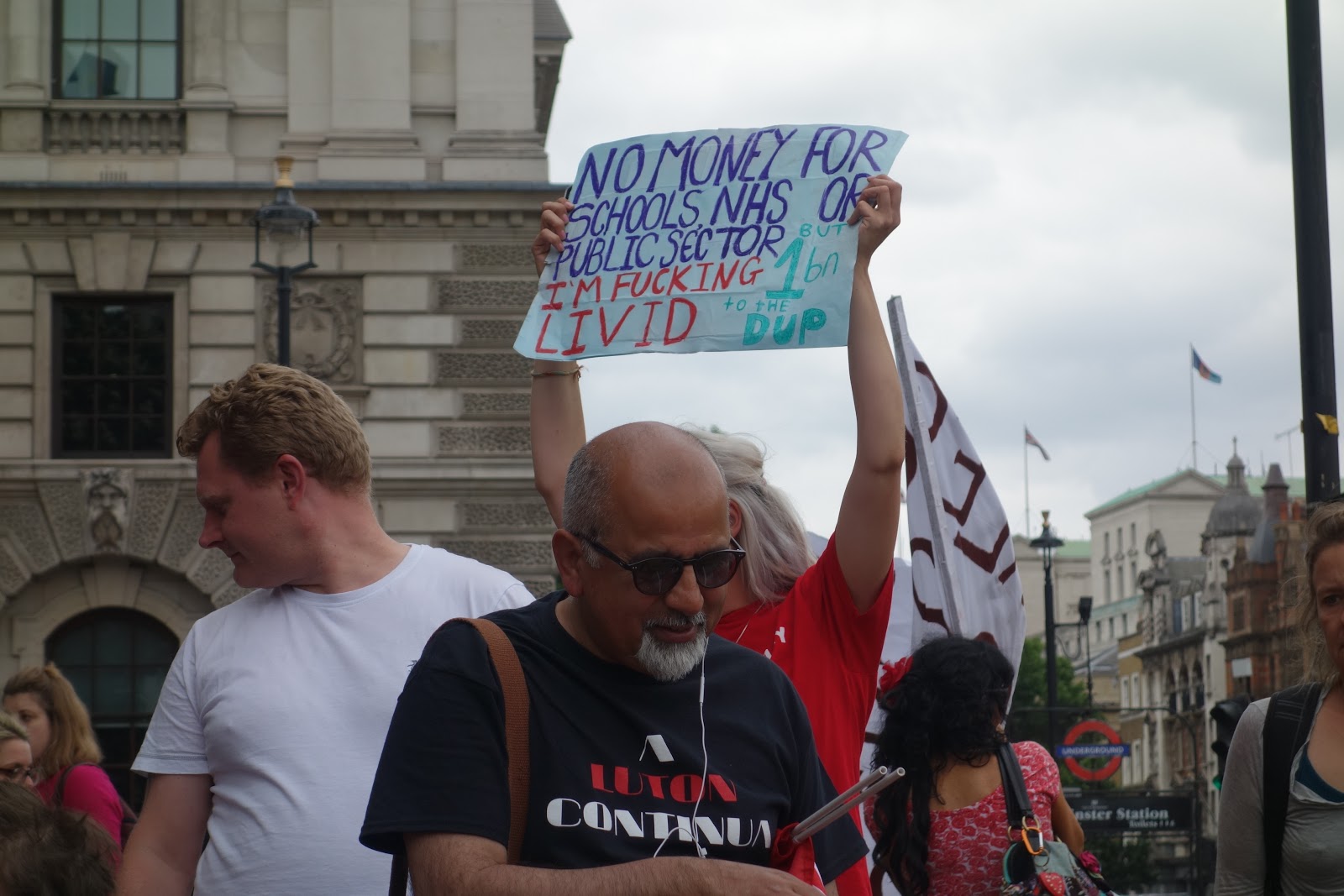
I attended the rally of the Not One Day More protest in central London today, and here are some photos and videos of some of the speeches made. The organisers, The People's Assembly said a hundred thousand people came to demonstrate.


The magic money tree


Captain Ska


Liar, Liar, the hit song of the recent general election campaign


Frances O'Grady, TUC General Secretary


Len McCluskey, Union UNITE General Secretary


John McDonnell, Labour MP and Shadow Chancellor


Sian Berry, Green Party London Assembly Member and Camden Borough Councillor


The man of the moment, Jeremy Corbyn, Leader of the Labour Party. 1/2.


An inspiring day in London, the times are a changing. Tories Out!

Friday, 19 May 2017

Why is May Taking a Risk with Core Tory Voters?


The Conservative Party general election manifesto was finally launched on Thursday, in Halifax in Yorkshire, a Labour held marginal constituency, and included some quite un-Tory like policies. At face value the manifesto is a departure from something like 40 years of Tory ideological dogma.

Take this passage from the manifesto: “We do not believe in untrammelled free markets. We reject the cult of selfish individualism. We abhor social division, injustice, unfairness and inequality. We see rigid dogmas not just as needless but dangerous.”  

This runs counter to everything the Tories have stood for since Margaret Thatcher became their leader in 1975. The ideology was fuelled by the thinking of neo-liberal economists like Milton Freedman and Friedrich Hayek and became known as the Chicago School of Economics (emanating in the main from the University of Chicago).

The essence of the ideology was that the nation state was bureaucratic and inefficient in supplying public services and in the process held back private businesses from being efficient (making big profits) with regulations on employment and much else. It was also said to discourage entrepreneurial activity by individuals, by taxing higher incomes and profitable businesses.

The solution offered was to reduce the size the state by privatising public services, closing down nationalised industries that were not profitable and to deregulate the economy to free up businesses to get on with money making. Along the way, trade unions would need to be weakened, if not crushed completely, as they were seen as holding back this process.

The first experiment of the theory in a real economy began in 1973 when Salvador Allende’s democratically elected socialist government in Chile, was violently overthrown by army General Pinochet’s coup, with help from America’s CIA. Many socialists and trade union activists were murdered in the process, and the economy was set on a neo-liberal pathway.

Thatcher became Tory Prime Minister in 1979, and set about transforming the British political and economic orthodoxy which had stood since the end of World War 2. By the 1990s the Labour Party and the Liberal Democrats had also adopted this neo-liberal ideology, but sought to smooth off some of the rough edges.

May is not advocating renationalising public services, or raising taxes on wealthy individuals and big businesses and there will be further curbs on trade unions taking industrial action. But if her rhetoric is to be believed, and there must be some doubt as to whether actual actions will amount to much of a change in practice, it will be news to many Tory supporters that they do not believe in ‘untrammelled free markets.’

May’s policies on immigration are not popular with the business community either, with the aim of reducing net immigration to ‘tens of thousands’ which I take to mean less than 100,000 net immigrants per year. Even her own ministers have said that this is unlikely to be met, and immigration may need to increase once we leave the European Union and freedom of movement ends. The economy would likely collapse for lack of workers.

This is compounded by the policy of charging businesses £2,000 per immigrant worker that they employ, which has received at best a lukewarm reception from business organisations. Normally, most business leaders are rock solid Tory supporters, so she is taking a risk here too.  

Then there is May’s apparent change of demographic electoral tactics that are her policies towards older, retired voters. The means testing of pensioners winter allowance, and therefore the taking of this money off the vast majority of pensioners, for example. 

The reduction of the so-called "triple lock" on pensions to a "double lock" with the state pension to rise by the higher of average earnings or inflation - but to no longer go up by 2.5% if they are both lower than that, will also make pensioners poorer.

But perhaps the riskiest policy of all is the proposal for how adult social care should be paid for. This is a huge problem in the UK, and certainly needs addressing, but forcing people to use the value of their properties to pay for care, is very un-Tory like.

Ever since Thatcher sold off the best of the public housing stock at knock down prices, house price rises and ownership has been central to economic strategy. Rising prices, achieved by restricting supply, particularly of affordable public housing, and so forcing up the price of housing, for sale or rent, has been the major driver of economic growth in the UK.

Property ownership is now expected to provide a pension for many people, and with these latest proposals it is to be expected to pay for health care as well, if necessary.

One of the few ways for younger people to have a chance of purchasing a property these days, is to get a parental loan, often raised against the value of the family home, or of inheriting the family home when their parents die. If this money is to be used (all but £100,000 of it) to pay for care, then this closes off an opportunity for young people too, or at least those lucky enough to have property owning parents.

This policy on its own, has the potential to be very unpopular with older voters, a demographic that tends to vote Tory in large numbers and are reliable at turning out to vote. It could cost the Tories the election.

A big risk, which May doesn’t need to take really, but she seems to be high on hubris, which for most Prime Ministers takes a few years, and more than one election victory. May has been Prime Minister for less than a year, won no elections and she already has delusions of grandeur.

This could well backfire on May, this election may not be the foregone conclusion that most commentators assume.  
   

Tuesday, 31 January 2017

Last Chance to Stop CETA - MEPs Vote 6 February


I'm sure you appreciate the significance of CETA by now, so here's the last useful action you can take. It will only take a 10 minutes, but might change your future drastically! More than Trump!

As always, we need to target those who are wavering - the Socialist and Democrat block (S&D) MEPs. 

The S&D vote on CETA will be absolutely critical - and pressure is definitely working - despite heavy trade lobbying, several S&D MEPs came out against CETA on the ENVI committee. According to Global Justice Now, its on a knife-edge, with only 3 or 4 MEPs out of 22 needing to be convinced.

They are voting on the final S&D position next Monday, 6th Feb

To make it convenient , you could simply copy or slightly adapt the suggested email below, right down to the bottom, with the references, which are underneath to your local constituency S&Ds. They can be found simply by typing your postcode into https://www.writetothem.com/, or you can use the attached spreadsheet. (You can drag your mouse down the email address column to select a block - or all 22 at once if you wish - but take care not to call them 'my MEP' at the end !).

Pass this on anonymously please, to whoever, wherever you can.

Ideally you'd write your own email to them this week (preferrable), as this is not written by an expert (we don't like them any more do we ?)

In addition to this letter, if you're in a rural constituency, you could express concern that the Conservative government has chosen not to protect any geographical indicators ( see this UK parliamentary briefing ), which will obscure the origins of our food, and could risk eroding regional food and farming.


Dear MEP 

I am a resident in the [  London ] constituency.  

As your constituent, I am writing to urge you to pledge to vote against the Comprehensive Economic and Trade Agreement, CETA.

Firstly, I have deep concerns over transparency and democracy itself.  You are no doubt aware of how little democratic participation there has been in the development of CETA - as shown by this ETUC statement which highlights the woeful lack of trade union consultation (1).  Even as an MEP I gather that you too, were inadequately consulted, and that the final text of CETA was more or less presented to you as 'take it all, or leave it all' situation. You are aware of how contentious ICS is, with the opinion of over 100 German legal professors that it is incompatible with EU law.(2) Despite claims that ICS is a much improved version of ISDS, the hastily rebranded version essentially contains the same investor priveleges, often using the same text as the EU-Singapore agreement. (3)

You are also by now probably aware that the economic modelling used to justify CETA magically assumes full employment.  When the more realistic United Nations Global Policy Model is used, there are predicted losses of GDP, government revenues, and rising inequality.(4)  It is unsurprising therefore, that this report concludes that “CETA will lead not just to economic losses, but also will have negative implications for social cohesion in an already complex and volatile political context”.  I cannot believe that the S&D block would consider signing up to such a risk to the social fabric, on the basis of highly dubious claims of economic benefit.

In addition to overall GDP losses, any claims that CETA may benefit SMEs are also unfounded.  The Employment and Social Affairs commitee (EMPL) has stated that an estimated 90 million SME jobs in the EU would be at risk under CETA, as part of their overall reasoning to reject it. (5)

I simply cannot understand why any S&D MEP would vote to accept CETA, and I urge you to back the considered opinion of your colleague, Jude Kirton-Darling MEP : 'Why I would vote against CETA' (6)   Indeed, it is most likely that CETA is not compatible with the S&D block's stated aims : see the report (7) 'How does CETA stand up to the S&D block's 10 progressive principles for trade?'

The
Conservatives wish to see CETA as a 'progressive' blueprint for all future trade deals, enshrining the first ever negative listing of all public services.   I therefore urge you to take this opportunity to demonstrate that you will put a clear dividing line between the S&D block and the Conservatives, as the French S&Ds have clearly done  ( CETA C'est assez ! ) (8)  You must demonstrate that, unlike the Conservatives, you do not wish to see this as the blueprint for all future trade, as we leave the EU.


As my MEP, I very much count on your support to vote against CETA. 
 Regards,
[ Your name and address ]
[ If applicable : your Labour Party member number ]

(1) https://www.etuc.org/sites/ www.etuc.org/files/press- release/files/etuc-clc_ statement_on_ceta_en.pdf
(2) https://stop-ttip.org/blog/ legal-statement-on-investment- protection-in-ttip-and-ceta/
(3) https://corporateeurope.org/sites/default/files/attachments/zombie-isds-ex-sum-en_0.pdf
(4)  http://www.ase.tufts.edu/gdae/ policy_research/ceta_ simulations.html
(5) http://www.europarl.europa.eu/ sides/getDoc.do?pubRef=-//EP// NONSGML+COMPARL+PE-593.983+02+ DOC+PDF+V0//EN&language=EN
(6) http://www.northeastlabour.eu/ why-i-would-vote-against-ceta- 0
(7) http://www.greenpeace.org/eu- unit/Global/eu-unit/reports- briefings/2016/201611%20CETA% 20and%20SandD%20progressive% 20trade%20principles.pdf
(8) http://www.deputes- socialistes.eu/ceta-cest- assez/