Showing posts with label CETA. Show all posts

Tuesday, 19 December 2017

After the Phase 1 Hype it’s back to Brexit Delusions


Tory ministers and MPs were falling over themselves to congratulate the prime minister, Theresa May, on getting past the first phase of Brexit negotiations with the European Union (EU). The prime minister herself was quick to claim the moment as a triumph for her negotiating skills too.

In reality, the agreement on the preliminary issues of EU/UK nationals status after Brexit and payment of the UK’s financial commitments, was basically a cave in to the EU demands. Why it took a year and a half to concede on these issues is hard to fathom, they could have been dealt with much earlier, especially as we ended up doing exactly what the EU wanted us to do. 

It has been a complete waste of precious negotiating time for the British government to hold out for so long, not to mention the opportunity spurned to get off to a start on the negotiations with a measure goodwill between the EU and UK intact.

It also has to be said, that the third preliminary issue in phase 1 of the negotiations, the land border in Ireland between north and south, has not been fully resolved, more like fudged. This particular can has been kicked down the road.

But this issue can’t be fudged forever, there will either be a hard border between north and south or there will not be. Drawing the border in the Irish Sea has been ruled out by the Democratic Unionist Party who the government relies on for a working Parliamentary majority, might have worked. So unless something changes, with the British government saying that it will leave the EU customs union and single market, finding a solution to the Irish border looks to be mission impossible.

It does fit into a general pattern though, played out in the week or so since the phase 1 agreement was agreed, of a return to the delusional thinking that has characterised the British government's approach to Brexit so far. It looked last week as though reality had finally dawned that Britain wasn’t going to get everything they wanted from the EU, but things soon returned to normal.

David Davis, the minister in charge of Brexit, who by his own admission is not very clever, was on the Sunday TV politics shows to describe phase 1 deal as only a ‘statement of intent,’ and Britain might not honour it, which drew a swift riposte from the EU that they would indeed hold Britain to the agreement, and any offer of a potential future trade deal could be withdrawn.   

The ‘Brexit Cabinet’ at long last met today to talk about what the UK actually wants out of any trade deal. The upshot apparently, is that Britain wants an ambitious ‘bespoke’ agreement. This has effectively been ruled out by Michel Barnier, the EU’s chief Brexit negotiator. He argued that it is important not to set a precedent of “cherry-picking” sectors. 

He said leaving the EU would mean City firms automatically losing the financial passports allowing them to trade freely in Europe.   

What Britain seems to think it can get, is a deal similar the CETA agreement between Canada and the EU, but with add ons for trade in services (a financial passport for British financial institutions) and fisheries, farming and aviation. It is likely that some agreement on aviation can be achieved and possibly fisheries and farming, although far from certain. But financial passports will be off limits if we leave the single market, as Barnier says.

So, we are pretty much back to square one, with realistically only about six months left to negotiate this seemingly impossible deal.

What the British government doesn’t appear to get, is that the EU will not allow us to have a better deal than we have at moment, not especially for economic reasons, as the EU have accepted that they will take a hit from Brexit, but for political reasons. Britain of course will take a much bigger hit to its economy than the EU if no deal can be made.

The EU has always been a political construction first and foremost, and the calculation will be that if Britain gets something better than what we have by being a full member of the EU, other countries will be encouraged to try get something similar, and whole union will start to unravel. That is the calculation the EU has made, and they will stick to it, whatever the economic costs to the EU are.

The sooner the British government wakes up to this state of affairs the better. Delusions are easier to sell to the Tory party of course, but the cold chill of reality can’t be put off indefinitely.   
           

Tuesday, 31 January 2017

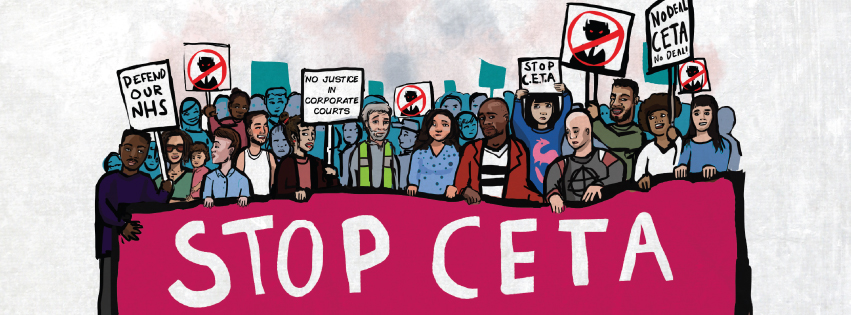
Last Chance to Stop CETA - MEPs Vote 6 February


I'm sure you appreciate the significance of CETA by now, so here's the last useful action you can take. It will only take a 10 minutes, but might change your future drastically! More than Trump!

As always, we need to target those who are wavering - the Socialist and Democrat block (S&D) MEPs. 

The S&D vote on CETA will be absolutely critical - and pressure is definitely working - despite heavy trade lobbying, several S&D MEPs came out against CETA on the ENVI committee. According to Global Justice Now, its on a knife-edge, with only 3 or 4 MEPs out of 22 needing to be convinced.

They are voting on the final S&D position next Monday, 6th Feb. 

To make it convenient , you could simply copy or slightly adapt the suggested email below, right down to the bottom, with the references, which are underneath to your local constituency S&Ds. They can be found simply by typing your postcode into https://www.writetothem.com/, or you can use the attached spreadsheet. (You can drag your mouse down the email address column to select a block - or all 22 at once if you wish - but take care not to call them 'my MEP' at the end !).

Pass this on anonymously please, to whoever, wherever you can.

Ideally you'd write your own email to them this week (preferrable), as this is not written by an expert (we don't like them any more do we ?)

In addition to this letter, if you're in a rural constituency, you could express concern that the Conservative government has chosen not to protect any geographical indicators ( see this UK parliamentary briefing ), which will obscure the origins of our food, and could risk eroding regional food and farming.


Dear MEP 

I am a resident in the [  London ] constituency.  

As your constituent, I am writing to urge you to pledge to vote against the Comprehensive Economic and Trade Agreement, CETA.

Firstly, I have deep concerns over transparency and democracy itself.  You are no doubt aware of how little democratic participation there has been in the development of CETA - as shown by this ETUC statement which highlights the woeful lack of trade union consultation (1).  Even as an MEP I gather that you too, were inadequately consulted, and that the final text of CETA was more or less presented to you as 'take it all, or leave it all' situation. You are aware of how contentious ICS is, with the opinion of over 100 German legal professors that it is incompatible with EU law.(2) Despite claims that ICS is a much improved version of ISDS, the hastily rebranded version essentially contains the same investor priveleges, often using the same text as the EU-Singapore agreement. (3)

You are also by now probably aware that the economic modelling used to justify CETA magically assumes full employment.  When the more realistic United Nations Global Policy Model is used, there are predicted losses of GDP, government revenues, and rising inequality.(4)  It is unsurprising therefore, that this report concludes that “CETA will lead not just to economic losses, but also will have negative implications for social cohesion in an already complex and volatile political context”.  I cannot believe that the S&D block would consider signing up to such a risk to the social fabric, on the basis of highly dubious claims of economic benefit.

In addition to overall GDP losses, any claims that CETA may benefit SMEs are also unfounded.  The Employment and Social Affairs commitee (EMPL) has stated that an estimated 90 million SME jobs in the EU would be at risk under CETA, as part of their overall reasoning to reject it. (5)

I simply cannot understand why any S&D MEP would vote to accept CETA, and I urge you to back the considered opinion of your colleague, Jude Kirton-Darling MEP : 'Why I would vote against CETA' (6)   Indeed, it is most likely that CETA is not compatible with the S&D block's stated aims : see the report (7) 'How does CETA stand up to the S&D block's 10 progressive principles for trade?'

The
Conservatives wish to see CETA as a 'progressive' blueprint for all future trade deals, enshrining the first ever negative listing of all public services.   I therefore urge you to take this opportunity to demonstrate that you will put a clear dividing line between the S&D block and the Conservatives, as the French S&Ds have clearly done  ( CETA C'est assez ! ) (8)  You must demonstrate that, unlike the Conservatives, you do not wish to see this as the blueprint for all future trade, as we leave the EU.


As my MEP, I very much count on your support to vote against CETA. 
 Regards,
[ Your name and address ]
[ If applicable : your Labour Party member number ]

(1) https://www.etuc.org/sites/ www.etuc.org/files/press- release/files/etuc-clc_ statement_on_ceta_en.pdf
(2) https://stop-ttip.org/blog/ legal-statement-on-investment- protection-in-ttip-and-ceta/
(3) https://corporateeurope.org/sites/default/files/attachments/zombie-isds-ex-sum-en_0.pdf
(4)  http://www.ase.tufts.edu/gdae/ policy_research/ceta_ simulations.html
(5) http://www.europarl.europa.eu/ sides/getDoc.do?pubRef=-//EP// NONSGML+COMPARL+PE-593.983+02+ DOC+PDF+V0//EN&language=EN
(6) http://www.northeastlabour.eu/ why-i-would-vote-against-ceta- 0
(7) http://www.greenpeace.org/eu- unit/Global/eu-unit/reports- briefings/2016/201611%20CETA% 20and%20SandD%20progressive% 20trade%20principles.pdf
(8) http://www.deputes- socialistes.eu/ceta-cest- assez/

Monday, 9 January 2017

January's Priority - Stop CETA


If you care about the NHS, railways, schools, colleges and universities, food, water and air quality, regulating banks, pesticides, energy supplies, fracking and the greenhouse effect, then read on. CETA is a seismic shift in corporate power over democracy, and is due for Provisional Application in February. We can act now though.

Like TTIP, the main agenda is not really 'free trade', or 'jobs and growth'. There is plenty of low tariff trade between the EU and US / Canada already. Any magical claims to 'jobs and growth' are based on economic modelling that assumes immediate re-employment when a sector moves away from a country. A more realistic analysis, based on the UN's Global Policy model, predicts a loss of jobs and loss of government revenue (see the conclusions here).

There's a lot in common with TTIP :
  • like TTIP,  the real target is not 'tariff barriers to trade' , but  'behind-the-border' barriers to trade - which means governments ability to regulate and pass laws affecting profits.
  • the ratchet clause will prevent any taking back public ownership and control of railways, NHS services, water supplies etc.
  • CETA will give investors the right to 'early information' about the government's intentions, threatening to sue states, in private courts if necessary, for up to 20 years worth of profits. They will be able to do this even if they breach UK law, if a private judge thinks the government's response is 'excessive'. This is via so called Investor-Court-System, ICS. (ICS used to be called ISDS, but was rebranded ICS in September 2015 - states can now appeal a courts decision, but the text is basically unchanged - see here).
  • all public services are most likely included unless they fall under the definition of 'services in exercise of government authority'. To do this, they must be BOTH (a) not in competition with other suppliers and (b) not on a commercial basis - the Commission has accepted that in practice, this might only mean legal services (prisons, judiciary, policing)
  • the change to a more 'gung-ho' , 'risk based' approach to public health, rather than using the EUs precautionary, hazard-based approach. For example, lead is a known hazard, and is not used in cosmetics in the EU. In the US, however, its possible to use lead in lipstick, if there's a commercial reason to do so. So, it would only be when we can definitely prove that its the dose of lead in the lipstick that's actually causing the harm, and not all the other possible causes, that the lead in lipstick would be regarded as posing an unacceptable risk.  Similarly for Monsanto's use of the carcinogenic glyphosphate pesticide, which is estimated to be present in 1 in 3 loaves of bread..

But it's also worse than TTIP. Its the worlds first ever 'opt-out' deal, casting a net over everything, unless we chose to exclude it. The clue's in the name - the Comprehensive Economic and Trade Agreement - and our government has chosen to exclude very little from the deal in practice. It will include - NHS services (as no longer services provided 'in the service of government authority'), food standards, water, housing corporations, education, transport, energy generation, financial service regulations - you name it.

The wording was finalised last year, so we're now in a position of 'take it all, or leave it all'. Liam Fox has already decided to pass off the deal in secret, bypassing any UK public scrutiny and debate (see here). The European Parliament are voting on whether CETA can be Provisionally Applied in early February, with an indefinite timeframe, and with a view to full application later, when the Investor Court System (ICS) will be applied.  

CETA could threaten environmental protection and worker’s rights. While trade unions, civil society organisations and even our MPs have been largely excluded from negotiations on CETA, big business has enjoyed significant influence throughout the process. If CETA passes the European parliament, it will be ‘provisionally implemented’, which means that even if the UK parliament votes against CETA, we’d still be part of the deal for at least 2 years. If the deal is fully approved, however, leaving the deal could take up to 20 years.

Provisional Application will happen just as we get swamped with news about Donald Trump. Brexit will not stop this vast takeover of UK parliamentary power (so much for 'taking back control').

Forget Trump and Brexit. CETA trumps the lot. We have to act :-

1. Get more informed about CETA - e.g.

Making sense of CETA' Canadian Centre for Policy Alternatives https://www.policyalternatives .ca/publications/reports/makin g-sense-ceta-2016

'The Great CETA Swindle' Corporate Europe Observatory https://corporateeurope.org/in ternational-trade/2016/11/grea t-ceta-swindle


2. Take action

(a) The Environment and Public Health Committee (ENVI) is reporting to the Commision this Thursday (12th) to recommend to accept or reject CETA. The draft recommendation to ENVI is to reject CETA on the basis of losing the precautionary principle, climate change considerations, amongst other things see http://www.europarl.europa.eu/ sides/getDoc.do?pubRef=-%2f%2f EP%2f%2fNONSGML%2bCOMPARL%2bPE -595.582%2b01%2bDOC%2bPDF%2bV0 %2f%2fEN 

We need to contact MEPs on ENVI who are persuadable to accept this  draft recommendation, asap before Jan 12th. There is no need to contact Greens, Conservatives, or UKIP whose minds are already made up. The MEPs on ENVI are here: http://www.europarl.europa.eu /committees/en/envi/members.ht ml

The most 'persuadable' ones are the S&D block MEPs -

(b) Tell your MP to attend a Commons debate on CETA: http://www.waronwant.org/mp- debate-ceta

(c)  Stop TTIP's  'CETA check ': https://stop-ttip.org/cetache ck/

(d)  Tweet using the hashtag #StopCETA

Please share far and wide.