Friday, 13 January 2017

Labour’s New Immigration Stance Sounds the Death Knell for a Progressive Alliance


Having been an ‘in principle’ supporter of an anti-Tory electoral pact at the next general election, I have also always been sceptical that it will ever transpire, in any meaningful way. There was a sort of pact between the Greens and the Lib Dems in the recent Richmond Park by-election, but Labour stood and has shown no real appetite for the concept.

With the Labour Party leader, Jeremy Corbyn, effectively re-launching his leadership in a speech and a tour of the media studios on Tuesday, I think he buried any faint possibility of a progressive alliance coming into being.

I say that, even though Corbyn’s position appeared to shift almost by the hour on Tuesday, in what we might charitably call a nuancing of his position, on fat cat pay, but more especially on the free movement of people within the (and between the UK and) European Union (EU).

By the end of the day Corbyn, although it wasn’t what the pre-speech press releases had said, was saying that:

"Labour is not wedded to freedom of movement for EU citizens as a point of principle, but I don't want that to be misinterpreted, nor do we rule it out."

Clear as mud, then. But the whole exercise had come on the back of the weekend comments from right wing Labour MPs, like Stephen Kinnock, that free movement of people would have to be curtailed as part of the Brexit negotiations. It could be Corbyn was trying please everyone in his party by being so vague by the end of the day, but it seemed to me that this was a shift towards ‘managed’ immigration from the EU, since staying in the EU single market almost certainly means accepting free movement. Reform of this it seems, is not an option.

Corbyn is of course mindful of the electoral threat to Labour from UKIP (and the Tories), in the north of England particularly, whilst trying to keep the 70% of Labour voters who voted to remain in the EU behind Labour. He can’t have it both ways though, we are either in the EU single market with free movement, or we are not, and Corbyn seems to be signalling, rather like the Prime Minister, Theresa May, that immigration trumps trade in any final Brexit deal.

Not only does this risk alienating a majority of Labour voters, but it really ends the prospect of electoral cooperation with the other likely participants of a progressive alliance, who all want to retain EU single market access and free movement, and even remain fully inside the EU.

The Lib Dems have of course made a second referendum on EU membership their flag ship policy, and they will be pleased if Labour leaves this ground free for them to exploit. Their leader, Tim Farron said: "This confirms what we all suspected, that Jeremy Corbyn never had his heart in fighting to protect Britain’s place in Europe.” 

Nicola Sturgeon, the SNP leader said: “Underlying signals are pointing towards the UK leaving the EU Single Market - the world’s biggest free trade area. Scotland did not vote to leave the EU and this year the Scottish Government will continue to do all we can to protect Scotland's vital interests.”

Plaid Cymru's leader, Leanne Wood, who said she favoured staying in the single market, was asked if the UK should stay in the single market and keep freedom of movement, replied: "Well I think we'd have to. I've been to Brussels and spoke to officials there and they are very clear about the freedom of movement of goods, trade and people all coming as a package."  

The Green Party co-leader, Caroline Lucas, a very vocal backer of a progressive alliance called it a ‘capitulation to the Tories’ and she added:

"The Labour Party is handing the post-referendum process to the Conservatives on a plate. First they risk throwing Britain off the Brexit cliff edge by voting with them to trigger Article 50 prematurely and now they seem set to sacrifice our access to the single market by joining the Tory blame game on free movement. At a time when we need a real opposition more than ever we're seeing Labour dancing to the Tories' Brexit tune.”

Increasingly, it looks as though on the central political issue of the time in the UK, Labour is taking a position where an alliance with the other anti-Tory parties, is all but impossible. Without Labour (and the Lib Dems), there is zero chance of a progressive alliance winning a general election, which makes it is all rather pointless really.

Progressive alliance – RIP?

Wednesday, 11 January 2017

What will the UK be like in the 2020s?


A report from the Institute of Public Policy Research (IPPR), which bills itself as the UK’s ‘leading progressive think-tank,’ was released at the end of 2016. Entitled ‘Future proof: Britain in the 2020s,’ the report tries to forecast the state of the nation up until 2030. Brexit, of course, features heavily in what the report describes as ‘firing the starting gun on a decade of disruption,’ that will lead to five powerful trends that will drive change in the UK in the 2020s.

These trends are:

A demographic tipping point: As the population grows, the UK is set to age sharply and become increasingly diverse. Globally, the long expansion of the working-age population is set to slow sharply.

An economic world transformed: The economic world order will become more fragile as globalisation evolves, trade patterns shift, and economic power gravitates toward Asia. At the same time, developed economies are likely to struggle to escape conditions of secular stagnation. The institutions governing the global economy are likely to come under intense pressure as the American hegemony that underpinned the post-war international order fades and the Global South rises in economic and geopolitical importance.

Brexit – the aftershock: The economic implications of Brexit are likely to put the country on a lower growth, lower investment trajectory, worsening the public finances, with important consequences for the UK’s economy and living standards. Migration is likely to become more controlled. At the same time, politics – long subservient to a liberalising economic consensus – is likely to become increasingly assertive in seeking to reshape Brexit Britain.

Technological transformation – between Star Trek and the Matrix: Exponential improvements in new technologies – computing power, machine learning, artificial intelligence systems, automation, autonomous vehicles, health and resource technologies, and the Internet of Things, among others – are expected to radically transform social and economic life. These changes have the potential to create an era of widespread abundance, or a second machine age that radically concentrates economic power. Which path we take – a future between Star Trek and the Matrix – will depend on the type of politics and institutions we build.

The shock of the Anthropocene – instability in an age of natural systems decay: Climate change, biodiversity degradation, and resource depletion mean we will increasingly run up against the limits of the physical capacity of the Earth’s natural systems to reproduce life as at present. The natural constraints of the Anthropocene age – our new geological era in which humans are the primary shaper of the Earth’s ecology and ecosystems – will force us to build a collective, democratic politics of restraint. The alternative is systemic degradation in ecosystems and rising inequalities in the years ahead.

Brexit complicates things more, but these changes would have happened anyway, so this not necessarily an anti-Brexit report, and here I would like to look at the technological changes in particular.

The report forecasts that technology will advance to the point that (in the UK and other western nations):        
  • Developments in automation, machine learning and general systems artificial intelligence could transform the workforce, and create new and as yet unimagined occupations.
  • By 2030 robots or smart machines are forecast to have on average an IQ higher than 99% of humans. The explosion in non-human intelligence has enormous economic potential, while also raising profound political and ethical questions.
  • A surge in autonomous or near autonomous vehicles is forecast by 2030, becoming ubiquitous by the mid-2030s. This will transform transport systems, urban design, and personal mobility.
  • The development of 3D printing will change the economics of manufacturing, reducing role of labour costs in location decisions, and increasing the importance of proximity to the customer. Additive manufacturing will create networks of microfactories akin to craft guilds, but with modern manufacturing capabilities, with radical discontinuities in trade as need for global supply chain eliminated.
  • Emergence of ‘smart factories’ cyber-physical systems and decentralised models of production. 
Although these developments will mean that economic and social change will be massive, it doesn’t need to be bad. In an echo of Murray Bookchin’s book ‘Post Scarcity Anarchism’, the report suggests that if handled fairly, they could lead to an improvement in the lifestyles of all citizens.

Many jobs will be lost, and although new ones will be created, 15 million of our current jobs are at risk of disappearing and there are likely to be less jobs overall. But how this is managed is very much a political choice. Technology is neutral, it is political and cultural forces that will determine who benefits.

As the report says:

This will require new models of ownership, higher wage floors to incentivize automation and boost the wage share, an education system that promotes creativity and skills that complement machines, a shorter working week to fairly share productivity gains, and potentially a universal basic income to supplement labour market income.

The report suggests that a new ‘social’-ism could shape how this change is managed, through democratic ownership of our collective national data. Data being the most precious resource, in the brave new world of the future. Common ownership of this data, will be as important as the physical infrastructure of the nineteenth century and the welfare state of the twentieth century, in policy terms.

The ‘Internet of Things,’ for example, will have a value of $11.1 trillion a year by 2025.Though this could lead to private network monopolies, and be analogous to the enclosure of the commons in the nineteenth century, so it will raise questions around the ownership and control of data and technology.

The report concludes by saying:

It will require building a new ‘common sense’ that reclaims a different type of modernity to that envisioned by neoliberalism – one that deepens and broadens economic and social freedom for everyone, not just a privileged few. This will require collectively shaping social, economic and technological change to extend democracy and deepen human flourishing, creating institutions that harness the growing power of technology to promote shared abundance, and building a common life that rewards purpose and kindness.

Monday, 9 January 2017

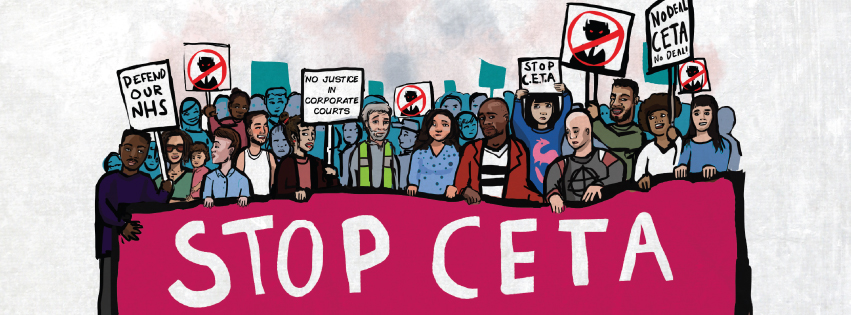
January's Priority - Stop CETA


If you care about the NHS, railways, schools, colleges and universities, food, water and air quality, regulating banks, pesticides, energy supplies, fracking and the greenhouse effect, then read on. CETA is a seismic shift in corporate power over democracy, and is due for Provisional Application in February. We can act now though.

Like TTIP, the main agenda is not really 'free trade', or 'jobs and growth'. There is plenty of low tariff trade between the EU and US / Canada already. Any magical claims to 'jobs and growth' are based on economic modelling that assumes immediate re-employment when a sector moves away from a country. A more realistic analysis, based on the UN's Global Policy model, predicts a loss of jobs and loss of government revenue (see the conclusions here).

There's a lot in common with TTIP :
  • like TTIP,  the real target is not 'tariff barriers to trade' , but  'behind-the-border' barriers to trade - which means governments ability to regulate and pass laws affecting profits.
  • the ratchet clause will prevent any taking back public ownership and control of railways, NHS services, water supplies etc.
  • CETA will give investors the right to 'early information' about the government's intentions, threatening to sue states, in private courts if necessary, for up to 20 years worth of profits. They will be able to do this even if they breach UK law, if a private judge thinks the government's response is 'excessive'. This is via so called Investor-Court-System, ICS. (ICS used to be called ISDS, but was rebranded ICS in September 2015 - states can now appeal a courts decision, but the text is basically unchanged - see here).
  • all public services are most likely included unless they fall under the definition of 'services in exercise of government authority'. To do this, they must be BOTH (a) not in competition with other suppliers and (b) not on a commercial basis - the Commission has accepted that in practice, this might only mean legal services (prisons, judiciary, policing)
  • the change to a more 'gung-ho' , 'risk based' approach to public health, rather than using the EUs precautionary, hazard-based approach. For example, lead is a known hazard, and is not used in cosmetics in the EU. In the US, however, its possible to use lead in lipstick, if there's a commercial reason to do so. So, it would only be when we can definitely prove that its the dose of lead in the lipstick that's actually causing the harm, and not all the other possible causes, that the lead in lipstick would be regarded as posing an unacceptable risk.  Similarly for Monsanto's use of the carcinogenic glyphosphate pesticide, which is estimated to be present in 1 in 3 loaves of bread..

But it's also worse than TTIP. Its the worlds first ever 'opt-out' deal, casting a net over everything, unless we chose to exclude it. The clue's in the name - the Comprehensive Economic and Trade Agreement - and our government has chosen to exclude very little from the deal in practice. It will include - NHS services (as no longer services provided 'in the service of government authority'), food standards, water, housing corporations, education, transport, energy generation, financial service regulations - you name it.

The wording was finalised last year, so we're now in a position of 'take it all, or leave it all'. Liam Fox has already decided to pass off the deal in secret, bypassing any UK public scrutiny and debate (see here). The European Parliament are voting on whether CETA can be Provisionally Applied in early February, with an indefinite timeframe, and with a view to full application later, when the Investor Court System (ICS) will be applied.  

CETA could threaten environmental protection and worker’s rights. While trade unions, civil society organisations and even our MPs have been largely excluded from negotiations on CETA, big business has enjoyed significant influence throughout the process. If CETA passes the European parliament, it will be ‘provisionally implemented’, which means that even if the UK parliament votes against CETA, we’d still be part of the deal for at least 2 years. If the deal is fully approved, however, leaving the deal could take up to 20 years.

Provisional Application will happen just as we get swamped with news about Donald Trump. Brexit will not stop this vast takeover of UK parliamentary power (so much for 'taking back control').

Forget Trump and Brexit. CETA trumps the lot. We have to act :-

1. Get more informed about CETA - e.g.

Making sense of CETA' Canadian Centre for Policy Alternatives https://www.policyalternatives .ca/publications/reports/makin g-sense-ceta-2016

'The Great CETA Swindle' Corporate Europe Observatory https://corporateeurope.org/in ternational-trade/2016/11/grea t-ceta-swindle


2. Take action

(a) The Environment and Public Health Committee (ENVI) is reporting to the Commision this Thursday (12th) to recommend to accept or reject CETA. The draft recommendation to ENVI is to reject CETA on the basis of losing the precautionary principle, climate change considerations, amongst other things see http://www.europarl.europa.eu/ sides/getDoc.do?pubRef=-%2f%2f EP%2f%2fNONSGML%2bCOMPARL%2bPE -595.582%2b01%2bDOC%2bPDF%2bV0 %2f%2fEN 

We need to contact MEPs on ENVI who are persuadable to accept this  draft recommendation, asap before Jan 12th. There is no need to contact Greens, Conservatives, or UKIP whose minds are already made up. The MEPs on ENVI are here: http://www.europarl.europa.eu /committees/en/envi/members.ht ml

The most 'persuadable' ones are the S&D block MEPs -

(b) Tell your MP to attend a Commons debate on CETA: http://www.waronwant.org/mp- debate-ceta

(c)  Stop TTIP's  'CETA check ': https://stop-ttip.org/cetache ck/

(d)  Tweet using the hashtag #StopCETA

Please share far and wide.

Sunday, 8 January 2017

Basic Income: Progressive Dreams Meet Neoliberal Realities


Photo by Eli Christman

Written by John Clarke and first published at Socialist Project

Up until now, the concept of Basic Income (BI) has enjoyed a greater history of being proposed than of being implemented. We may well be approaching a period, however, when this changes. The Ontario Government is holding consultations on setting up a BI pilot project. The Legislature in another Canadian Province, Prince Edward Island, has agreed to test out a version of BI. Pilot projects are also impending in Finland, the Netherlands and Scotland.

Basic Income has been suggested in an exceptionally wide range of forms, often with completely different objectives in mind. In fact, we can draw a line between the models that are concerned with improving lives and raising living standards and those that are focused on intensifying the capacity for capitalist exploitation. Among those in the ‘progressive’ category there is considerable diversity.

There’s the ‘universal demogrant’ that provides an income to everyone and the concept of a ‘negative income tax’ involving some level of means test. BI proposals come from liberal quarters that are responsibly redistributive, reduce poverty and inequality and ease up on bureaucratic intrusion. The above mentioned proposal for an Ontario pilot project would be part of this camp. Then there are the models that have more radical, transformative objectives in mind. These suggest that BI could be used to take from employers the power of economic coercion itself by severing the link between work and income. Often such ideas are tied to the notion of preparing for sweeping technological displacement and a ‘workless future’ by providing secure, adequate and unconditional income. Given the vast extent to which forms of unpaid labour are performed by women in this society, it is hardly surprising that there are also feminist arguments for BI.

I have to say that the one really common thread that I see running through all of the notions of a progressive BI is that they pay great attention to explaining how nice their systems would be but give little if any thought to the concrete prospects of implementation. Before looking further at these deficiencies and proposing an alternative approach, it might be useful to consider more seriously the neoliberal version that is hanging like a sword over all our heads.

Neoliberal Version

The deeply reactionary ideas of Charles Murray have extended to some very sinister proposals for BI. There are two basic elements that shape his system. Firstly, the universal payment, after the compulsory purchase of private health insurance, is set at the dreadfully low amount of $10,000 a year. Secondly, he is utterly insistent that all other systems of provision must be dismantled as a BI is put in place. Canada’s right wing Fraser Institute, recently used its blog to stress the same points as Murray, making clear that the level of provision must not interfere with the supply of low waged workers.

If governments today, as they intensify the neoliberal agenda, are starting to consider the possibilities of BI, I see three factors at work. Firstly, there is the not unimportant issue of legitimacy. Particularly because they are being provided with a generous amount of ‘progressive’ cover, they are able to present their deliberations on BI as a responsible weighing of the common good. The Ontario Liberals stand out as international champions in this regard. Their BI pilot project consultations, have enabled them to put in place yet another round of fake dialogue, with the empty promise of a “better way” diverting attention as they push people even deeper into poverty. The World Bank and the IMF have been worrying out loud about the backlash against their austerity agenda and its devastating impacts. That IMF economists are themselves musing about BI, is perhaps significant in this regard. It advances their agenda but can be dressed up to look progressive. It may be the best thing for the institutions of global capitalism since the myth of ‘poverty reduction’.

The second element of BI that I think is of interest to the architects of neoliberalism is that it can fine tune economic coercion as they create an ever more elastic workforce based on the most precarious forms of employment. The income support systems that emerged out of the Poor Law tradition, stressed intense restrictions and moral policing. Along with horribly inadequate benefit levels, this has been very useful in driving people into low waged work to an unprecedented extent. It may, however, be time to rethink this to a degree. If people are moving between poverty wages and poverty level benefits more frequently in a precarious job market, perhaps they can be more effectively prodded into the worst jobs with less intrusive benefit systems. A less rule bound delivery of poverty income, that gives people a chance of retaining their housing, may be needed to keep them job ready.

Linked to this, of course, is the huge boost to the employers of a BI system that constitutes a form of wage top up. Provided the payment is meagre, it will not impede the flow of low paid workers but it will mean that their employers receive a subsidy that absolves them from having to pay living wages or come under pressure to increase the amount they do provide.

Thirdly, the great advantage of neoliberal BI is that the inadequate and dwindling payment it provides turns those who receive it into customers in the marketplace. In my opinion, BI would be far from the best way to strengthen the social infrastructure at any time but in the context of an intensifying agenda of austerity and privatization, it is a recipe for disaster. It’s really about the commodification of social provision. Your payment may actually be less conditional and somewhat larger but, as you shop through the privatized remains of the social infrastructure, with inadequate means and very few rights, you are dramatically worse off. That, in my view, is what is being prepared by those who will actually implement a system of BI and the hopes and wishes to the contrary of its progressive advocates don’t count for very much.

Progressive Dreams

I said previously that proposals for redistributive or transformative models of BI are generally marked by a tendency to focus on the desirability of what is being advanced while paying much less attention to actual prospects for implementation. I’ve yet to see, quite bluntly, any serious attempt to assess what stands in the way of a progressive BI and what can be done to bring it into existence. It simply isn’t enough to explain how just and fair a given model would be if it could be adopted. In order to credibly advance BI as the solution, there are some questions that must be settled.

Firstly, income support systems came into being because, while employers welcome an oversupply of labour and the desperation that comes with it as something that boosts their bargaining power, the total abandonment of the jobless creates social unrest. Some measure of income support, provided as a reluctant concession, has proved to be necessary. However, the systems of provision that have been put in place have always been as inadequate as possible so as to undermine employer strength as little as possible. A widely delivered or even universal adequate payment would greatly tilt that balance back the other way. What reason is there to think that this is likely to be implemented?

Secondly, over the last several decades, concessions made during the post war years have been taken back. Trade unions have been weakened, workers’ rights undermined and low waged work has increased considerably. The degrading of income support systems has been central to creating the climate of desperation needed to achieve this. Not only have benefits for the unemployed been attacked but other systems, especially for disabled people have been undermined so as to generate a scramble for the worst jobs. This has led to a shift in the balance of forces in society and we are fighting a largely defensive struggle. Given this very unfavourable situation, in which unions and movements are not in the ascendancy, how can it be supposed that those profiting from the present situation are likely to accept a measure of redistributive social reform that is at least as sweeping as anything put in place during the post war boom? What is the plan to make this happen?

Thirdly, as right wing governments and political parties directly linked to the most reactionary business interests consider BI and set up pilot projects that provide meagre payments and focus on how to ensure people on social benefits become low waged workers, what reason is there to imagine that a progressive BI, rather than the neoliberal variant, is being cooked up?

Regardless of these issues, it is sometimes asserted that an adequate system of provision must be put in place simply because we are moving toward a “workless future.” In such a society, it is suggested, masses of people who have been displaced will have to be provided for and the capitalists will have to think like Elon Musk, of Tesla Motors and support BI because it is the only sensible and rational solution. To imagine such responsible provision for the future is to place undue faith in a system based on the making of profit. If they won’t stop building pipelines in the face of environmental catastrophe, there’s little reason to expect them to worry too much about sensible solutions to technological displacement. There simply is no post-capitalist capitalism and no social policy innovation that is going to bring it about.

At a recent panel on Basic Income that I spoke at, the moderator posed a challenge. She accepted that BI might not be a way forward but asked, if that were so, what “bold vision” could be advanced in its place. It’s a fair question but a realistic appraisal of what we are up against is still obligatory, even if that has some sobering aspects to it. The great problem that we have is that the neoliberal years have done a lot of damage. The level of exploitation has been increased and working class movements have been weakened. While what we demand and aspire to is very important, the bigger question is what we can win. What’s disturbing about the left wing turn to BI is that is seems to think there is a social policy end run around the realities of neoliberalism and the need to resist it. There is no such thing.

British Labour Party and BI

With very good reason, there has been considerable excitement internationally around the Jeremy Corbyn leadership in the British Labour Party. His close ally, Shadow Chancellor, John McDonnell, has been paying some attention to adopting BI, as part of a platform that would express a break with the austerity consensus. McDonnell, from a position on the left of a major social democratic party, raises the possibility of a ‘best case scenario’ for progressive BI. For that very reason, the question is posed of whether the ‘bold vision’ I spoke of should be framed around the universal payment concept or devoted to other objectives.

In my opinion, if we are to consider goals we set and demands we put forward in the face of neoliberalism, that are based on the needs of workers and communities and create the conditions for challenging capitalism itself, we sell ourselves well short if we settle for something so limited and inherently conservative as the universal payment. BI, when all is said and done, is a vision for nothing more than the means to be a customer in an unjust society that decides what is for sale. How much bolder and more meaningful to fight for free, massively expanded and fully accessible systems of healthcare and public transportation? How much better to focus on the creation of social housing and try to expand it so that, not only the poorest, but most working class people enjoy its benefits?

There is universal child care and vast array of important community services to pay attention to. Moreover, we can work to wrest as much power as possible out of the hands of the mandarins of state bureaucracy and fight to increase the control working class people exercise over the public services they rely on. When it comes to existing systems of income support, we should not for a moment accept their poverty level benefits, bureaucratic intrusion and forms of moral policing steeped in racism and sexism. There is a fight to be taken forward for living income, full entitlement and programs that meet the real needs of unemployed, poor and disabled people, as opposed to the present ‘rituals of degradation’ they embody. At every point, let’s try to ensure that these expanded services are not paid for by other working class people but by forcing the corporations, banks and those who own them to pay by increasing their tax burden and imposing levies on their wealth.

The struggle to expand and improve public services would have to, of course, be linked to workers’ struggles for living wages, workplace rights and real compensation for injured workers. Beyond this, let’s challenge as much as we can the ‘business decisions’ that deplete resources, pollute and threaten us with ecological disaster.

I am suggesting that our movements need to challenge, rather than come to terms with, the neoliberal order and the capitalist system that has produced it. For all its claims to be a sweeping measure, the notion of progressive BI is a futile attempt to make peace with that system. In reality, even that compromise is not available. The model of BI that governments are working on in their social policy laboratories will not ‘end the tyranny of the labour market’ but render it more dreadful. The agenda of austerity and privatization requires a system of income support that renders people as powerless and desperate as possible in the face of exploitation and that won’t change if it is relabelled as ‘Basic Income’.

John Clarke is an organizer with the Ontario Coalition Against Poverty (OCAP).

Saturday, 7 January 2017

New globalism: a counterculture that could redraw the world map


Written by Matti Mattila and first published at The Conversation

For the past few decades, globalisation has been the status quo. Advancements in communication and transport technology have made the world far smaller than it once was, and governments and businesses everywhere have long since sought to make this notion profitable. This has manifested in free-trade agreements, economic and political unions and, in Europe, the unprecedented common citizenship of 500m people across 28 countries.

But after the Brexit vote, after Donald Trump’s victory, and with Marine Le Pen’s French presidential campaign on the horizon, globalised nations are finding themselves divided down the middle on ideological lines. So entrenched are the beliefs on each side of the divide that they invoke a counterculture of their own, threatening to spurn the society they once shared.

In 1996, political scientist Samuel Huntington hypothesised that identity politics would become the fulcrum of global conflict. He described the fundamental bonds of nation as “history, language, culture, tradition and, most importantly, religion”. For him, these characteristics bind nations together above all, and do so in opposition to those on the outside.

Huntington foresaw a heightened awareness of cultural differences as a result of globalisation. Regional cultures, he predicted, would see their own identity through differences with their neighbours. Detractors of Huntington, such as economist Amartya Sen, warned that such a homogenised view of cultural groups was a mistake as most valued diversity as a defining characteristic. In reality, they were both correct. But not entirely.

New priorities


Language, culture, tradition and religion are no longer enough to bind the regions of the Western world. There has been a markedly political transformation. Identity within Western culture has unravelled into a question of how outsiders are, or should be, viewed. Working-class voters, traditionally the base of social democratic parties, are turning towards the anti-immigration populism of the right. This in itself is nothing new, but for the first time traditional notions of “left” and “right” are being replaced. In the US, it’s for or against the Mexican wall. In the UK, it’s “Remain” or “Leave”.

On the other side of the aisle, globalists are equally determined to preserve a common citizenship. Luxembourg MEP Charles Goerens, for example, proposed that “associate” EU citizenship could allow citizens of former member states to opt-in voluntarily. Here, a new kind of transnational citizenship would be on offer – one that would be invulnerable to the whims of nation-state isolationism.

Division and union


The existing geography of nationhood then, at least in terms of nation-state unions, is under pressure from both globalists and anti-globalists simultaneously. Right-wing populist movements in Europe are pushing for more countries to leave the EU, while the UK wrestles with internal disputes. It’s not just the familiar spectres of regional nationalism that threaten to dismantle the UK now either.

In London, city mayor Sadiq Khan wants a “London work permit” to sidestep the EU immigration restrictions that look to become an inevitable part of Brexit. There are even murmurings of a full London independence movement. In the US the notion of Californian independence (“Calexit”) has been gaining traction since the election of Donald Trump.

While right-wing populists seek to destroy the globalised world in pursuit of a traditional nationalism, these new independence movements seek to do the opposite: to liberate themselves from their historical identity in order to forge worldwide relationships.

Herein lies a striking similarity between the music subcultures I study and current geopolitical trends. Scholars in my own field have found that music lovers – goths, for example – can feel they have more in common with other members of their musical subculture, even if they live thousands of miles away, than with people in their geographical community.

In the same sense, internationalism has become a subcultural identity. A social democrat in the UK is likely to have more in common with a social democrat in France or Germany than with a nationalist in their home town. The prospect of individual EU citizenship (which seems increasingly possible), alongside desperate attempts for British citizens to seek citizenship in other EU states, is proof of this. Irish passport applications doubled overnight after the Brexit vote, while Trump’s election saw the Canadian immigration homepage crash.

Globalisation may have paved the way for the populist right to flourish in response but, in opening up the world through technology, the barriers of geography have been diminished permanently.

After the end


As Trump’s election was assured, Florian Philippot, the vice-president of Le Pen’s Front National, tweeted: “Their world is collapsing. Ours is being built.”

This is momentarily true for the physical world, in the form of existing governmental power structures. But the ideological sphere of internationalism is still intact. Imagine a world, within our lifetime, in which the people of California, Scotland, Catalonia, London, and Berlin shared free movement and common citizenship, but where visas were required to visit Florida or Plymouth.

Once, not too long ago, such an idea would have been absurd, but no more – we have already witnessed the unimaginable. Is the possibility of a world map shaped by ideological nationhood so extraordinary?

Thursday, 5 January 2017

If you carry a Firearm the Police will Assassinate You, it Seems


Photo credit: metro.co.uk

The fatal shooting by police of Yassar Yaqub in a slip road off the M62 in west Yorkshire on Monday, throws up many questions. Official details have so far been very limited to say the least, but it appears that Yaqub was shot by police marksmen, without any returning fire from the car that Yaqub and one other person were travelling in. The police have said that they have recovered a ‘suspected firearm’ from the scene.

As far as I can tell from what has been reported in the media, Yaqub’s car was stopped by a police car swerving in front of it and blocking its path, at which point other police vehicles surrounded the target car, and police marksmen opened fire, shooting through the windscreen and killing Yaqub. It doesn’t appear that any attempt was made by the police to arrest the people in the target car, before police opened fire. As I say, we don’t know much yet, and perhaps we never will.

The word assassinate is a strong one, but it was the term used by the victim’s father, Yassar, as reported in the Guardian, in an exclusive interview. He also raises some of the questions that he wants answers to. In the piece he asks:

“If they’ve gone all the way to Bradford and come back, would they not have stopped them when they thought the public were in danger or would they stop them when they were almost home?” 

“So what happened between getting on the motorway and getting off? Nothing’s happened in between has it?

He added: “The terrible thing is that if it was a fight you could understand it but this – somebody in the car just bang, finished – that’s what is killing me more.”

Yassar Yaqub is hopeful of getting answers to his questions, and he quoted the similar police shooting of Mark Duggan in Tottenham, London, which led to riots in the area and most of the English cities in 2011. In truth we never really got to the bottom of what happened when Duggan was shot, so I think Mr Yaqub may be disappointed.

This is what Stafford Scott, a community activist in Tottenham said after the verdict of ‘lawful killing’ in the inquest into Duggan’s death in 2014:

‘Firstly the family is struggling to understand how the shooting of an unarmed man can still be deemed a lawful act. The "safety net" for police officers in such circumstances is that the killing is lawful if the officer has an "honestly held belief" that he or others are in imminent danger. But in this case the jury themselves stated it was their belief that Duggan had thrown the gun before being fatally shot, so where was the immediate, clear and present danger?

At the inquest, V53 – the officer who fired the fatal shots – said that he definitely saw the sock-covered gun and was even able to describe seeing the barrel of the gun sticking out of the hole in the sock. He also gave this sworn testimony in the two trials of the alleged gun supplier, Kevin Hutchinson Foster. On each of these occasions he stated he was positive that Mark had the gun in his hand when he shot him the first and second time. Each time he described it as a "freeze frame" moment, adding: "This is something that you do not forget." He further justified the need for shooting Duggan twice by describing how the first shot spun Duggan around so that the gun was pointing directly at him when he shot him the second time.’

I would add, that there were inconsistences and contradictions in the police’s evidence, with eye witness reports completely at odds with the police’s version of events. Indeed, the word on the street in Tottenham, is that Duggan’s gun was in a shoe box, and he made no attempt to use it at all. The feeling is that the police took the gun out of the box and planted it some twenty yards away from the car Duggan was travelling in.

So, I wouldn’t expect we will get to the truth of Yaqub’s killing, officially, either. But it does appear that the police now operate a shoot to kill policy, if they suspect a person is carrying a firearm. We know that these instances are very difficult ones for the police officers involved, but they should be highly trained individuals, and act in a professional manner. By making no attempt to arrest armed suspects, the police are effectively acting as judge, jury and executioner.

Where is the rule of law in all of this? This cannot be allowed to continue, or else people in similar situations will fire first on the police, in what would be a rational case of self defence. The police’s actions are escalating these situations, basically encouraging a fire fight.  
     

Tuesday, 3 January 2017

Top Climate Stories to Watch in 2017


Written by Mike Gaworecki and first published at Common Dreams

2016 was something of a mixed bag for the global climate. On the one hand, renewable energy use has never been higher — but on the other hand, 2016 brought with it news of record fossil fuel consumption, as well.

Meanwhile, the Paris Climate Agreement went into force on November 4, far sooner than anyone ever expected, signaling a new era of international climate action — but just a few days later, the U.S., the second-largest emitter in the world, elected a new president who has called global warming a hoax and pledged to withdraw the U.S. from the Paris Climate Agreement as soon as possible.

Needless to say, 2017 is likely to be a pivotal year in the fight to halt global climate change and all of its impacts. Here, in no particular order, are some of the top stories to keep an eye on in the new year.

1. Will Trump withdraw U.S. from Paris Climate Agreement and kill clean energy funding?

More than 90 countries had ratified the Paris Climate Agreement when it entered into force on November 4, 2016. Just 55 countries representing at least 55 percent of the world’s greenhouse gas emissions needed to formally adopt the pact in order to trigger its entry into force, and that threshold was reached far quicker than anyone anticipated.

When Donald Trump was elected to the presidency a few days later, Mongabay contributor Justin Catanoso reported from the UN climate talks in Marrakesh, Morocco that delegates were “aghast and shaken, with emotions ranging from defiance to wishful encouragement.”

All 195 countries party to the Paris Agreement are obligated to achieve their voluntary pledges to reduce carbon emissions and abide by all provisions of the agreement for three years before they can seek to withdraw. The withdrawal process itself is likely to take another year. But news quickly broke that Trump’s transition team was already seeking ways to bypass the four-year procedure for exiting the pact.

The whole world will, of course, be watching closely to see whether or not Trump makes good on this pledge and his other anti-climate action stances, such as his proposal to end all federal funding for clean energy development and climate science research. The fact that Trump has chosen Oklahoma Attorney General Scott Pruitt to head the Environmental Protection Agency (EPA) is perhaps a sign that he does indeed intend to follow through.

Pruitt is a close ally of the fossil fuel industry and a staunch climate denier with ties to the Koch Brothers. The confirmation process for Pruitt is shaping up to be quite contentious, and is well worth watching as an indication of how U.S. climate action will fare in 2017, as well.

2. How will countries and others respond to a climate-denying US administration?

Responding to the election of Trump and the news that he was seeking a speedy exit from the Paris Climate Agreement, Katherine Hayhoe, an atmospheric scientist and associate professor of political science at Texas Tech University, said in a statement that “The bright light of hope the Paris Agreement shone on the bleak and discouraging landscape of climate change has been dimmed but not extinguished.”

Numerous other responses were forthcoming. For instance, a letter signed by nearly 400 companies and investors urged Trump not to withdraw the U.S. from the Agreement and to continue “investment in the low carbon economy at home and abroad” specifically because they see climate action as good for business.

As Justin Catonoso reported for Mongabay, the U.S. could face a serious backlash above and beyond the loss of standing on the world stage that would result from a withdrawal from the Paris Climate Agreement. That backlash might take the form of faltering trade agreements, failed military cooperation, economic sanctions, or even a carbon tax levied on the U.S. for not reaching its emissions-reduction pledges.

One thing that’s clear is that, at this point, no one country can put climate action back in the bottle, so to speak. U.S. Secretary of State John Kerry made this point during the UN climate talks in Marrakesh: “This is bigger than one person, one president. We have to figure out how we’re going to stop this [Trump’s plan]… No one has the right to make decisions that affect billions of people based solely on ideology or without proper input.”

The rest of the world, especially China, India, and the European Union, plans to continue rapidly decarbonizing their economies with 21st-century technologies, no matter what route the U.S. takes. China is widely expected to step into the power vacuum created by Trump’s failure to carry on in the climate leadership role adopted by the Obama Administration, according to Catonoso, who added that withdrawing from the Paris Climate Agreement “could have far-reaching negative implications for future US foreign policy, and for the US economy.”

3. China, the world’s largest emitter, and coal consumption.

In order to be a world leader on climate action, China will have to get its own house in order. And that will mean aggressively phasing out the use of coal more than anything else.

As of July 2016, China had 895 gigawatts of existing coal capacity, another 205 gigawatts under construction, and plans for a further 405 gigawatts, according to a report by the London-based Carbon Tracker Initiative. The report also found that the country’s 895 gigawatts of installed coal capacity was being utilized less than half the time — meaning China could be planning to spend nearly half a trillion dollars on coal-fired power plants that it doesn’t even need.

“China’s coal power investments have reached an important juncture: keep pouring capital into increasingly unviable projects and put the financial system under additional pressure from the risk of large-scale defaults, or stop investing and promote efficiency,” the Carbon Tracker Initiative said. If China completes all of the coal-fired projects that are currently in the works or in the planning stage, the country would blow through its carbon budget for limiting global warming to two degrees Celsius by 2036, the group added.

Two years ago, the U.S. and China — the two biggest greenhouse gas emitters on the planet — signed a joint agreement to combat climate change in which China pledged to generate 20 percent of its electrical power from renewable sources by 2030 and to hit peak emissions that same year (some experts have estimated that China has already hit peak emissions, but the data is inconclusive).
The joint leadership shown by the two countries is widely believed to have been a significant factor in making the Paris Climate Agreement possible in December 2015.

Of course, it made sense for China to take such a strong public stance regarding its future use of coal. Air pollution from burning coal is so bad that it caused 366,000 premature deaths in China in 2013 alone, researchers have found.

If China, a country with a rapidly growing middle class that is heavily reliant on coal for energy production, is to meet its emissions-reduction targets, that would have huge implications for major coal producers in Australia and the U.S. as well as for the global coal industry as a whole. If it doesn’t meet those goals, particularly because of not phasing coal out of its energy mix aggressively enough, that could have a serious impact on its ability to lead the rest of the world towards a sustainable, low-carbon future.

4. Will Arctic Sea ice continue to decline, opening up the fabled Northwest Passage once and for all?

In almost every summer since 2007, the southern route of the Northwest Passage, which connects the northern Atlantic and Pacific Oceans, has been nearly ice-free. In 2016, the luxury cruiseliner Crystal Serenity became the largest passenger vessel to ever travel through the route, which was considered nearly impassable just over a century ago.

As Mongabay staff writer John Cannon reported earlier this month, higher-than-normal water and air temperatures coupled with shifts in wind patterns led to record-low sea ice extents in both the Arctic and the Antarctic in November 2016. “It looks like a triple whammy – a warm ocean, a warm atmosphere, and a wind pattern all working against the ice in the Arctic,” said Mark Serreze, director of the National Snow and Ice Data Center in Boulder, Colorado.

Dropping temperatures in the months leading up to winter usually lead to increases in Arctic Sea ice, a process that typically starts in September and peaks in March. But at one point in mid-November, the extent of Arctic sea ice had actually shrunk by about 50,000 square kilometers (19,300 square miles). In some places, air temperatures were 10 degrees Celsius (18 degrees Fahrenheit) higher than the November averages recorded between 1981 and 2010. As a result, Arctic Sea ice extent was just 9.08 million square kilometers (3.51 million square miles), 18 percent lower than the November average. That made November the seventh month of 2016 with record-low levels of Arctic Sea ice.

We won’t really begin to know what 2017 will bring for the Arctic until late March, when the melt season returns. But it doesn’t look good: For the second year in a row, scientists forecasted ice-melting December temperatures for some parts of the Arctic.

5. Renewable energy getting cheaper and cheaper vis a vis fossil fuels.

As Bloomberg reported earlier this month, “A transformation is happening in global energy markets that’s worth noting as 2016 comes to an end: Solar power, for the first time, is becoming the cheapest form of new electricity.”

In mid-2015, the world hit an important turning point, entering an era in which we’re building more capacity for clean energy each year than for coal and natural gas combined. It’s now predicted that the world could reach peak fossil-fuel use for electricity generation within the next decade.

Coal and natural gas — and the CO2 they emit when burned for energy — are likely to continue playing key roles in the global energy mix for years to come, however. According to a report that came out in June, in fact, global consumption of fossil fuels is at an all-time high. Even though consumption of renewables is also at a record-high level, 2015 was still the sixth year in a row that a new record for total global emissions was set.

We can probably expect lots of confusing and contradictory stats to emerge in 2017 as the global energy mix continues to experience drastic growth and changes. For instance, the U.S. Energy Information Administration forecasts that, after declining by 2.6 percent in 2015, energy-related CO2 emissions in the U.S. will have declined by another 1.3 percent in 2016 but will increase by 0.9 percent in 2017.

Still, there are undeniable signs that a clean energy economy is fast approaching. Look for wind and solar to continue getting cheaper and supplying an ever-larger share of the world’s energy needs in the new year.

6. Climate change, forests, and REDD+.

According to some estimates, deforestation is responsible for as much as one-fifth of all global greenhouse gas emissions — more than all of the world’s planes, trains, and automobiles combined.

That means that curbing deforestation is not only good for forests and the people and wildlife that depend on them (which is pretty much everybody and every creature on Earth), but it’s also good for combating climate change.

In acknowledgement of this reality, the nearly 200 countries that adopted the Paris Climate Agreement in December 2015 included the UN’s mechanism for Reducing Emissions from Deforestation and forest Degradation, known as REDD+, as a standalone article in the pact.
In 2015 alone, governments and companies from around the world committed a record $888 million in new funding to projects aimed at keeping forests and other carbon-absorbing landscapes intact, through REDD+ initiatives and other mechanisms such as carbon markets. This is an encouraging sign that large-scale financial flows might be starting to materialize for forest protection efforts.

Nonetheless, late 2016 brought news that deforestation in Brazil had jumped 29 percent over 2015 levels. That means that, even though destruction of the Brazilian Amazon continues to occur at historically low rates, deforestation is at the highest level recorded since 2008. (We also learned in late 2016 that Brazil was planning to restore 22 million hectares (about 54 million acres) of land in what the World Resources Institute called “the largest restoration commitment ever made by a single nation.”)

Deforestation is a large and complex issue, so it’s no surprise that there should be setbacks even as the world is making great strides in dealing with the issue. For example, agricultural commodities like beef, palm oil, pulp & paper, and soy have become an increasingly important driver of tropical deforestation, which is why hundreds of companies have now made “Zero Deforestation Commitments” in order to root out the deforestation in their supply chains. But according to recent analyses, even many of the companies that have made these pledges are underestimating the extent to which they are exposed to the risk of their operations contributing to deforestation, and are therefore unlikely to achieve their time-bound targets for severing their ties to forest destruction.

The good news is that many tropical countries are committed to only promoting sustainable production of agricultural commodities, and we’re pouring more resources than ever into understanding exactly which forest conservation strategies are most effective.

7. Ongoing global coral reef bleaching event and other climate impacts on Earth’s oceans.

2016 saw a lot of action to protect Earth’s oceans and its inhabitants. In August 2016, U.S. President Barack Obama expanded the world’s largest protected area, the Papahānaumokuākea Marine National Monument in Hawaii, which provides important habitat for monk seals, sea turtles, sharks, and several other species of at-risk marine wildlife. Then, in October, the Commission for the Conservation of Antarctic Marine Living Resources (CCAMLR), an international organization that represents 24 countries and the European Union, one-upped Obama by establishing a larger, 1.55-million-square-kilometer (598,000-square-mile) marine protected area in the Ross Sea, off Antarctica.

More than 3.6 million square kilometers or 1.39 million square miles were protected in 2016, bringing the total amount of protected ocean to five percent — which still represents just half the amount called for by the Convention of Biological Diversity.

There’s no way to protect marine biodiversity from the impacts of climate change, however.

Thankfully, an obituary for Australia’s Great Barrier Reef that went viral this year was inaccurate — but, as Mongabay staff writer Shreya Dasgupta reported at the end of November, scientists have confirmed that the Great Barrier Reef suffered the worst coral bleaching event on record due to higher than normal water temperatures in 2015 and 2016.

It’s not just the Great Barrier Reef, either — a global coral reef bleaching disaster that started in 2015 is ongoing today, and corals around the world have been effected.

Meanwhile, an octopus was found in the parking garage of a seaside condo complex in Florida in November after flooding associated with unusually high tides carried it up through the garage’s drainage pipes. As University of California, Santa Barbara scientists Douglas McCauley and Caroline Jablonicky wrote for Mongabay, “Projections for sea level rise suggest this may be just the tip of the (melting) iceberg. Climate change is causing ocean waters to expand and melting land ice is adding more volume to the oceans, which are projected to rise about two feet by the end of this century.

Much more alarming than marine wildlife in parking garages is the potential for trillions of dollars in damage that sea level rise may cause to coastal communities if climate change goes unchecked.”
Amidst all of the climate change-induced pressures on marine wildlife, mankind is about to start mining the seabed in search of copper, gold, manganese, nickel, and other minerals. Canadian company Nautilus Minerals is hoping to open the world’s first deep sea mine off the coast of Papua New Guinea in the Bismarck Sea in early 2018.

8. Citizen-led climate action.

While major protests in the U.S. against the Keystone XL tarsands pipeline and the Dakota Access Pipeline have targeted specific infrastructure projects that would lock us into decades of continued fossil fuel use, they have also shown the power of a united climate movement to effect real policy changes.

The global divestment movement is another example of citizen-led climate action that is making a real impact. As of December 2016, investment funds worth more than $5 trillion have now committed to divesting their fossil fuel assets.

As ThinkProgress reports, “while the push for divestment began originally as a grassroots campaign on college campuses, the movement has gone mainstream, with 80 percent of the divested funds coming from commercial investment funds or pensions.” Even a number of cities, from Sydney, Australia to Washington, D.C. are getting in on the divestment action.

As the divestment movement and opposition to projects like Keystone XL and the Dakota Access Pipeline continue to grow, it will make it more and more expensive for oil, gas, and coal companies to finance new development projects — and stigmatize their product in the process.

Mike Gaworecki is based in San Francisco. His writing has appeared on BillMoyers.com, Alternet, Treehugger, Change.org, Huffington Post, and more. Mike started writing for Mongabay as a contributor on forests issues and joined the staff in September 2015.