Showing posts with label Caroline Lucas. Show all posts

Friday, 17 July 2020

Can the Green Party be Saved from its Leadership Clique?


Written by Dee Searle, who is a former member of the Green Party of England and Wales. 

Earlier this month the widely respected campaigning journalist and writer Bea Campbell left the Green Party, citing bullying, authoritarianism and narcissism among radical transgender activists.

Campbell’s description of the impact on the party of what she calls the “extreme trans dogma” that transwomen are women; transmen are men - at the expense of women’s rights and safety - is pretty shocking. Unfortunately, it’s just one aspect of a much wider and deeper crisis in the party. 

The party claims to do politics differently but in practice acts pretty much the same as other political parties. It is riven with internal tribalism; allows key decisions to be taken by small groups of well-connected members; prioritises electoral success over radical environmental campaigning; has a dysfunctional, partisan disciplinary system; engages in some questionable employment practices; and has become a platform for those with political or professional career ambitions and/or who want to advance a particular strand of identity politics. 

Most Green Party members bask in Caroline Lucas’s speeches and/or focus on local activities, oblivious to machinations at national level. However, in my four stints on the Green Party Executive from 2015 to earlier this year, I’ve witnessed the party become more ruthless and less tolerant of genuine discussion. In addition, as an ordinary, elected, Green Party Executive (GPEx) member, I was powerless to make any real difference because the big decisions are taken by the Administration and Finance Committee and/or a group around the leadership and Caroline Lucas’s office. 

This is why I took the sad decision to leave the party in June, after almost seven years of active membership. In addition to GPEx membership and almost daily involvement in national or local organising, I’d spent three years as Chair of Camden Greens, and stood for the party in local council and London Assembly elections, and in Tottenham during the 2015 General Election, when our small, last-minute scratch team achieved our best ever result there. 

Many of the Greens’ troubles stem from the decision taken by the party in early 2016 to prioritise winning local council elections under the Target to Win (TtW) system. The rationale was that we desperately needed a second MP to support Caroline and the way to achieve that was to first win control of a local council as had happened in Brighton. The flaw in this logic is that Brighton is atypical of pretty much anywhere else in England and Wales. Plus, there is only one Caroline Lucas! 

At surface level it makes complete sense for a political party to focus on winning elections. However the underside is that pretty much all of the party’s resources were devoted to developing and maintaining a national election machinery, with no funds left for issue-based campaigning. 

Field offices were established and regular “campaign” schools (in reality elections training) held to enforce the rigour of TtW. Local parties selected to pursue TtW must work only in target wards, with activities limited to door knocking and repeat newsletter deliveries (no street stalls allowed). Newsletters and other publications can only include material on local issues and not cover wider politics, such as the climate emergency or Brexit. 

This concentration of resources on elections goes a long way to explaining why the Green Party is often missing from the big political debates. It’s not just that there are few of us and the media is biased towards the big parties: we actually don’t have much substance to contribute. 

At an internal review of the 2019 snap General Election manifesto, it was revealed that genuinely radical climate mitigation policies developed by the party’s Climate Change Policy Working Group had been removed by a small group around the leadership team and Caroline Lucas’s office because they weren’t vote winners. Yet the election was being held against a background of almost daily revelations about the gathering pace of climate-related environmental calamity. A squandered opportunity to step up campaigning pressure if ever there was one. 

The creation of the manifesto was a microcosm of so much that is wrong with the party. GPEx Publications Coordinator and Policy Coordinator (both roles elected by the membership) were excluded from substantive input, which is slightly odd for a policy-heavy publication. The manifesto was finalised by the group that had removed the climate policies. Green Party Regional Council (which was the body with official sign-off responsibilities) was given around 24 hours to approve an 88-page document. This enabled the leadership to insert favoured commitments (such as transgender people being able to change their legal gender based on self-identification, which is not Green Party policy) and weaken inconvenient ones. 

The party has not published a full internal review of its 2019 General Election campaign, despite the fact that it spent far more than on any previous election (£409,475, according to the Electoral Commission) but was still way behind its best showing (2.7 per cent of the vote, compared with 3.6 per cent in 2015) and didn’t achieve its stated aim of winning a second seat. 

Of course, it’s not unreasonable for a radical political party to underachieve in elections nor to avoid washing its dirty linen in public. What is more worrying is that these unaccountable actions have become the norm for the Green Party, where even those in elected governance positions are unable to hold the decision-takers to account. Instances where GPEx members have been blocked from raising concerns range from the use of social media election ads quoting comedian Jimmy Carr (notorious for tax evasion and a stage show that includes rape jokes) and a woman posing in bra and knickers, to a staff member being summarily dismissed and denied access to union representation, and a court finding of race discrimination in recruitment practices. 

The Greens are supposed to stand for a better kind of politics, based on transparency, integrity, decency and, above all, selfless campaigning to protect our planet’s natural and human resources. The party has no monopoly over environmental politics. Following success by Europe Ecologie Les Verts (an environmentally-focused green party) in France’s local elections, some Extinction Rebellion groups are looking at setting up their own political wing to fight the London Assembly elections and beyond, and there are rumblings elsewhere of setting up a new ecological party. 

This may all come to naught. But if those taking the decisions at the top of the Greens have misjudged the wider mood, they risk leading the party into oblivion. A salutary thought for candidates in the forthcoming leadership and GPEx elections.

Friday, 6 December 2019

Leaving the Greens – A Pact Too Far


Written by Allan Todd

“Labour really need to get their act together and I would like to see them announce at the general election that they will go into coalition with the Greens and Caroline Lucas will be their environment secretary.”

George Monbiot, Viva! Life, Issue 72, Winter 2019, p.9

Sadly, life - especially political life - sometimes springs surprises on us all: some of which are good, but also some which are totally unforeseen and very bad.

Last Friday, I regretfully felt it necessary to resign from the Green Party - and from my role as Membership Secretary of Allerdale and Copeland Green Party, my local Green party. As a consequence of that decision, I have also decided that I should stand down as a Green Party councillor in Keswick. I am under no illusion that those who voted for me in June did so because of who I am - the votes I received were simply because I was representing the Green Party. As I am no longer a member of the Green Party, I feel that - morally - I have no option now but to stand down from Keswick Town Council.

I was proud to join the Green Party in 2012, proud to stand as their candidate in Copeland for the 2015 General Election, proud to stand for various local elections as a Green Party candidate - and proud to be elected this June to Keswick Town Council as its only Green Party councillor.

In addition, I have been very proud, as a Green Party member, to have organised the anti-fracking ‘Green Monday’ protests at Preston New Road over the past 2 and a half years.

And, finally, I was proud to be a member of Green Left, the small but influential ecosocialist group within the Green Party.

Down the Yellow-Tory Brick Road?

Though very disappointed by the decision of my local Green party to stand in both the marginal seats of Copeland and Workington, I could have lived with that - and was prepared to do so. 

Sadly, my pride in being associated with the Green Party began to erode on Thursday 7 November, when the ‘Unite to Remain’ pact with the neoliberal Lib Dems was first announced.

This is a party which has yet to apologise for its part in causing over 120,000 austerity-related deaths since 2010 - Professor King of Cambridge University, one of the authors of the 2017 Report in question, described those deaths as “economic murder”.


Of course, I’m fully aware that it’s always possible to argue that different analyses are more correct than others - & I really hope my fears are unfounded. But, given that John Curtice (one of the UK’s top election experts) thinks the pact will yield the Greens not a single extra seat, it seems immoral to gamble - on the lives of the most deprived - that he’s wrong; or that Greens standing in the 80+ key marginals that Labour need to win/hold to prevent Johnson returning as PM on 13 December, won’t make any difference to the national outcome. It’s ok to gamble with our own lives - but gambling with the lives of others seems to me to be incredibly wrong.

In particular, the push for Bristol West, Stroud & Warrington South as target seats threatens to see Labour MPs replaced by Tories. The latest YouGov poll for Stroud sees Molly Scott Cato increasing the Green vote in this extremely marginal seat - but the Tories taking it from the sitting Labour MP.

The more I’ve examined this pact, the more it appears to be a short-sighted, opportunistic and unprincipled pact: 10 of the 60 ‘target’ seats actually target pro-Remain Labour MPs!

In fact, on 19 November, The Guardian ran an OpEd from Tom Meadowcroft, who had been the Green Party parliamentary candidate for the Bristol seat of Filton and Bradley Stoke, in which he explained why he had withdrawn from the election: 

https://www.theguardian.com/commentisfree/2019/nov/19/unite-to-remain-anti-brexit-labour-green-party-seat 

Describing the pact as “rank opportunism”, he stated his main reason for resigning was because:

“The obvious problem, to me, was that the [Unite to Remain] alliance could end up hurting the Remain cause as much as helping it. Polling expert John Curtice predicted immediately after details were released that there were ‘probably five or six seats’ that might be turned over by the pact - but rather counterproductively, it targets 10 pro-Remain Labour MPs…. As a prospective Green Party MP, I would have taken crucial votes from Labour - but its Brexit policy is [now] the closest to ours."

But when the leader of the LibDems - in the ‘other’ Leaders’ Debate on ITV - announced her willingness to unleash the horrors of nuclear warfare on civilians - something so much in conflict with Green Party policy and values - I really expected our leaders to say that was a step too far and that they were therefore withdrawing from the pact. It has been their deafening silence on this that finally drove me to resign. 

On my Todd? 

To be honest, I was expecting a lot of very angry reactions to my decision to resign - instead, the opposite has been true: only one negative/hostile one (so far!) & LOADS of sympathetic responses (it would be big-headed to say how many - but it’s taking me ages to reply!). Quite a few have told me that they also have resigned from the Green Party over the LibDem pact issue. Which seems to confirm that the pact is a BIG mistake.

The saddest thing for me is that, as regards both policies & core values, the Green Party is by far and away the only party I want to belong to - I most categorically WON’T be joining Labour. 

I’ve supported Proportional Representation (PR) for almost 50 years, and fully get that the whole ‘No PR' thing makes a mockery of real democracy - Labour really need to commit to that, AND to forming a pact with the Greens. In virtually every other European country, this happens - & results in a significantly increased vote for radical policies. 

But Labour’s policy weaknesses are no excuse for holding hands with an unrepentant neoliberal party.


In fact, with less than a week to go to the election - and with opinion polls predicting a Tory victory - it is not too late for the Green and Labour Parties to come to their senses and act like they really mean their respective straplines: 

For The Common Good - For The Many, Not The Few  

What Labour needs to do now - before it is too late - is to ask the Greens to join them in a truly radical pact. This would include getting their candidate in Caroline Lucas’s Brighton seat to stop campaigning and instead to ask all Labour voters there to vote Green. They should also do the same in the Isle of Wight. Ideally, they should also commit - at long last - to the much-needed democratic reform of PR.  

In return, the Greens should end their toxic pact with the neoliberal LibDems and, instead, join with Labour in a radical anti-Tory pact. In addition, they should get all their candidates in the 80+ crucial marginals - that Labour need to win/hold in order to stop Johnson returning as Prime Minister - to cease campaigning and, instead, call on all Green voters in those seats to vote Labour.

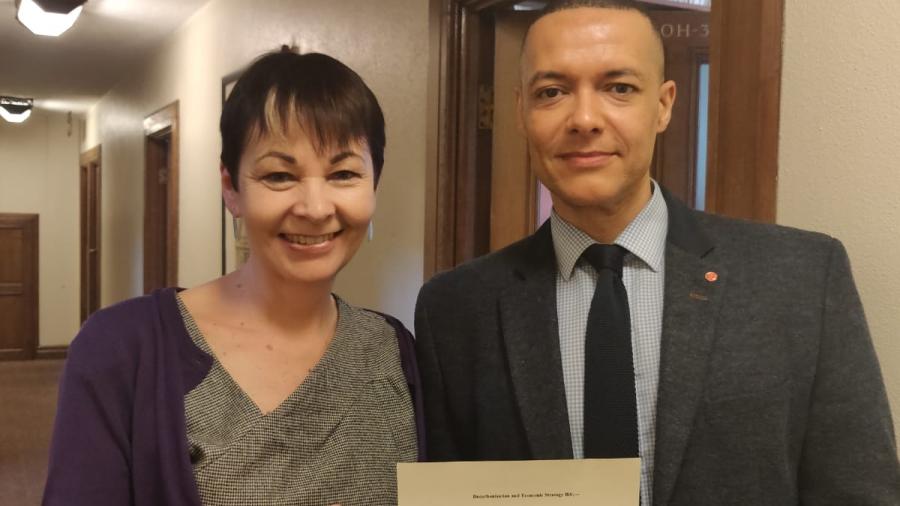
Caroline Lucas (Green Party) & Clive Lewis (Labour Party)

The 99% need - and deserve - to have both parties behaving in such a principled political way in such a crucial general election as this one. Sadly, I’m not holding my breath - both seem determined to continue behaving like squabbling children in the playground. 

Both parties need to realise that politics isn’t some comfortable Sixth Form Debating society for the relatively well-off, who won’t pay a price if their various ‘guesstimates’ prove to be mistaken - instead, it’s an arena in which the wrong decisions can, quite literally, spell death-by-austerity for yet more members of the precariat. 

What now? 

What I have been doing in my marginal seat of Copeland (Tory MP) - and in our adjoining marginal seat of Workington (where pro-Remain Labour MP Sue Hayman is under serious pressure from the ex-UKIP Tory candidate) - is campaigning for both the Labour candidates.  

Although I’m voting for Labour in Copeland, I will be arranging for a much more effective Green vote (and one which doesn’t risk helping the Tories MP gain another seat!) in the Isle of Wight, via Swap My Vote: https://www.swapmyvote.uk/ 

I urge all Green voters in key Labour marginals to vote Labour and then, via Swap My Vote, get a Labour supporter in the Isle of Wight to cast an effective vote for the Green Party candidate there, who stands a real chance of defeating the sitting Tory MP. 

At the end of the day, I don’t want to wake up on 13 December & find Johnson has just managed to get one more MP than the Labour Party. 

I remain an ecosocialist, & will still be voting Green in local and European elections (if we ever have another one!) - and am more than willing to help my former local party members & supporters with such election campaigns (assuming they’d want my help). 

In the interim, I’ve signed up to DiEM25: its political position - in what they correctly call “This once-in-a-lifetime election” - is to campaign for Labour; or, in those seats where the Greens, SNP or Plaid Cymru have a greater chance of defeating the Tories, to campaign for them. SIGNIFICANTLY, they are NOT doing so for the neoliberal Lib Dems - which is yet another indication that we/the Greens have made a HUGE strategic & political mistake by signing up to this ‘Unite to Remain’ pact with the Lib Dems. 

Pessimism - a sin? 

I first became involved in politics in 1963, when I was 14, thanks to Shelley’s Collected Prose & Rachel Carson’s Silent Spring - and my first political ‘act’ was to join CND (though living in the rural depths of South Norfolk at the time, my parents wouldn’t let me join the CND marches!). And ever since first coming across his Prison Notebooks in 1977, I’ve always tried to follow Antonio Gramsci’s maxim: “Pessimism of the intellect, but optimism of the will!”  

But I have never been so pessimistic/depressed about how things, across the board (but especially the Climate and Ecological Crisis), are going. 

Quite frankly, I have to say I’m dreading the results of this election - both locally & nationally. To be blunt, I think we’ll be f**ked for decades to come. 

Allan Todd is anti-fracking and Extinction Rebellion activist and an ecosocialist campaigner

Thursday, 4 April 2019

What Now for the Green Party?


Written by David Taylor

The Green Party seems to be taking increasingly desperate measures to justify its existence. Yet climate change is now recognised, almost universally as the most serious issue facing humanity – so why the anomaly? As usual, to quote Harold Macmillan, its “events, old boy”: in this case the events put in train by Corbyn`s rise and Brexit. Both, I would say, compounded, by the origins and social composition of the Green Party itself. 

During the Blair years the party started to break out of the old Ecology Party niche, with its emphasis on lifestyle choices, and opposed not only the Iraq war but New Labour`s economic policies. After the 2008 financial crash and the election of Caroline Lucas as the first Green Party MP, this process accelerated and attracted many who had been politically homeless in the face of the New Labour/Tory/LibDem consensus for globalisation, privatisation and austerity. Many were former Labour Party activists and by 2015 the party had its best ever general election result – fought on a social justice and anti-austerity agenda and membership peaked at 68,000.

2015 General Election campaign postcard

Some say that the success of this Green Surge helped to open the door for Corbyn.  Most of the Green Party's policies of 2015 were in Labour`s 2017 manifesto and most of the activists who joined the Green Party from Labour returned to work for a radical Corbyn led government. The notion that such a government was now a real possibility focused the minds of many other Green Party members. Was supporting Labour now a more realistic vehicle for radical social change than just voting Green? 

Obviously Labour had the potential to be more effective, but only if the left won the battle in the party and its green policies were to be extended, prioritised and implemented. In spite of these caveats many did decide to join Labour (some saying they did so with a heavy heart). Nearly 40,000 left the Green Party during 2017/18 including many experienced activists and people who had held key positions on leading bodies. The current membership of around 36,000 reflects a more recent influx – mostly people attracted by the Peoples Vote on Brexit stance of the Green Party leadership.

In 2013 the Green Party conference decided to define the party “as a party of environmental and social justice, the two elements being inseparable”. The loss of many on the left of the party since 2016 led to calls to “go back to our core roots” ie scrap the social justice dimension. The days when Natalie Bennett could tell conference “ask not what the trade unions can do for us, Ask what we can do for the trade unions!” were over. 

The leadership were in a bind, unsure of how to position the party and it was clear that a difficult period lay ahead. This was to be amply confirmed at the 2017 general election when the Greens lost 700,000 votes, mostly to Labour. But in 2016, with Caroline Lucas back again as leader, the party concentrated its efforts on a “Yes to the EU” campaign for the Brexit referendum. This was a shift from the historical position of favouring localism “think global, act local” over ceding control to centralised, unaccountable blocs. In fact the party was largely eurosceptic from its foundation – until 2016!

One of the striking posters from former national
Campaign Co-ordinator Howard Thorp`s team

“With its elitist smears against Leave voters the Peoples
Vote campaign is as divisive as Farage himself”
Adrian Cruden, writer and blogger

The Leave result in the EU referendum was entirely predictable; the government having handed voters a cudgel, millions took the opportunity to bash them with it – for reasons often unconnected with Europe. This is where the class nature of the Green Party comes in. The party has a far higher proportion of academics, professionals and middle and upper class members than any other party – the very people who were horrified by the result. Some could hardly believe it, saying their lives were shattered whilst others thought about leaving the country. 

So no big surprise that the party piled onto the “Peoples Vote” bandwagon with enthusiasm, making it a top policy priority. This call for a second referendum confirmed the widely held view that the establishment wanted endless votes until the people “voted the right way” - as had happened with EU votes in several countries in the past.

“A series of missteps and strategic errors”

Green MP Caroline Lucas

Countless people have been inspired by Caroline Lucas who never seemed to put a foot wrong in her approach, her media appearances or her analysis. She still has wide public respect and will probably become a “national treasure” but the shock of Brexit resulted in a series of missteps and strategic errors. The Green Party seemed locked into a period of panic reactions to events – backing the divisive “Peoples Vote” campaign; panicking over anti-semitic allegations; not defending party democracy in the face of attacks by “identity politics” militants - and moving heaven and earth to make sure the Urgent Holistic Review (HR) proposals to change the Green Party structure took effect. 

The 2018 Autumn conference spent more time wrangling over internal party organisation  than debating the political challenges facing the party. The membership at large had little or no interest in the HR rigmarole or the referendum to agree the changes. Party staff and resources had to be fully mobilised to harvest enough votes for a 16% turnout and avoid an “egg on face” outcome.

The Green Party has some of the trappings of an NGO including a well paid CEO and a culture tending to favour outsourcing of tasks to “professional” companies and fundraisers rather than using the skills and expertise which many members have offered voluntarily. These same members are bombarded with financial appeals to support a head office bureaucracy whose internal workings are pretty hit and miss with constant changes in staff and systems. 

A review to make the party more efficient and member friendly would be a good idea but the HR is almost the exact opposite. Decisions on political activities will be centralised in an 11 member Political Executive (PEX) and the Board of Directors of a limited company will deal with staff, finance and day to day functions. A 45 member Council will take on all the work done by committees currently dealing with policy development, conferences,  publications and campaigning  and international affairs. 

Only a dozen of these 61 posts will be directly elected. This adds up to centralisation of control by the party leadership and bureaucracy. Members have described the abolition of the International Committee as “Our Very Own Brexit” as the changes do not accord with the rules of the European Green Party.

“There will not be a Green government in time to make the necessary changes. So we need
to work with as many others as we can”
Romayne Phoenix, former Co-Chair Green Party of England & Wales

The first fruits of the HR decision making process were not long in coming. In early 2019 a “WinterFest” was held to review policy and discuss possible conference motions. More of these forums are in the pipeline with the distinct possibility that Spring conference will be ended or downgraded. This is all too reminiscent of New Labour under Blair when policy forums, attended by a minority of councillors, wonks and spin doctors made policy and conference became little more than a rally. Labour have now scrapped the forums in favour of more democracy and a much more democratic conference. 

A new Green Party Political Strategy document says  “research on the 2017 general election has shown that the party does not “own” an important and popular policy in the eyes of the electorate. We will undertake further research to help us identify which of our policies might fill this gap”. If only we had George Orwell to comment on these immortal lines! A Green Objectives section defines the key objectives as environmentalism and “social liberalism” - a slippery term to replace “social justice”. 

Then we have the Strategic Objectives which include overtaking the LibDems to become the third most popular party; increasing councillors to 300 (out of 14,000 !); retain the Green MP; poll 1,000,000 at the next general election and reach 80,000 members by 2022. This wish list puts the party only slightly ahead of where it was in 2015, yet by 2022, on worst case scenarios, we will be only 8 years away from unstoppable climate breakdown. 

Many people thought that the Urgent Holistic Review would be confined to organisational tinkering but it has become clear that such a root and branch reorganisation reflects a political reorientation. The main activity of the Green Party has always been electoral and, with no prospect of more MPs in the near future, the party is now focused on competing with the LibDems – in mainly Tory held local council seats. If the motley crew of Blairites,Tories and Labour rejects of the “Independent Group” manage to contest local elections, they will also be competing for the same ground. 

All members have had an appeal from HQ assuring them that they would have to do nothing more than sign their name to become a “paper candidate”. The hope must be to contest enough seats to keep up the appearance of still ranking as a player. More generally the party is concentrating on “green thinking” people who are really concerned about climate change issues – anti-fracking campaigners, Extinction Rebellion etc.  

Taken together with the “Peoples Vote” axis, this denotes a distinct middle class orientation which inevitably moves the party in a rightward direction. No longer a social democratic anti-austerity party, but “eco-lib.dem” with councillors morphing into a band of LibDem lookalikes with a green streak.

“The climate movement must engage with the labour movement,
the only political force with the capacity to deliver the
transformation needed to avert catastrophic climate change”
Green Party Trade Union Group post


In a global context all this may seem like a sideshow at a far corner of the fair. It is, in fact, part of a pattern. The 2008 financial crash ended three decades of unstable equilibrium for the world economy and we entered a new era of uncertainty which has been described as a “post-modern” variant of the 1930s. In Europe opposition to austerity and the rise of populism has led to the near collapse of opposition parties identified with the Establishment. This includes Green parties in France, Italy, Greece and elsewhere. 

The Irish Greens are only starting to recover from their wipe out after entering Coalition with austerity parties. In the 2018 Swedish general election the Green party lost 10 seats (down to 15) whilst the Left party gained 7 seats (up to 28).  Where the Greens and the Left are united, substantial gains have been made. In the Netherlands local elections the Green Left topped the poll in several cities and came second in Amsterdam.

In the European parliament the UK`s three Green MEP`s are in the Nordic Green Left bloc and know better than most that the “Another Europe is Possible” campaign most closely resembled official Green Party policy. Yet in the Brexit debate the party seemed joined at the hip with the official Remain campaign. Even worse, the party leadership later made common cause with, and appeared on platforms with, leading LibDem, Tory and Blairite Labour MP`s, calling for another referendum – identifying the Green Party as part of the Establishment. 

Personally, I voted Remain, mainly in disgust at the xenophobia whipped up by the Leave campaign and sections of the media. There is another side of the story though. I have an old friend who lives on a large ex-council estate where austerity has inflicted an almost Dickensian level of poverty, where people are literally starving and where little kids rummage in bins for food before they go to school. 

He told me that he had never seen such solidarity and community spirit on the estate, as the residents turned out to vote Leave. After being ignored for years, with nothing left to lose, here was a chance to “stick it to the man”. A pretty well heeled crowd of people, draped in EU flags, later told them they were wrong, illustrating both the divisive nature of Brexit and the distraction it has been from the real issues.

The Green Party is not alone in facing an uncertain future – the other parties being equally at the mercy of unknowable events. Nevertheless we can be certain that concern about climate change will mushroom as people move from being aware to being scared and there will be a wider and more receptive audience for the Greens. Unfortunately, the Green Party has been particularly prone to attract those who regard membership as another item to add to their green portfolio, and after a bit of box ticking, they play no further part in party deliberations or activities. Caroline Lucas has described the Green Party as “necessary but not sufficient” stressing the need to engage with co-thinkers in parliament and campaigners outside. 

This is truer than ever. The climate crisis can be only be tackled at government level and with countries working together on a global scale and, if humanity is to have a future, an end to the capitalist model of never ending exploitation of resources to maintain constant growth. Bearing in mind the timescale this seems a tall order but we can only do what we can.  

For now this must include supporting the election of a Corbyn led progressive government while working with those such as Red Green Labour who are raising the profile of climate change and economic growth issues within the Labour Party, and demand that a future Labour led government will lead the move towards green policies.

“In a time of universal deceit telling the truth
is a revolutionary act” - George Orwell
*Thanks to Howard Thorp for his favourite quote

David Taylor former Sedgemoor Green Party co-ordinator and Chair of West Somerset Green Party is a Green Left supporter

Tuesday, 7 August 2018

Should Green Writers Boycott Left Foot Forward Over Anti-Semitism Smear Story?


A post on the website Left Foot Forward claiming that Shahrar Ali, one of the current candidates for the leadership of the Green party, and a former deputy leader, is anti-Semitic has caused outrage among grass root members of the party. The post, which has been through several edits from what was originally posted on 3 August, is a fine example of bad journalism and pretty much a textbook case of fake news. The full video of the speech is now displayed.

Highly selective quotations from a speech by Ali were first posted, from a 2009 rally against Israeli military forces attacking the Gaza strip, Operation Cast Lead, where about 1,500 Palestinian civilians were killed, were used. Ali’s speech was aimed at supporters of the Israeli action in western countries, but was twisted by the Left Foot Forward website to imply it was aimed at Jewish people more generally. The story is confected.

Mainstream media in the guise of the London Evening Standard, which has been running anti-Semitic themed attacks on the Labour party, amongst other themes, on an almost daily basis for the past couple of years, has now run the story. The paper is edited by former Tory chancellor George Osborne.

The Left Foot Forward post reports a complaint to the Green party by the Campaign Against Antisemitism, a group that was formed in 2014 to challenge anti-Semitism in the UK, which has frequently complained about Labour party members, including the leader, Jeremy Corbyn. The Green party has said that it is looking into the matter.

Quite why a website like Left Foot Forward is spreading a reheated story and video used by the Alt-Right Breitbart news network is something of a mystery to me. What is so Left about spreading right-wing smears and propaganda? Is this what the trade unions funding Left Foot Forward had in mind when setting up the site? You do have to wonder.

The piece was written by Left Foot Forward editor, Josiah Mortimer, a Labour party member who supports Corbyn’s leadership, and former Green party member, who became editor about twelve months ago. So, again I’m left wondering why should someone with that kind of politics write such a post? What is the motivation?

The story has topical value of course, with voting still open in the Green party elections for leader and other roles until the end of August. The only thing that I can think of is it is a desperate attempt to raise the viewing figures of his website with sensationalist, but inaccurate news stories. Are the numbers down or something?

I know Shahrar, and he is a passionate anti-racism campaigner who champions the cause of the oppressed, often the Palestinians, by questioning the role of the Israeli state in such oppression. He is not anti-Semitic, he is anti the terrible human rights record of the state of Israel and its military forces, quite rightly. The Israeli lobby is quick to call people anti-Semitic when Israel is criticised, as a tactic to silence those who oppose their actions, but I am shocked that a left-wing website would support this kind of bullying.

Genuine anti-Semitism should not be tolerated, and likening the actions of Israel to the Nazi’s is inaccurate, and given historical events, is grossly insensitive and should be avoided. But that is not case with this story anyway, where Ali did no such thing. Although, you would be forgiven for thinking that it was, by reading Mortimer’s post.

Plenty of Green party people have contributed to Left Foot Forward, Caroline Lucas, Jenny Jones, Natalie Bennett and indeed this writer. We should ask ourselves this question though, 'do I want to be associated with a media outlet that peddles fake news like this, and is aimed at smearing the Green party?' Reputation in politics is something that can be tarnished easily and is often judged on who you associate with. It can be difficult to restore.  

Thursday, 19 April 2018

Why Remainers Should Vote Green in the Local Elections


The local authority elections on 3 May, are the last full scale elections in England before our departure from the European Union in March 2019. Yes, it looks like we will get a transitional deal which will last for almost two further years, when to all intents and purposes nothing will change, but we will no longer be a member of the EU. So, this is the last chance to send a message to the Labour and Tory parties, whose leaderships are in favour leaving.

The Greens have consistently opposed leaving the EU, at the referendum itself and since the vote. The Greens want a referendum on the final terms negotiated by the government, before we leave the organisation. Given the lies about NHS spending, the probable breaching of spending rules during the campaign and the probable misuse of personal data now exposed, even some leave voters that I know are regretting their decision, and would like the opportunity to put it right.

The Greens recognise that environmental matters need to be dealt with internationally to be effective, and the EU has improved environmental conditions in the UK, like cleaning up coastal waters and beaches and forcing the UK government to improve air quality. The Greens also worry about the environmental effects of moving to trading with far flung countries in terms of increasing carbon emissions with long haul transportation. The Greens also have concerns over food standards and general democratic accountability that goes with all of the global trade deals in operation already. 

The Tory leadership is held hostage by probably about 70 or 80 hard line Brexiter MPs, easily enough to bring down the government in Parliament, so even if there was desire to reverse or soften the result, which I don’t think there is, the hard liners are calling the shots. Labour has generally fudged its position, but has softened its stance a little with the recent conversion to remaining in ‘a customs union’ with the EU, but wants to leave the single market, end the free movement of people, and won’t hold a referendum on the terms of exit.

Apart from the Greens the only other sizable national party in England to oppose Brexit, and want a referendum on the final terms of our leaving the EU, are the Lib Dems. But the Lib Dems are slippery in general, leaning to the right in Tory held areas and to the left in Labour held areas. You can’t really trust them to be principled about almost anything. Most of all they entered a coalition with the Tories at national level in 2010.

If the Lib Dems hadn’t propped up the minority, austerity obsessed Tory government for five years, we probably wouldn’t have even had a referendum on EU membership in 2016. Although no longer in coalition since the Tories won a small overall majority in Parliament in 2015, I think it unlikely this would have happened if the Tories were forced to be a minority government in 2010, and probably would not have lasted a full five years. The Lib Dems bear responsibility for where we have ended up today, so they should not be rewarded by Remain voters.

The Greens and Lib Dems did not do well at last year’s general election, but my bet is that many Remain voters voted Labour because they saw it as the best way to shackle the Tories who were offering the hardest version of Brexit. I think people had tired of Tory austerity too, which the Lib Dems were party to, but with the First Past The Post electoral system, anything other than voting Labour was a risk in most places.

3 May has no such risk, because we are not electing a government, only local councils with very little power. Which is not to say that these elections are unimportant, because local councillors can make a positive difference to local government. Indeed elected Greens do this all the time. Greens have defended social housing for example, against attacks from councils controlled by Labour mainly. You can see what Green councillors have achieved in local government here.

But this is a golden opportunity for Remainers to send a message to the Tories and Labour, without having to sully themselves by endorsing the toxic Lib Dems. Vote Green on 3 May to proclaim you support staying in the EU.     

Thursday, 18 January 2018

Does Caroline Lucas’ 3 Stage Plan to stop Brexit Stand Up?


Caroline Lucas, the Green party MP for Brighton Pavilion and co-leader of the party, revealed her three point plan for the UK to remain in the European Union (EU) writing on politics.co.uk this week. Lucas, a long standing campaigner for the country to remain in the EU, laments the paucity of the Remain campaign in the run up to the 2016 referendum on whether or not we should stay in the organisation..

Too much reliance was put on people worrying about their finances, if we left the bloc, and the scare tactics employed by the Remain campaign. This tactic had worked at the Scottish independence referendum two years earlier, but it didn’t in the EU referendum.

Lucas says that the consequences of leaving the EU are only now starting to reveal themselves, with prices rising and shortages of nurses because EU nationals are have more or less stopped applying for these jobs. With the Tory government held hostage to a faction of hard right Brexiteers, hell bent on getting as complete a break as possible with our erstwhile European partners, and even the best possible outcome will be a much worse deal than we have now.

This is all true, but we did vote to leave the EU, although leaving could mean joining the European Economic Area (EEA), Norway style, or being treated as a ‘third country’ like Canada. Lucas favours a referendum on the outcome of the negotiations between our relationship with the EU, or staying in as we are currently. But how is this to be achieved?

Lucas suggests a three stage plan. In stage one, the stay in the EU message would be made by new faces. She is right, I think, that the likes of Tony Blair, George Osborne and Nick Clegg, have no credibility with the voters, as they are seen as symbolising the establishment that many people voted against. She also suggests organising at grass roots level, but this may be easier said than done on a wide-scale basis.

Stage two ‘must be a commitment to seriously tackling the underlying issues which fuelled Brexit,’ Lucas says. This is a key point. Yes, immigration played a part in the motivation of many Leave voters, but it wasn’t the only one. There was also a ‘stick it up the establishment’ attitude, although that should have been directed at the UK government more than the EU. Lucas goes onto make the argument of the EU as a limited, but possibly more powerful buttress against global corporations, who are the real thieves of our democracy. Essentially though, there needs to be repudiation of, and break with nearly forty years of neo-liberal ideology.  

So far so good, but stage three looks to be the most problematic of all, getting the Labour party leadership on board. Lucas suggests that Jeremy Corbyn, the Labour party leader, should sign up to the Another Europe is Possible pan European movement, which seeks to reform the EU, to the benefit of its citizens, as opposed to global corporations.

The ambiguous signals about our future relationship with the EU, coming out of the Labour leadership, must stop insists Lucas, as push comes to shove. Corbyn says we will not stay in the European single market, once we leave the EU, but Kier Starmer, the shadow Brexit secretary, has said we will remain in the single market during a transition phase, ‘for as long as it takes’ to secure a good future arrangement with the EU. Lucas points out that 78% of Labour supporters want to remain in the EU. Fudging this issue has worked out quite well for Labour so far, but I agree with Lucas that they will have to take a side soon.

It is fair point too, that if we are to remain in the EU, it is essential that Labour backs the move, to give such a push credibility, and to tie in with part of stage 1 of this plan, to organise a grass roots movement in support of staying in the EU. Realistically, only the Labour party can do this on the scale that is needed.

Lucas cites the example of the recently formed community campaign unit in the Labour party, and with their membership numbers and general organisational infrastructure, this could be made a success of. It is hard to see a grass roots campaign achieving the critical mass to make it effective without Labour, but will they want to do this?

That is a hard question to answer, different people in the Labour party say different things about Brexit, but as the negative consequences of leaving the EU become clearer, and perhaps if the public shifts sufficiently in the remain direction, this may become a logical pathway for Labour to follow.

My feeling is that there is a long way to go with withdrawal from the EU, and pretty much anything could happen along the way. I am unconvinced that the EU will reform itself into the sort of community that Lucas describes, but maybe we should not discount even that in these volatile times. 

Thursday, 4 January 2018

The Future of the European Left and the EU


It must be the end/beginning of the year, resolutions and all that, together with quite volatile political events, but it seems the broad Left, and by that I mean the liberal and radical Left, in Europe, has been pondering the EU’s future role, and the Left’s strategy in it. Green themes come into it, too.

In part of a series of Op Ed’s over the last week or so, The Guardian has published its ideas for the future of the UK and in the final piece on Wednesday turned its attention to the EU. It is in line with the previous editorials in the series, and not unsurprisingly it is unashamedly liberal, leftish liberal, in content. Whilst giving a nod to some of downsides of the EU, it largely praises the EU for being a positive force for good.

Take this line as an example:

‘There is nothing quaint about saying that to safeguard Europe, and make the EU thrive, is simply to contribute to a better world.’

The piece also calls on the EU to ‘truly reclaim a mission of social justice,’ and to play more of a role shaping world events, especially in the era of Trump’s presidency of the US, and right wing populism in Europe. Here climate change and the environment are particularly mentioned, together with ‘social protections,’ civil rights and more democratic engagement. The EU has a chequered history on all of these issues, of course, but it has also undoubtedly done some good as well.

I would guess that most Green party members and voters would broadly agree with The Guardian’s view on these matters, but not all. Admittedly, from December 2016, Paul Kingsnorth, a writer and former deputy editor of the Ecologist, espoused a different green type of approach to the EU. Writing on the US Counterpunch website titled ‘Brexit Reconsidered: a Modern Day Peasants’ Revolt?’ he describes a very different Europe.

One which has a culture of homogenisation, centralisation, control and profit, and Kingsnorth cries in despair, ‘where are the radical greens?’ Greens he says are mostly ‘crying into their muesli about Brexit.’

Brexit hovers over UK politics at present, but the Left in continental Europe has also been thinking about what kind of EU it wants after the years of austerity being imposed, mainly on Southern European nations, Greece, Spain, Portugal and Italy.

Walter Baier, a Vienna based economist and former National Chairman of the Communist Party of Austria (KPÖ) from 1994 to 2006, writing at Transform Europe, looks at thinking on the EU by the more radical Left elements on the continent. He puts the re-think on the Left down to collapse of the Eastern European socialist regimes and the adoption of neo-liberalism by social democratic parties during the 1990s.

In particular, Baier examines ‘Plan B’ supported by French presidential candidate in 2017, J. L. Mélenchon, and DiEM25, an initiative spearheaded by Yannis Varoufakis, the former Greek finance minister.

DiEM25’s ideas for a reformed EU, within existing EU Treaties, is largely supported by the leadership of the UK Labour and Green parties, and formed the basis for the Remain strategy in the 2016 referendum followed by these leaders. It amounted to a remain in the EU and reform platform, but in the end did not cut through to the voters as desirable.

DiEM25 proposes a New Deal for Europe, which contains policy proposals and strategies based on four principles:

All Europeans should enjoy the right to basic goods (e.g. nutrition, shelter, transport, energy), paid work while receiving a living wage, to decent social housing, to high quality health and education, and to a sustainable environment (environment included here too).

To harness the wealth that accumulates in Europe and turn it into investments in a real, green, sustainable, innovative economy.

The EU must implement policies for sharing the dividends from digitisation and automation amongst all its citizens.

Macroeconomic management should be democratised fully and placed under the scrutiny of sovereign peoples. 

Mélenchon’s A Plan B in Europe recommends a complete break with the existing EU Treaties and basically starting again. The plan also has four main principles:

Nation states are considered as leverage in the European struggle with the EU.

The withdrawal from EU Treaties should in combination with ‘negotiations on a new framework for the EU, but if this failed to work, France would unilaterally withdraw from the Treaties.

The French people would be given the final choice on staying in a new EU or withdrawing completely, in a referendum.

Plan B’s in different countries would not necessarily be same as in other EU nations who decide to follow France’s lead.

Plan A seems to me to be more realistic than the DiEM25 proposals, with the EU unlikely to reform radically from within existing structures, and so to facilitate a ‘new radical EU,’ starting again is probably necessary. I am not advocating not having some kind of cooperative union in Europe, and the UK being part of it, but the large, remote and bureaucratic entity it has become, does seem to have run its course.

I’m also not saying that I prefer the UK leaving the existing structures of the EU, which I expect will be counter-productive and play into the hands of the UK populist right, some of whom are in government. But I do think that the EU could be made much better and more responsive to the needs of European citizens, and so if that means starting from square one, so be it.    

Tuesday, 31 October 2017

English Green Party Conference Report – Sparsely Attended, a bit Bleak but Not Without Controversy


Written by David Taylor 
    
I thought that Green Party conference in Harrogate, Yorkshire, might be a fairly low key affair after the 2017 General Election but it turned out to be the most sparsely attended of the seven Green conferences I have been to. One motion was passed by 84 votes to 81 with no more than 200 present; at times people had to be summoned back from the refreshment bars as conference had become inquorate. 

This compares with 2016 where there were well over 1,000 people in the hall at times. The social scene was a bit bleak with less of the traditional shindigs. No disco, young greens music night or open mic. night - although the Big Green Quiz survived.

Klina Jordan addressed conference the next day as co-proposer, with Caroline Lucas and other notables, of a motion which became controversial. Part of it “welcomed” the fact that many Constituency Labour Parties had signed up to Klina`s Make Votes Matter campaign for proportional representation. 

An amendment was moved to replace “welcome” by “noted” - after all, nothing Labour members did could possibly be welcome, could it? It is ironic that the very next week the Young Labour conference declared that fossil fuels must be kept in the ground if the planet is to avoid the worst climate change scenario. They passed a motion calling for all public bodies to divest their funds from fossil fuels and reinvest in renewables as part of the Just Transition industrial strategy to decarbonise the economy while ensuring jobs for workers in affected industries. A welcome move.    

Green Party Governance

Much of the Green Party`s structure and processes date back to the mid 1970s and for many years there have been proposals for both procedure and policy making to be more inclusive, straightforward, efficient, up to date, democratic etc. A Governance Review Group was set up a few years ago and, as I understand it, was due to come up with some proposals about now. However, this body seems to have bit the dust after conference passed a motion backed by the party leadership saying that “further consideration” of proposals be suspended.

There is now to be an “Urgent and Holistic Review of how the Green Party operates”. The Executive Committee and Regional Committee have been instructed to establish a Commission, chaired by “a respected member” of the party and appoint ten other members selected for their skills and experience. 

They will conduct a complete review and submit their report to conference urgently. Some members have said that the whole thing seems a bit “top down” but the final decision on their proposals will go to a referendum (oh no!) of the full membership. 

Interesting and Inspiring Fringes

A well attended and informative fringe called jointly by Green House think tank, Lucas Plan Just Transition Group, Green Party Trade Union Group, Green Left and PCS asked - How can a low carbon economy create new employment? It was pointed out that there are over 31 million workers and they all have a stake in the transition to a low carbon/low energy economy – not just those in the obvious sectors. 

Sam Peters, from the civil service union PCS, outlined the union`s thinking on the transformation of the economy by a future radical government and some of the nuts and bolts involved. These included a Ministry for Jobs, Skills and Social Protection with a positive role for Job Centres working in partnership with and having democratic input from the local community. A National Climate Agency would ensure that environmental costs and benefits were factored into all projects.

Deputy Leader Amelia Womack chaired the panel discussion “After Grenfell”.  Everyone on the panel agreed that the leaders of Kensington & Chelsea council had treated their tenants with contempt over many years; little imagining that a tower block tenant would prove to be their nemesis. Joe Delaney lived in the next tower block to Grenfell, and only 25 metres away. 

He described how he woke up in the early hours to see a raging inferno outside his window. Now a spokesperson for the Grenfell Action Group, Joe told us how he had been going through a difficult period in his life “it doesn`t sound good” he said “but the fight for justice for the Grenfell victims and their families has given me something to live for.” 

Unfortunately for the council Joe is not only articulate and determined but his previous career was in the housing and legal departments of a large council in the north. He is an inspiring speaker and received a standing ovation.        

Another charismatic speaker was local solicitor Jennifer Nadel, who gave us a brilliant picture of election night in Kensington when the Tories lost one of their safest seats. She had seen from early in the day that masses of people from the estates, including Grenfell, were turning out and queuing at the polls – mostly people who never usually voted. 

As night fell and news of a recount spread, people began to gather outside the town hall, the crowd soon swelling to several thousand. When the news of a Labour win was announced everyone was ecstatic and started the singing and dancing that made it seem like carnival for the rest of the night. Jennifer said she was deeply moved and although she had been a Green party candidate said “that night the people won”. 

Two Motions Lost

The Trade Union Congress, often depicted as a lumbering carthorse, is not noted for its lightning speed in grasping issues and tackling them before you can say knife. So the unanimous decision to pass a Climate Change Motion at their 2017 conference is a historic step. The motion notes “the irrefutable evidence that dangerous climate change is driving unprecedented changes to our environment...” and they advocate various measures for transition to an environmental sustainable future for all. 
    
An emergency motion to the Green Conference, although recognising that the TUC motion did not go far enough, welcomed their new stance and called upon the Green Party leadership to work with the trade union movement and their political representatives to campaign for a just transition. This motion was lost. This reflects the composition of the 2017 conference as the motion would have probably have passed at previous conferences. 
         
A motion which advocated emphasising the “environmental dimension” to all issues and bringing ecological themes into topics “not normally associated with them” was generally understood as being an attempt to move the party back to the “good old days” of the Ecology Party. This motion was also defeated. But only by the narrow margin of 129 to 112. 

A Difficult period ahead for the Green Party

Jonathan Bartley gave a rip roaring address listing all the reasons he was so proud of the Green Party and so proud to be a member. The reasons were many and each one received a thunderous round of applause. Jonathan was proud that we have never failed to live up to the new Green Party slogan “Speaking Truth to Power” and we never will, whatever others may do. The Green Party had the second best General Election result in its history in 2017 and he was pleased to see Theresa May lose her majority but disappointed with Labour.

All is not doom and gloom. The Greens still have Caroline Lucas MP. We are still winning council seats in some areas. The party has three times as many members as a few years ago and has held on to 65% of people who joined in the Green Surge. Our members are at the forefront of the anti-fracking movement and other campaigns on the ground and as the effects of global warming become more evident the party is bound to attract new support. 

But these positives cannot disguise the fact that the political landscape has changed and there is the realistic possibility of a Corbyn led Labour Party with a radical agenda forming a progressive government. The Green Party is bound to be squeezed electorally.

Paul Mason has said “Many Labour people, including myself, want to see a strategic alliance of Labour, the progressive nationalists and the Greens in place, even if Labour were to win an overall majority”. That, along with PR, is the stuff to give the troops. Rather than retreat into a glorious isolation we can campaign for Green Party policies while also working for the election of a Corbyn led government. 

David Taylor is member of Bridgwater & West Somerset Green Party and a Green Left Supporter